










Bajaj Steel inventory up 23%, current liabilities reach Rs 297 crore
Key highlights
- Bajaj Steel’s inventory rose by Rs 41.3 crore to Rs 218.4 crore between March 2026 and September 2026.
- Bajaj Steel’s current liabilities increased by Rs 51.5 crore to Rs 296.9 crore in six months.
- Bajaj Steel reported Rs 100.6 crore of balance-sheet cash and cash equivalents at September 2026.
- Bajaj Steel reported H1FY27 EBITDA of Rs 18.3 crore and PAT of Rs 7.4 crore.
powered by IRIS
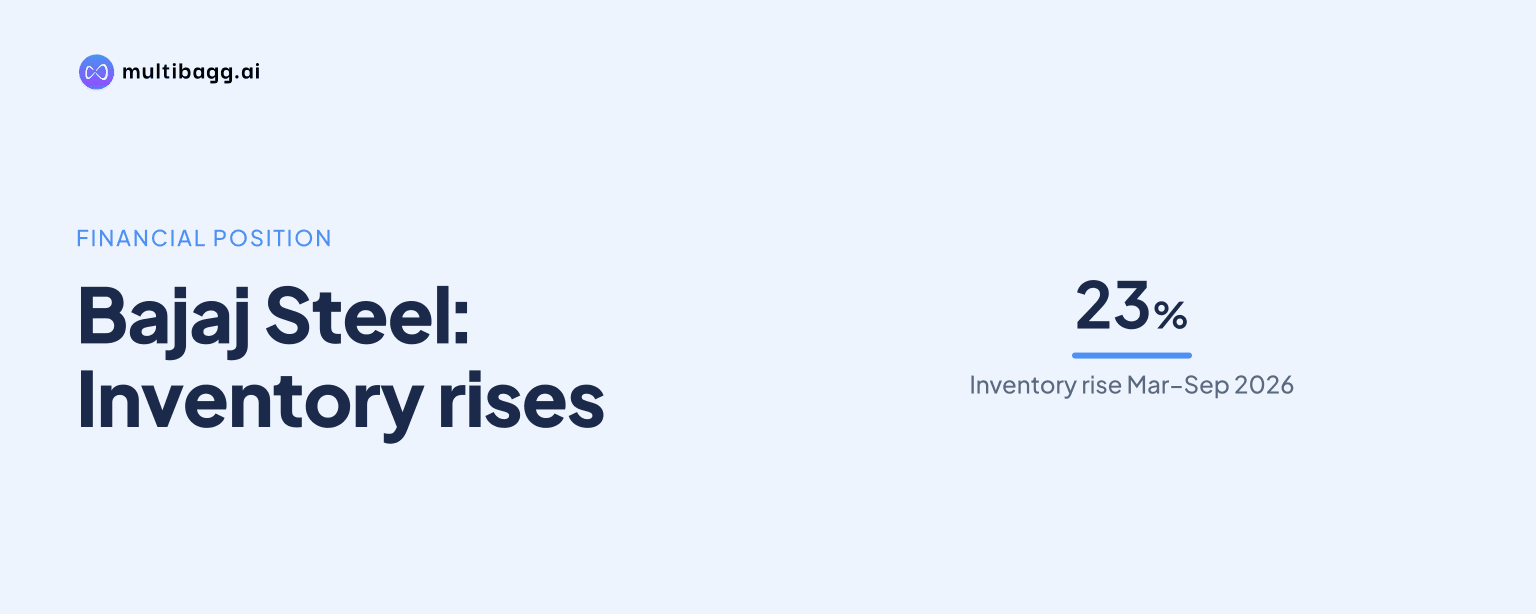
Bajaj Steel’s inventory rose 23% in the six months to September 2026, reaching Rs 218.4 crore from Rs 177.1 crore in March 2026, while current liabilities increased to Rs 296.9 crore from Rs 245.4 crore. Cash and cash equivalents on the balance sheet were Rs 100.6 crore at September 2026.
Know Bajaj Steel Industries inside out
Results, valuation, peers and who's buying, in one view.
How did Bajaj Steel’s working capital change by September 2026?
Bajaj Steel’s current assets increased by Rs 52.5 crore over six months to Rs 466.1 crore at September 2026, but current liabilities increased by a similar Rs 51.5 crore to Rs 296.9 crore. As a result, the excess of current assets over current liabilities was Rs 169.2 crore at September 2026, compared with Rs 168.2 crore at March 2026. The presentation therefore shows little change in this absolute balance despite larger current asset and liability pools.
Inventory was the largest driver of the rise in current assets. It increased by Rs 41.3 crore, or about 23%, from Rs 177.1 crore at March 2026 to Rs 218.4 crore at September 2026. Other current assets increased by Rs 16 crore to Rs 96 crore over the same period, whereas trade receivables fell by Rs 5.8 crore to Rs 51.3 crore. Cash and cash equivalents increased by Rs 1.3 crore to Rs 100.6 crore in the balance-sheet presentation.
The inventory increase came during a period in which Bajaj Steel reported consolidated revenue from operations of Rs 275.6 crore for H1FY27, compared with Rs 524.2 crore for the full FY26. The supplied presentation does not state the reasons for the inventory build, its product composition, or whether it reflects orders, procurement timing, work in progress, or finished goods. It also does not provide inventory turnover or ageing data.
What caused Bajaj Steel’s current liabilities to reach Rs 296.9 crore?
Bajaj Steel’s total current liabilities reached Rs 296.9 crore at September 2026 mainly because trade payables and other current liabilities both increased. Trade payables rose by Rs 27.8 crore in six months to Rs 122.6 crore, while other current liabilities rose by Rs 17.9 crore to Rs 124.6 crore. Short-term borrowings increased by Rs 5.2 crore to Rs 46.1 crore, and short-term provisions added Rs 0.5 crore to reach Rs 3.6 crore.
The mix of current liabilities changed materially from March 2026. Trade payables represented Rs 122.6 crore of the September total and other current liabilities represented Rs 124.6 crore, together accounting for Rs 247.2 crore. The presentation does not identify the items included in other current liabilities, their payment dates, or the suppliers and obligations within trade payables. That limits conclusions about the timing of the liability increase.
Compared with earlier balance-sheet dates, September 2026 current liabilities were also above the Rs 182.5 crore recorded at March 2025 and Rs 202.8 crore at March 2024. At the same time, current assets of Rs 466.1 crore were the highest shown in the six-date series, above Rs 413.6 crore at March 2026. The data show expansion on both sides of the short-term balance sheet rather than an increase in liabilities alone.
Got a follow-up? Ask IRIS
Does Bajaj Steel have cash to support its short-term balance sheet?
Bajaj Steel reported Rs 100.6 crore of cash and cash equivalents in its September 2026 balance sheet, an increase from Rs 99.3 crore at March 2026. This cash balance was lower than inventory of Rs 218.4 crore and lower than total current liabilities of Rs 296.9 crore. The presentation also lists Rs 51.3 crore of trade receivables at September 2026, down from Rs 57.1 crore six months earlier.
The cash-flow table reports a separate period-end cash and cash-equivalents figure of Rs 102.7 crore for September 2026, compared with Rs 101.0 crore at March 2026. This differs from the balance-sheet cash figures of Rs 100.6 crore and Rs 99.3 crore respectively. The supplied pages do not explain the Rs 2.1 crore September difference or the Rs 1.7 crore March difference, so the presentation does not provide enough information to reconcile the two cash series.
Net cash flow from operating activities was Rs 9.4 crore at September 2026, while net cash flow from investing activities was negative Rs 10.1 crore and financing cash flow was Rs 2 crore. These movements produced a reported net increase of Rs 1.3 crore in the cash-flow table. For comparison, FY26 operating cash flow was Rs 78.2 crore, investing cash flow was negative Rs 58.4 crore, and financing cash flow was negative Rs 5 crore; September 2026 is presented as a partial period, not a full-year result.
How does the balance-sheet movement compare with Bajaj Steel’s profit trend?
Bajaj Steel’s working-capital increase coincided with lower profitability in H1FY27. Consolidated earnings before interest, tax, depreciation and amortisation, or EBITDA, were Rs 18.3 crore on revenue of Rs 275.6 crore, yielding a 6.7% EBITDA margin. Profit after tax, or PAT, was Rs 7.4 crore, with a 2.7% PAT margin. The presentation lists FY26 EBITDA of Rs 60.3 crore on Rs 524.2 crore of revenue and PAT of Rs 36.9 crore.
The H1FY27 EBITDA margin of 6.7% was below the 11.5% reported for FY26, and the PAT margin of 2.7% was below FY26’s 6.9%. Cost of goods sold was Rs 153.4 crore in H1FY27, employee-benefit expense was Rs 45.3 crore, and other expenses were Rs 58.5 crore. Depreciation and amortisation was Rs 10 crore, while finance cost was Rs 3 crore in the half year.
Non-current investment also rose, though by less than current assets. Property, plant and equipment and intangible assets increased from Rs 210.7 crore at March 2026 to Rs 215.8 crore in September 2026, while capital work in progress remained Rs 27.1 crore. Total non-current investment was Rs 289.3 crore, up Rs 3.8 crore from March 2026. Long-term borrowings declined by Rs 1 crore to Rs 14.3 crore over that period.
Conclusion
Bajaj Steel’s September 2026 balance sheet shows a Rs 41.3 crore inventory increase alongside a Rs 51.5 crore increase in current liabilities, with trade payables and other current liabilities accounting for most of the latter movement. Current assets also expanded, leaving the reported excess of current assets over current liabilities broadly unchanged at Rs 169.2 crore. Cash remained above Rs 100 crore in both the balance-sheet and cash-flow presentations, although their reported closing figures differ.
The next reported period will clarify whether inventory converts into revenue and operating cash flow, particularly after H1FY27 EBITDA of Rs 18.3 crore and PAT of Rs 7.4 crore. Readers can also watch trade payables, other current liabilities and short-term borrowings after their September 2026 increases. The presentation discloses an Rs 10 crore order book for Other Products as of November 6, 2026, but does not state an expected execution schedule.