










Bajaj Steel heavy engineering holds Rs 67 crore orders
Key highlights
- Bajaj Steel reported a Rs 67 crore heavy-engineering order book as of November 6, 2026.
- Bajaj Steel had delivered 57 aerobridges by December 31, 2024.
- Heavy-engineering revenue was Rs 33 crore in FY26, down from Rs 42 crore in FY25.
- Bajaj Steel states 12,000 MT of heavy-engineering capacity across two Nagpur sites covering 50,757 square metres.
powered by IRIS
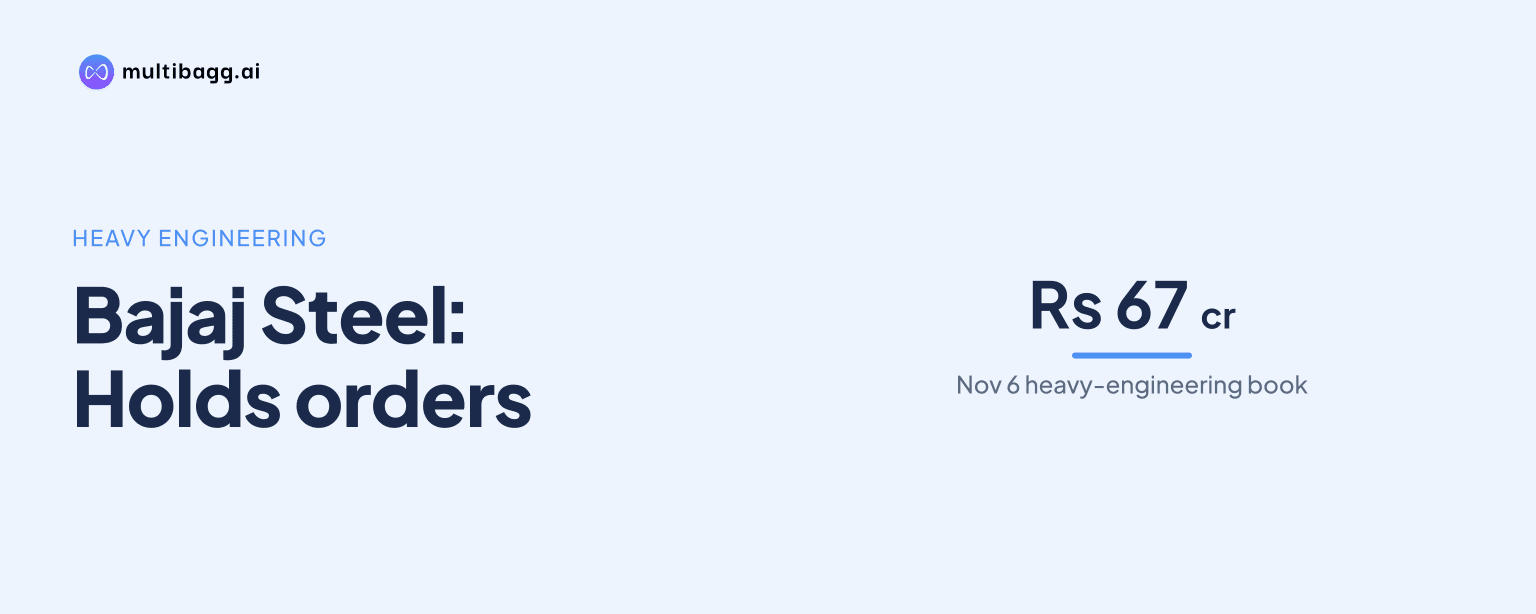
Bajaj Steel Industries Limited reported a Rs 67 crore heavy-engineering order book as of November 6, 2026, compared with Rs 33 crore of revenue in financial year 2026 (FY26), after expanding into passenger boarding bridges and delivering 57 aerobridges by December 31, 2024.
Know Bajaj Steel Industries inside out
Results, valuation, peers and who's buying, in one view.
What is Bajaj Steel’s heavy-engineering order book?
Bajaj Steel’s heavy-engineering order book was Rs 67 crore on November 6, 2026. The disclosed backlog was Rs 34 crore higher than the division’s Rs 33 crore revenue in FY26, although the company does not state an execution timetable or the period in which those orders could be recognised as revenue. The division supplies custom fabrication and structural solutions to original equipment manufacturers (OEMs) in the steel, cement, mineral and power sectors.
The Rs 67 crore figure places heavy engineering between Bajaj Steel’s other disclosed non-cotton division backlogs on the same November 6, 2026 date. Infrastructure reported an Rs 83 crore order book, electrical panels reported Rs 50 crore, and other products reported Rs 10 crore. Bajaj Steel does not disclose customer-wise values, cancellation terms, profitability or the split between aerobridges and industrial equipment within the heavy-engineering order book.
The order book follows FY26 revenue of Rs 33 crore, after the business had reached Rs 42 crore of revenue in FY25. That comparison indicates a disclosed pipeline that exceeds the latest full-year sales figure, but it does not establish the pace of order conversion because Bajaj Steel has not provided a delivery schedule.
How has Bajaj Steel heavy-engineering revenue changed?
Bajaj Steel’s heavy-engineering revenue rose from Rs 5 crore in FY23 to Rs 42 crore in FY25 before declining to Rs 33 crore in FY26. The division first reported export revenue in FY25, when exports were Rs 10 crore, and export revenue was Rs 6 crore in FY26. Domestic revenue rose from Rs 5 crore in FY23 to Rs 32 crore in FY25, then declined to Rs 27 crore in FY26.
Total revenue fell by Rs 9 crore in FY26 from FY25, comprising a Rs 5 crore reduction in domestic revenue and a Rs 4 crore reduction in export revenue. The FY26 result followed growth from Rs 5 crore in FY23 to Rs 19 crore in FY24 and Rs 42 crore in FY25. Bajaj Steel does not provide divisional operating profit, margins or an explanation for the FY26 revenue change.
At the consolidated level, Bajaj Steel reported revenue from operations of Rs 524.2 crore in FY26, down from Rs 584.8 crore in FY25. Consolidated earnings before interest, tax, depreciation and amortisation (EBITDA) were Rs 60.3 crore in FY26, compared with Rs 92.1 crore in FY25, while the heavy-engineering division accounted for Rs 33 crore of FY26 revenue.
Got a follow-up? Ask IRIS
Which products and customers does Bajaj Steel heavy engineering serve?
Bajaj Steel heavy engineering serves industrial-equipment and airport-infrastructure requirements, including aerobridges, passenger boarding systems, biomass pellet plants, hoppers and custom fabrication. The division had delivered 57 aerobridges for airports in India and abroad as of December 31, 2024. Bajaj Steel describes aerobridges and passenger boarding systems as a new segment entered using its in-house heavy-fabrication and design capabilities.
Bajaj Steel names Danieli, Steel Plantech, Metso, Primetals Technologies and Beumer Group among the division’s clients. It also identifies 3D Bukakka of Indonesia and Adelte of Spain as international partners. The disclosed relationships cover the division’s work in steel, cement, mineral and power sectors as well as its airport-equipment offering.
Executed-project examples include a molten-steel transfer car for steel plants associated with Primetals, a torrefaction-plant drum assembly for TSI USA, and a six-metre stacker wheel for limestone mines. A passenger boarding bridge is also shown among the division’s executed projects. These examples show that the stated portfolio includes both airport systems and fabricated equipment for process industries.
Bajaj Steel does not disclose separate revenue, order-book value or geographic exposure for aerobridges, biomass equipment, mining equipment or steel-sector fabrication. The 57 aerobridge deliveries therefore demonstrate completed installations as of December 31, 2024, but do not quantify the revenue contribution or order-book share of the airport segment.
What capacity supports Bajaj Steel heavy-engineering work?
Bajaj Steel states that its heavy-engineering division has capacity of 12,000 metric tonnes (MT). The company lists two heavy-engineering manufacturing sites in Nagpur: a 12,000-square-metre facility at G-10, MIDC Hingna, and a 38,757-square-metre facility at G-108, MIDC Butibori. Together, the two facilities cover 50,757 square metres.
The two sites form part of Bajaj Steel’s stated manufacturing footprint of more than 100,000 square metres across six facilities. The other four facilities serve cotton processing machinery, pre-engineered buildings and electrical panels, while the G-10 and G-108 locations are designated for heavy engineering. This separates the disclosed 50,757 square metres of heavy-engineering space from the company-wide footprint.
The 12,000-MT capacity supports a mix ranging from passenger boarding bridges and hoppers to biomass equipment and fabricated assemblies for steel and mineral applications. Bajaj Steel does not state whether the capacity figure is annual, provide capacity-utilisation data, or identify planned additions. It also does not specify how much capacity is assigned to aerobridges versus OEM fabrication.
Bajaj Steel’s FY26 consolidated cash flow from operating activities was Rs 78.2 crore, while net cash flow from investing activities was negative Rs 58.4 crore. The company’s non-current investment total rose from Rs 244.8 crore at March 2025 to Rs 285.5 crore at March 2026, but the presentation does not connect those changes to a specific heavy-engineering capacity project.
Conclusion
Bajaj Steel has established a heavy-engineering offering that combines airport passenger boarding bridges with industrial fabrication for steel, mineral, cement and power applications. The Rs 67 crore order book reported on November 6, 2026, follows 57 aerobridge deliveries by December 31, 2024, but divisional revenue declined from Rs 42 crore in FY25 to Rs 33 crore in FY26.
The next disclosed matter to watch is conversion of the Rs 67 crore order book into reported revenue and its mix between aerobridges and industrial equipment. Bajaj Steel has not disclosed an execution schedule, a segment revenue target, capacity utilisation or a capacity-expansion plan for its stated 12,000-MT heavy-engineering capacity.