










Bajaj Steel Q2 revenue rose 29%, margin 10 points lower YoY
Key highlights
- Bajaj Steel’s Q2FY27 revenue rose 29% QoQ to Rs 155.2 crore.
- Bajaj Steel’s Q2FY27 EBITDA margin was 8.0%, down 1,019 basis points year on year.
- Other Businesses generated Rs 64.7 crore in Q2FY27, or 42% of revenue.
- Bajaj Steel reported a Rs 560 crore order book as of November 6, 2026.
powered by IRIS
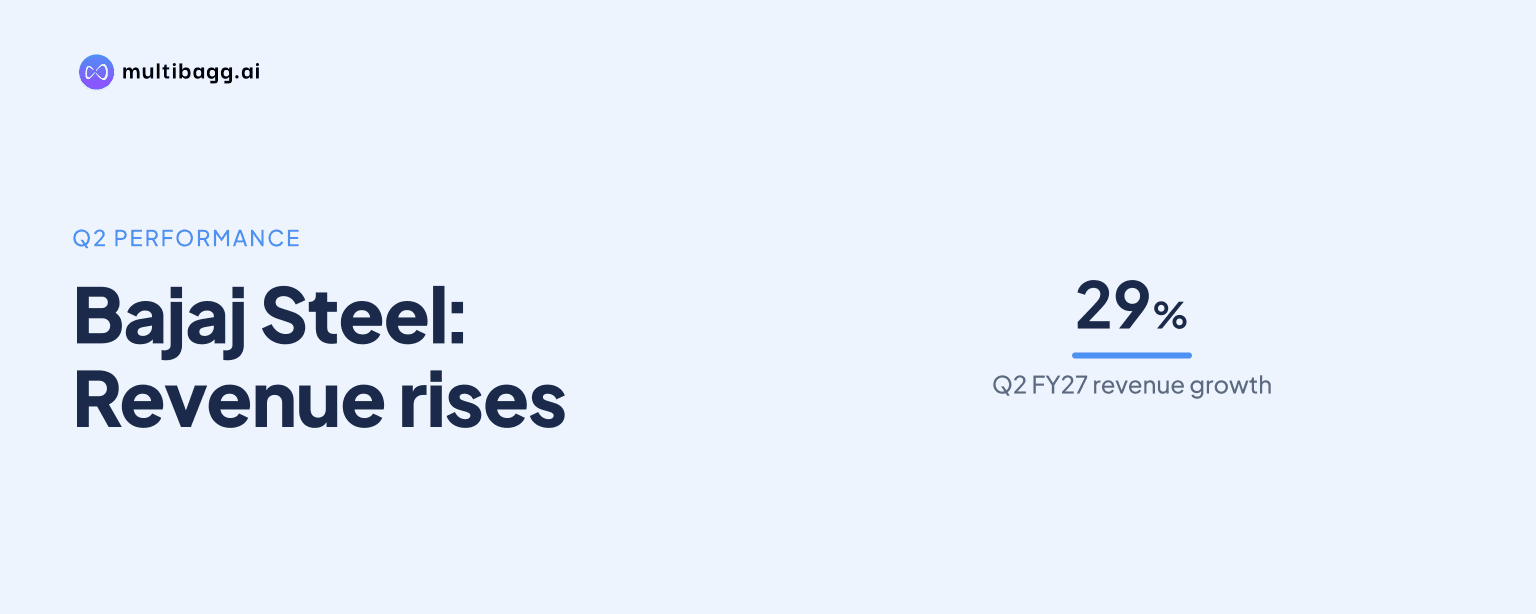
Bajaj Steel Industries Limited reported Q2FY27 revenue of Rs 155.2 crore, 29% above Q1FY27, but its earnings before interest, tax, depreciation and amortisation (EBITDA) margin was 8.0%, down 1,019 basis points, or 10.19 percentage points, from Q2FY26. Improved execution and dispatches lifted sequential performance, while higher inputs and delayed conversion constrained year-on-year earnings.
Know Bajaj Steel Industries inside out
Results, valuation, peers and who's buying, in one view.
Why did Bajaj Steel’s Q2FY27 revenue rise sequentially?
Bajaj Steel’s Q2FY27 revenue from operations rose 29% quarter on quarter (QoQ) to Rs 155.2 crore from Rs 120.4 crore in Q1FY27, according to its consolidated profit and loss statement. Management attributed the sequential increase to improved execution and dispatches, reversing part of the softer first-quarter revenue level.
The recovery did not restore revenue to the prior-year level. Q2FY27 revenue was 11% below Rs 174.6 crore in Q2FY26, with management citing delays in order conversion, raw-material availability constraints and volatile global trade conditions. For the first half of FY27, revenue was Rs 275.6 crore, 2.3% below Rs 282.2 crore in H1FY26, showing that the quarterly rebound was not sufficient to offset the slower start to the year.
The two principal revenue pools moved differently during the quarter. Cotton Ginning Machinery revenue increased to Rs 90 crore in Q2FY27 from Rs 56 crore in Q1FY27, while Other Businesses reached Rs 64.7 crore, or 42% of quarterly revenue. The segment chart rounds Other Businesses to Rs 65 crore, and shows a steadier progression from Rs 54 crore in Q2FY26 and Rs 64 crore in Q1FY27.
Which businesses supported Bajaj Steel’s quarterly revenue?
Bajaj Steel’s Other Businesses supported diversification by growing 19% year on year to Rs 64.7 crore in Q2FY27, partly offsetting the weaker Cotton Ginning Machinery business. The company defines Other Businesses as Infrastructure, Electrical Panels, Heavy Engineering and other product segments, which together accounted for 42% of Q2FY27 revenue.
Infrastructure and Heavy Engineering recorded approximately 30% and 44% year-on-year revenue growth, respectively, during H1FY27. The presentation does not give their individual rupee revenue for the half year, but identifies their growth as continuing momentum in the diversified engineering portfolio. Cotton Ginning Machinery, by contrast, was affected by softer export demand and execution delays during Q2FY27.
The reported segment series illustrates both the rebound and the remaining gap in cotton equipment. Cotton Ginning Machinery generated Rs 120 crore in Q2FY26, fell to Rs 60 crore in Q4FY26 and Rs 56 crore in Q1FY27, then recovered to Rs 90 crore in Q2FY27. Other Businesses ranged from Rs 54 crore to Rs 65 crore across the four displayed quarters, providing a more stable contribution while cotton machinery remained below its prior-year quarter.
Why did Bajaj Steel’s EBITDA margin remain below last year?
Bajaj Steel’s Q2FY27 EBITDA margin was 8.0%, compared with 18.2% in Q2FY26, a decline of 1,019 basis points. EBITDA fell 61% year on year to Rs 12.4 crore from Rs 31.8 crore, even as quarterly revenue reached Rs 155.2 crore, because management said higher steel and other input costs could not be fully passed through in existing orders.
The quarter nevertheless improved materially from Q1FY27, when EBITDA was Rs 5.9 crore and margin was 4.9%. Q2FY27 EBITDA rose 111% QoQ to Rs 12.4 crore, while margin increased 313 basis points. Management linked the sequential margin improvement to improved execution and gross-margin recovery, although gross margin at 45.7% was still below 52.5% in Q2FY26.
The lower operating margin flowed through the income statement. Profit before tax was Rs 8.9 crore in Q2FY27, versus Rs 28.3 crore a year earlier, while profit after tax (PAT) was Rs 7.7 crore against Rs 21.3 crore. PAT margin was 4.9%, compared with 12.1% in Q2FY26, and earnings per share were Rs 3.7 versus Rs 10.2.
Got a follow-up? Ask IRIS
How did Bajaj Steel’s first-half profitability compare with last year?
Bajaj Steel’s H1FY27 EBITDA was Rs 18.3 crore, down 59.6% from Rs 45.3 crore in H1FY26, and its EBITDA margin declined to 6.7% from 16.1%. The 942-basis-point margin difference reflects the impact of weaker operating profitability across the first six months, despite the improvement recorded in Q2FY27 over Q1FY27.
H1FY27 profit before tax fell 74.5% to Rs 9.8 crore from Rs 38.2 crore, and PAT declined 74.1% to Rs 7.4 crore from Rs 28.7 crore. Depreciation and amortisation expense increased to Rs 10 crore from Rs 7.5 crore, while finance cost was Rs 3 crore compared with Rs 2.6 crore. Other income was Rs 4.4 crore, up from Rs 2.9 crore.
The first-half comparison also shows that costs rose despite lower revenue. Cost of goods sold was Rs 153.4 crore in H1FY27, above Rs 133.8 crore in H1FY26, while employee benefits expense increased to Rs 45.3 crore from Rs 42.9 crore. Other expenses declined to Rs 58.5 crore from Rs 60.1 crore, but the reduction did not offset the higher goods and employee costs against H1 revenue of Rs 275.6 crore.
What order book and margin actions should investors monitor?
Bajaj Steel reported an order book of Rs 560 crore as of November 6, 2026, comprising Rs 350 crore in Cotton Ginning Machinery and Rs 210 crore across Other Businesses. This disclosed backlog provides revenue visibility across divisions, but the presentation does not specify a conversion timetable or the share expected to be executed in FY27.
Management said new orders are being priced to reflect prevailing input costs and expects progressive margin recovery over coming quarters. That expectation is tied to three disclosed mechanisms: improved execution, operating efficiencies and a diversified business mix. It is a management outlook rather than a reported financial result, and remains relevant because Q2FY27 gross margin of 45.7% was below the 52.5% reported a year earlier.
The order-book split also places the recovery in context. Cotton Ginning Machinery represented Rs 350 crore of the Rs 560 crore total, even though softer export demand and execution delays affected that segment’s Q2FY27 performance. Other Businesses accounted for Rs 210 crore, aligning with their 42% share of Q2 revenue and the H1 growth reported in Infrastructure and Heavy Engineering.
Conclusion
Bajaj Steel’s Q2FY27 results show a sequential operational recovery, with revenue rising by Rs 34.8 crore from Q1FY27 and EBITDA more than doubling to Rs 12.4 crore. However, Q2 revenue remained Rs 19.4 crore below Q2FY26 and the 8.0% EBITDA margin remained 10.19 percentage points lower, leaving first-half PAT at Rs 7.4 crore versus Rs 28.7 crore a year earlier.
The next result periods will show whether the Rs 560 crore order book converts without the delays cited in Q2FY27 and whether newly priced orders improve margins. Management’s stated plan is for progressive recovery through input-cost pricing, better execution, operating efficiencies and a diversified mix, while cotton machinery’s Rs 350 crore portion of the backlog leaves export demand and execution central to that outcome.