










Bajel Projects Limited EBITDA Rises 38% to ₹87 Crore
Key highlights
- Bajel Projects Limited reported EBITDA of ₹87 crore in 9M FY26, up 38% year-on-year.
- Revenue from operations was ₹1,784 crore in 9M FY26, 1% lower than ₹1,797 crore a year earlier.
- EBITDA margin improved to 4.8% from 3.5% in the corresponding prior-year period.
- The unexecuted order book stood at ₹2,912 crore on December 31, 2025, with 93% in power transmission.
powered by IRIS
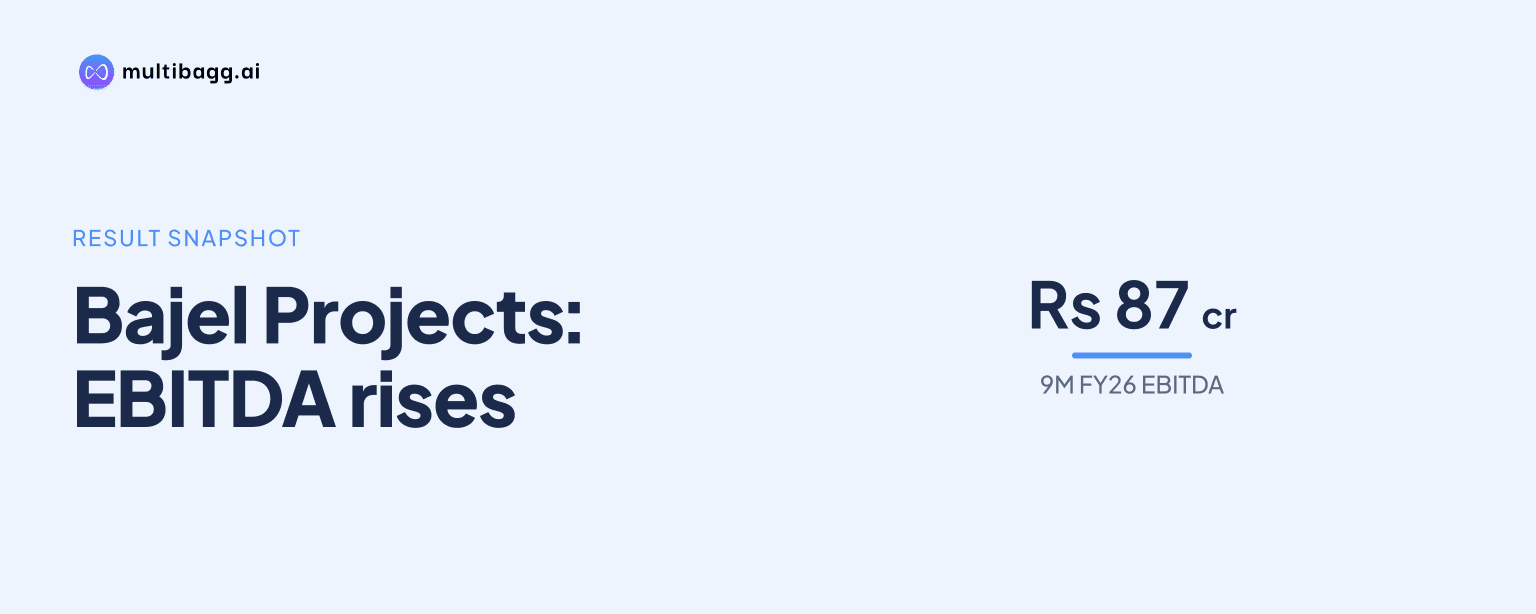
Bajel Projects Limited reported a 38% year-on-year rise in EBITDA to ₹87 crore in the nine months ended December 31, 2025, despite a 1% decline in revenue from operations. The result indicates improved operating profitability as the power transmission EPC company prioritises higher-margin project execution over revenue volume.
Know Bajel Projects inside out
Results, valuation, peers and who's buying, in one view.
What did Bajel Projects report for the nine months ended December 2025?
Bajel Projects reported revenue from operations of ₹1,784 crore for the nine months ended December 31, 2025, compared with ₹1,797 crore in the corresponding period of the previous year. While revenue was lower by 1%, EBITDA rose from the prior-year base by 38% to ₹87 crore.
The company’s EBITDA margin improved to 4.8% from 3.5% a year earlier. Profit before tax, before exceptional items, increased 30% year-on-year to ₹23 crore. These figures were disclosed in Bajel Projects’ investor presentation on its unaudited financial results for the third quarter and nine-month period ended December 31, 2025.
Why did EBITDA grow even as revenue declined?
The EBITDA increase reflects Bajel Projects’ stated shift towards margin-accretive growth and what it describes as quality of earnings. The company said it is pursuing contracts that fit its long-term profitability objectives rather than seeking revenue volume alone.
This approach is relevant to engineering, procurement and construction, or EPC, businesses, where project selection, execution discipline and contract economics can materially affect margins. Bajel Projects said a measured revenue environment has not changed its focus on profitability as a key differentiator.
The presentation also referred to a strong rise in EBITDA during the third quarter. However, the available information does not provide standalone third-quarter revenue, EBITDA or profit figures. The disclosed nine-month data therefore provides the clearest basis for assessing the company’s operating performance during the period.
What does Bajel Projects’ order book show about its operations?
Bajel Projects had an unexecuted order book of ₹2,912 crore as of December 31, 2025, with power transmission accounting for 93% and power distribution making up the remaining 7%. The mix underlines the company’s growing emphasis on transmission EPC work.
The company executes projects across power transmission, power distribution, monopoles and international EPC. Its stated capabilities include engineering, design, testing, procurement, manufacturing, installation and commissioning for high-voltage transmission lines, distribution infrastructure, substations and underground cabling.
Complex projects under the Green Energy Corridor and Inter-State Transmission System, or ISTS, framework remain an execution focus. These networks are important for connecting generation sources and moving electricity across regions, particularly as renewable-energy capacity expands in different parts of India.
Got a follow-up? Ask IRIS
How does the power infrastructure market support Bajel Projects’ strategy?
Bajel Projects’ RAASTA 2030 strategy targets stronger win ratios, improved margins, a digital-first operating model, international expansion and entry into new business areas. Its financial objective is double-digit revenue growth and high single-digit EBITDA margins by FY30.
The strategy is linked to the investment requirement in India’s transmission infrastructure. The company’s presentation cited estimated government investment of ₹4.25 lakh crore between 2022 and 2027, followed by ₹4.90 lakh crore for 2027 to 2032. These estimates point to a substantial pipeline for transmission-related equipment, construction and project-management services.
Bajel Projects was formed following the demerger of the EPC business from Bajaj Electricals Limited and was separately listed on Indian stock exchanges on December 19, 2023. The company also operates a manufacturing facility at Ranjangaon, near Pune, supporting its power-infrastructure operations.
What does the result mean for investors and the EPC sector?
For investors, the principal takeaway is the improvement in Bajel Projects’ EBITDA margin to 4.8% despite a modest fall in nine-month revenue. The 38% rise in EBITDA and 30% growth in pre-exceptional PBT indicate that the company’s profitability focus produced a better operating outcome over the period.
The ₹2,912 crore order book offers visibility into ongoing work, although the presentation does not specify the pace at which this backlog will convert into revenue. The heavy concentration in power transmission also means that execution performance in this segment will be central to the company’s financial progress.
Bajel Projects retains CRISIL A/Stable and CRISIL A1 ratings from CRISIL. Its ability to sustain margin improvement will depend on disciplined project selection and execution, particularly as it pursues complex Green Energy Corridor and ISTS assignments.
Conclusion
Bajel Projects Limited’s nine-month FY26 results show a divergence between revenue and profitability: revenue from operations declined 1% to ₹1,784 crore, while EBITDA increased 38% to ₹87 crore and margin expanded by 130 basis points to 4.8%. The company’s stated move towards better-quality, margin-accretive work is the central factor behind the reported performance.
Investors will next watch whether Bajel Projects converts its ₹2,912 crore unexecuted order book into revenue while maintaining the improved margin profile. Progress against the RAASTA 2030 plan, which targets double-digit revenue growth and high single-digit EBITDA margins by FY30, remains a disclosed longer-term measure of execution.