










Bajel Q2 revenue falls 16% as project starts are delayed
Key highlights
- Bajel reported Q2 FY27 revenue from operations of Rs 514 crore, down 16% from Rs 614 crore in Q2 FY26.
- Bajel's Q2 FY27 EBITDA was Rs 25 crore, while its EBITDA margin remained 4.8%.
- Bajel's H1 FY27 profit after tax rose to Rs 10 crore from Rs 9 crore despite an 11% revenue decline.
- Bajel's Q2 FY27-end unexecuted order book was about Rs 5,000 crore, up 48% year on year.
powered by IRIS
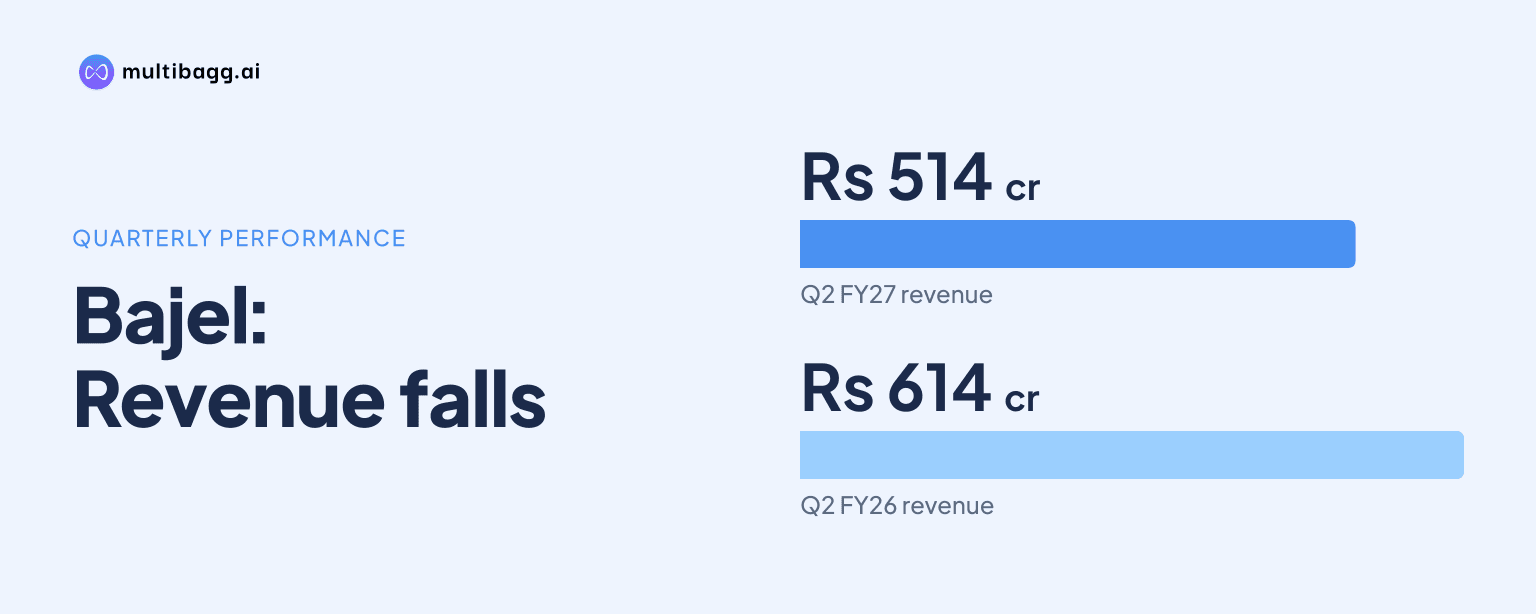
Bajel Projects Limited reported second-quarter fiscal year 2027 (Q2 FY27) revenue from operations of Rs 514 crore, down 16% from Rs 614 crore a year earlier, because project starts were delayed by the war in the Middle East and domestic right-of-way issues; its EBITDA margin remained 4.8%.
Know Bajel Projects inside out
Results, valuation, peers and who's buying, in one view.
Why did Bajel's Q2 FY27 revenue fall 16%?
Bajel said Q2 FY27 revenue fell because project starts were delayed by the war in the Middle East and domestic right-of-way, or RoW, issues. Revenue from operations was Rs 514 crore for the quarter ended September 30, 2026, compared with Rs 614 crore in Q2 FY26. The company described the quarterly revenue as modest and identified execution timing as the reason for the lower result.
The first-half fiscal year 2027 (H1 FY27) comparison also showed lower revenue, although the decline was less than in the second quarter. H1 FY27 revenue from operations was Rs 1,081 crore, down 11% from Rs 1,221 crore in H1 FY26. Bajel did not disclose the value of projects affected by overseas disruption or domestic RoW issues.
How did Bajel's Q2 EBITDA margin remain at 4.8%?
Bajel reported earnings before interest, tax, depreciation and amortisation, or EBITDA, of Rs 25 crore in Q2 FY27, down 16% from Rs 30 crore, while the EBITDA margin remained 4.8% in both periods. Bajel said the margin held despite high commodity prices and other cost pressures. The company calculates EBITDA margin on total income, and its EBITDA measure includes other income.
Profit before tax was Rs 8 crore and profit after tax was Rs 6 crore in Q2 FY27, compared with rounded figures of Rs 8 crore and Rs 6 crore in Q2 FY26. The reported year-on-year changes were declines of 2% for both measures, indicating movement in underlying unrounded values. Bajel attributed the quarterly profit outcome to a 31% reduction in interest costs from the same period a year earlier.
What changed in Bajel's first-half FY27 results?
Bajel's H1 FY27 EBITDA declined 12% to Rs 49 crore from Rs 55 crore in H1 FY26, while its EBITDA margin was unchanged at 4.4%. Revenue from operations fell 11% to Rs 1,081 crore from Rs 1,221 crore over the same period. EBITDA therefore declined by a slightly greater percentage than revenue in the first-half comparison.
Profit before tax increased 21% to Rs 15 crore in H1 FY27 from Rs 12 crore, and profit after tax increased 16% to Rs 10 crore from Rs 9 crore. Those profit increases occurred despite the Rs 140 crore reduction in first-half revenue and the Rs 6 crore EBITDA decline. The release gives a 31% year-on-year reduction in interest costs for Q2 FY27, but does not provide an equivalent first-half interest-cost figure.
Got a follow-up? Ask IRIS
Which orders lifted Bajel's unexecuted order book?
Bajel's unexecuted order book, or UEOB, was about Rs 5,000 crore at the end of Q2 FY27, its highest reported level and 48% above the level at the end of Q2 FY26. During the quarter, Bajel formalised an agreement with Egypt's Egyptian Electricity Transmission Company for a 500 kilovolt transmission line worth more than Rs 400 crore, including goods and services tax.
Bajel also secured ultra-mega and mega orders worth about Rs 1,600 crore, including goods and services tax, under the Western Region-Eastern Region Inter-Regional Network Expansion Scheme. In October, after the September 30 quarter-end, it won two Mumbai substation-work orders from Tata Power worth more than Rs 200 crore each, including goods and services tax. It also won about Rs 1,500 crore of orders, including goods and services tax, for 765 kilovolt transmission lines and substations in Gujarat.
The Gujarat orders were Bajel's largest disclosed power-transmission order win. Rajesh Ganesh, Bajel's managing director and chief executive officer, said the UEOB was about Rs 6,500 crore as of November 6, 2026, compared with the Rs 5,000 crore figure reported at the Q2 FY27 close. The latter is a period-end measure, while the Rs 6,500 crore amount is an as-of-date management update.
What execution priorities has Bajel disclosed for coming quarters?
Bajel's management said its priorities for coming quarters are to strengthen execution, improve efficiency and support sustainable, profitable growth. The plan follows Q2 FY27 project-start delays and the resulting 16% fall in quarterly revenue to Rs 514 crore. Management also said Bajel would focus on seamless project delivery while pursuing opportunities aligned with its capabilities and return expectations.
Bajel operates in engineering, procurement and construction and manufacturing solutions across power transmission and new energies, previously called power distribution. Management linked opportunity to India's effort to expand its power-transmission network for energy demand and clean-energy ambitions. However, the release provides no revenue target, margin target or completion timetable for converting the Rs 5,000 crore Q2-end UEOB into reported revenue.
Conclusion
Bajel's Q2 FY27 results show that project mobilisation delays reduced revenue while the reported EBITDA margin remained unchanged. Revenue fell by Rs 100 crore year on year to Rs 514 crore, EBITDA declined by Rs 5 crore to Rs 25 crore, and the margin stayed at 4.8%; in H1 FY27, lower revenue and EBITDA coincided with higher profit before tax and profit after tax.
The next issue to watch is execution against management's stated plan to improve efficiency and project delivery, particularly as the UEOB increased from about Rs 5,000 crore at September 30, 2026, to about Rs 6,500 crore as of November 6, 2026. The release leaves unresolved how long Middle East disruption and domestic RoW issues may continue to delay project starts.