










Bajel Projects Limited EBITDA Rises 38% in Nine Months FY26
Key highlights
- Bajel Projects reported ₹87 crore EBITDA in 9M FY26, a 38% year-on-year increase.
- Revenue from operations was ₹1,784 crore in 9M FY26, down 1% from ₹1,797 crore a year earlier.
- EBITDA margin improved to 4.8% in 9M FY26 from 3.5% in 9M FY25.
- The unexecuted order book stood at ₹2,912 crore on December 31, 2025, with 93% in power transmission.
powered by IRIS
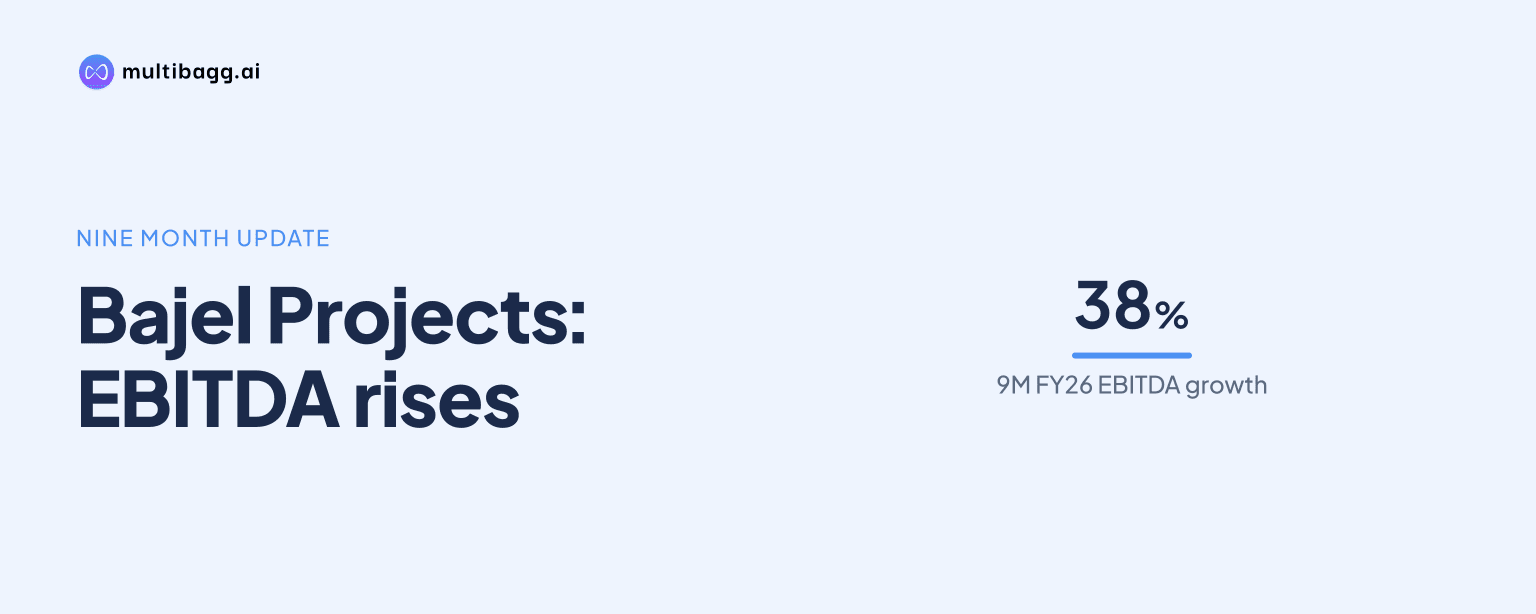
Bajel Projects Limited reported EBITDA of ₹87 crore for the nine months ended December 31, 2025, up 38% year-on-year, even as revenue from operations declined 1% to ₹1,784 crore. The result highlights the power transmission EPC company's stated shift towards contracts with stronger profitability rather than pursuing revenue volume alone.
Know Bajel Projects inside out
Results, valuation, peers and who's buying, in one view.
What did Bajel Projects report for the first nine months of FY26?
Bajel Projects reported a 38% year-on-year increase in EBITDA to ₹87 crore for the nine months ended December 31, 2025. Its EBITDA margin improved to 4.8% from 3.5% in the corresponding period of the previous year, indicating better operating profitability despite a measured revenue environment.
Revenue from operations was ₹1,784 crore, compared with ₹1,797 crore a year earlier. Profit before tax before exceptional items increased 30% to ₹23 crore. The presentation linked the stronger profitability to its focus on quality of earnings and the selection of projects that fit its long-term margin objectives.
Why did margins rise despite lower revenue?
Bajel Projects said its nine-month performance reflected a strategic pivot towards margin-accretive growth. The company is positioning itself as a specialised power transmission EPC player and is prioritising contract wins that support profitability, rather than seeking volume at the expense of returns.
The presentation described profitability as a core differentiator in a period of measured revenue growth. Higher EBITDA and margin expansion alongside a 1% revenue decline suggest that project mix and execution discipline were more important to the reported operating performance than top-line growth during the period.
The company also highlighted execution of complex projects under the Green Energy Corridor and Inter-State Transmission Systems, or ISTS, as an operating focus. These projects are associated with India's expanding transmission network for renewable generation and inter-regional electricity movement.
What does Bajel Projects' order book indicate?
Bajel Projects had an unexecuted order book of ₹2,912 crore as of December 31, 2025, with power transmission accounting for 93% and power distribution contributing 7%. The order mix shows that transmission remains the central business line for the company.
A transmission-heavy order book aligns with Bajel Projects' stated goal of becoming a specialised transmission EPC company. Its operations cover turnkey engineering, design, testing, manufacturing, execution and commissioning for extra-high-voltage transmission lines, along with substations, underground cabling and power distribution infrastructure.
The company also operates in monopoles and international EPC work. It has a manufacturing facility at Ranjangaon, near Pune, that supports its transmission and distribution structure business. Bajel Projects was formed through the demerger of the EPC segment from Bajaj Electricals Limited and was separately listed on Indian stock exchanges on December 19, 2023.
Got a follow-up? Ask IRIS
How does the power transmission market support Bajel Projects?
India's planned transmission investment provides the broader backdrop for Bajel Projects' strategy. The investor presentation cited estimated government investment of ₹425,000 crore in transmission infrastructure for 2022-27 and ₹490,000 crore for 2027-32.
The spending need is being shaped by rising electricity demand and the addition of renewable energy capacity, which requires grid links between generation locations and consumption centres. Green Energy Corridor and ISTS projects are part of this infrastructure build-out, creating a significant addressable market for transmission contractors.
For Bajel Projects, the relevant issue is not only the availability of sector opportunities but also whether those opportunities can be converted into profitable execution. The nine-month results showed margin improvement, while the company retained a CRISIL A/Stable and CRISIL A1 rating cited in its presentation.
What are Bajel Projects' financial and strategic targets?
Bajel Projects' RAASTA 2030 strategy targets double-digit revenue growth and high single-digit EBITDA margins by FY30. The plan includes improving bid win ratios, raising margins, becoming a digital-first organisation, expanding international operations and entering new business areas.
The strategy makes the latest margin performance relevant for investors because the 4.8% EBITDA margin remains below the company's stated high single-digit FY30 ambition. At the same time, the increase from 3.5% in the prior-year period and the 38% EBITDA growth provide a reported measure of progress in its quality-of-earnings approach.
The company previously reported adjusted EBITDA of ₹115 crore in FY25, compared with ₹43 crore in FY24, and PBT of ₹17.6 crore in the nine months ended December 2024. These figures provide context for the post-demerger effort to build a standalone, sector-focused transmission and distribution EPC platform.
Conclusion
Bajel Projects' nine-month FY26 presentation showed improved operating profitability despite a marginal fall in revenue. EBITDA rose 38% to ₹87 crore, EBITDA margin increased to 4.8%, and the company carried a ₹2,912 crore unexecuted order book led overwhelmingly by power transmission projects.
The next areas to watch are the conversion and execution of the transmission-led order book, progress in EBITDA margin towards the high single-digit FY30 target, and the company's ability to win projects under its RAASTA 2030 strategy without weakening its stated focus on profitability.