










Bajel Projects operating cash inflow reaches Rs 108.84 crore
Key highlights
- Bajel Projects reported Rs 108.84 crore of net operating cash inflow for the half year ended September 30, 2026, versus Rs 67.89 crore a year earlier.
- Trade receivables released Rs 607.59 crore of cash during the half year ended September 30, 2026.
- Inventories absorbed Rs 86.48 crore of cash and stood at Rs 225.07 crore on September 30, 2026.
- Cash and cash equivalents fell by Rs 20.99 crore to Rs 2.73 crore at September 30, 2026.
powered by IRIS
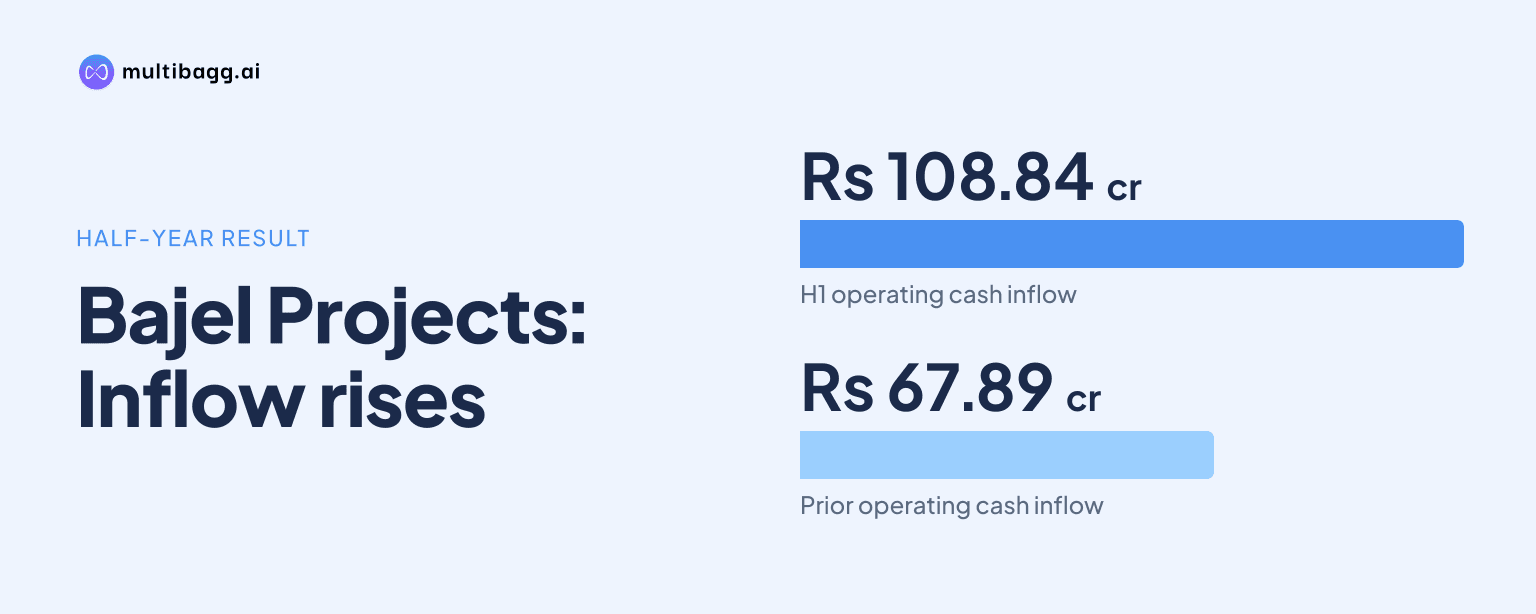
Bajel Projects Limited generated net operating cash inflow of Rs 108.84 crore in the half year ended September 30, 2026, compared with Rs 67.89 crore a year earlier. A Rs 607.59 crore reduction in current and non-current trade receivables was the largest contributor, despite cash being absorbed by inventories, other assets and lower liabilities.
Know Bajel Projects inside out
Results, valuation, peers and who's buying, in one view.
How much operating cash did Bajel Projects generate?
Bajel Projects generated Rs 108.84 crore of net cash from operating activities in the half year ended September 30, 2026, up Rs 40.95 crore from Rs 67.89 crore in the corresponding 2025 period. The standalone financial results were reviewed by the audit committee and approved by the board on November 6, 2026.
Cash generated from operations before tax payments rose to Rs 120.98 crore from Rs 74.99 crore. Net income taxes paid increased to Rs 12.14 crore from Rs 7.10 crore, leaving the reported operating cash inflow of Rs 108.84 crore. Profit before tax increased to Rs 14.69 crore from Rs 12.43 crore, while the larger cash-flow increase reflected movements in operating assets and liabilities.
The reported cash flow relates to Bajel Projects' standalone operations. The company identifies power transmission and distribution as its single reporting segment under Indian Accounting Standard 108, which covers operating-segment disclosures.
What drove Bajel Projects' working-capital movement?
Bajel Projects reported a Rs 607.59 crore decrease in trade receivables, including current and non-current balances, during the half year ended September 30, 2026. That compared with a Rs 48.70 crore decrease in the corresponding 2025 half year and was the main source of the increase in operating cash generation.
The balance sheet showed current trade receivables of Rs 1,042.25 crore at September 30, 2026, down from Rs 1,633.78 crore at March 31, 2026. Non-current trade receivables declined to Rs 199.41 crore from Rs 215.27 crore. The balance-sheet reduction differs slightly from the cash-flow movement because the cash-flow statement presents changes under its own classification.
Other working-capital movements used cash. Financial and other assets consumed Rs 116.27 crore, versus a Rs 7.41 crore release a year earlier, while inventories consumed Rs 86.48 crore against Rs 22.79 crore in the earlier period. Inventories stood at Rs 225.07 crore at September 30, 2026, compared with Rs 138.51 crore at March 31, 2026.
Trade payables, provisions, employee-benefit obligations, other financial liabilities and other liabilities together fell by Rs 323.73 crore, reducing operating cash. The comparable decline was Rs 5.08 crore a year earlier. Dues to creditors other than micro and small enterprises fell to Rs 393.58 crore from Rs 636.71 crore, while dues to micro and small enterprises declined to Rs 141.29 crore from Rs 244.84 crore.
Got a follow-up? Ask IRIS
How did profit adjustments affect Bajel Projects' cash generation?
Bajel Projects recorded Rs 39.88 crore of cash-flow adjustments before working-capital changes in the latest half year, compared with Rs 46.76 crore in the year-earlier period. Finance costs of Rs 23.60 crore were the largest adjustment, down from Rs 32.89 crore, while depreciation and amortisation increased to Rs 10.29 crore from Rs 9.43 crore.
Interest income reduced these adjustments by Rs 9.30 crore, compared with Rs 6.80 crore in the prior-year half. Bajel Projects also reported a Rs 1.65 crore credit balance written back, a Rs 0.17 crore gain on sale of current investments and a Rs 0.07 crore reversal of provision for inventory obsolescence.
Employee share-based payment expense fell to Rs 2.61 crore from Rs 7.79 crore. The company recorded Rs 0.25 crore of net provision for doubtful debts, bad debts and advances written off, whereas the earlier period included a Rs 0.87 crore net reversal; net unrealised exchange loss was Rs 0.35 crore, down from Rs 3.90 crore.
Revenue from operations declined to Rs 1,080.99 crore in the half year ended September 30, 2026, from Rs 1,221.46 crore a year earlier. Net sales fell to Rs 1,054.77 crore from Rs 1,207.90 crore, while other operating income rose to Rs 26.22 crore from Rs 13.56 crore.
How did investing and financing affect Bajel Projects' cash balance?
Bajel Projects used Rs 119.45 crore in investing activities during the six months to September 30, 2026, compared with an inflow of Rs 23.82 crore in the prior-year period. Bank deposits not classified as cash and cash equivalents accounted for Rs 99.13 crore of the outflow, and purchases of property, plant and equipment, intangible assets and capital work in progress used Rs 20.44 crore.
The company invested Rs 6.83 crore in compulsorily convertible debentures and equity shares of an associate, and provided Rs 0.24 crore of loans to an associate. Interest received of Rs 7.02 crore and proceeds of Rs 0.17 crore from sale of current investments partly offset those investing outflows.
Financing activities used Rs 10.38 crore, compared with a Rs 122.45 crore inflow in the corresponding 2025 half year. Net borrowing proceeds were Rs 25.11 crore, while Bajel Projects paid Rs 24.87 crore of interest, Rs 6.94 crore of dividends, Rs 3.22 crore of lease principal and Rs 0.71 crore of lease interest.
The operating inflow, investing outflow and financing outflow produced a Rs 20.99 crore decrease in cash and cash equivalents. Bajel Projects ended September 30, 2026 with Rs 2.73 crore of cash and cash equivalents, compared with Rs 23.72 crore at the start of the financial year.
What receivables uncertainty remains for Bajel Projects?
Bajel Projects has ongoing or invoked arbitration proceedings against three customers to recover outstanding balances, interest on delayed payments and losses suffered. The outstanding customer balance was Rs 85.92 crore, net of provision, at September 30, 2026.
Management stated that no further adjustment was considered necessary because the arbitration outcomes cannot presently be determined. The independent auditor drew attention to the matter in its review report and did not modify its conclusion on the unaudited standalone financial results.
The arbitration disclosure is relevant to the receivables movement because it concerns customer balances, but the filing does not identify how much of the Rs 607.59 crore cash-flow reduction in receivables relates to these three customers. The reported arbitration balance was stated after provisions as of September 30, 2026.
Conclusion
Bajel Projects reported Rs 108.84 crore of operating cash inflow for the half year ended September 30, 2026, versus Rs 67.89 crore a year earlier. The Rs 607.59 crore receivables reduction outweighed Rs 86.48 crore absorbed by inventories, Rs 116.27 crore absorbed by other assets and Rs 323.73 crore associated with lower payables and other liabilities.
The disclosed matter to watch is the outcome of arbitration involving three customers and Rs 85.92 crore of outstanding balances, net of provision, at September 30, 2026. Future filings will also show whether the lower receivables balance is sustained while inventory remained Rs 225.07 crore at the half-year date.