










BAJEL Projects holds margin as H1 pre-tax profit climbs
Key highlights
- BAJEL Projects' H1 FY27 revenue from operations fell 11% year on year to Rs 1,081 crore.
- BAJEL Projects maintained a 4.4% H1 FY27 EBITDA margin as EBITDA declined to Rs 49 crore.
- BAJEL Projects' H1 FY27 interest expense fell 28% to Rs 24 crore, while profit before tax rose 21% to Rs 15 crore.
- BAJEL Projects' unexecuted order book reached Rs 5,001 crore at September 30, 2026, up 48% year on year.
powered by IRIS
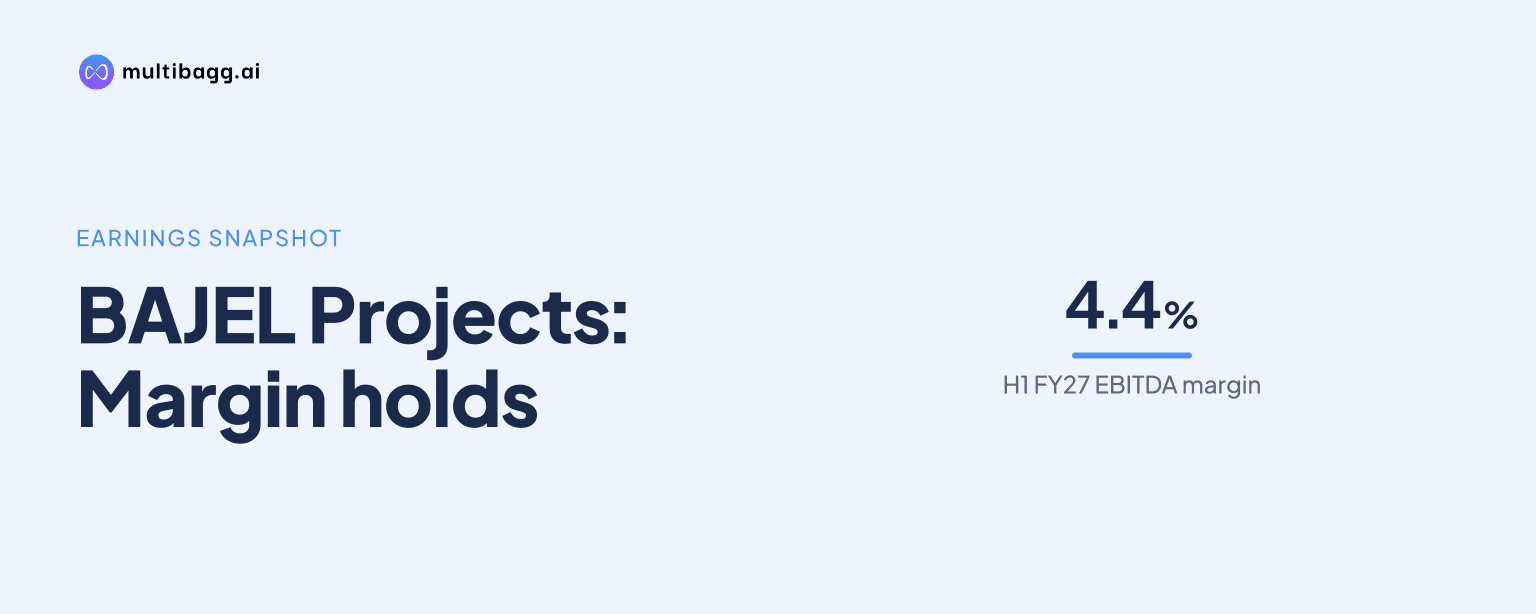
BAJEL Projects maintained a 4.4% earnings before interest, tax, depreciation and amortisation (EBITDA) margin in H1 FY27 while profit before tax rose 21% year on year to Rs 15 crore, despite revenue from operations falling 11% to Rs 1,081 crore. Interest expense declined 28% to Rs 24 crore over the same period.
Know Bajel Projects inside out
Results, valuation, peers and who's buying, in one view.
How did BAJEL Projects perform in H1 FY27?
BAJEL Projects reported lower H1 FY27 revenue but maintained its EBITDA margin and increased pre-tax profit. Revenue from operations declined to Rs 1,081 crore from Rs 1,221 crore in H1 FY26, while total income fell 12% to Rs 1,093 crore. Management attributed the modest revenue performance to delayed project starts arising from the war in the Middle East and domestic right-of-way, or RoW, issues.
EBITDA fell 12% to Rs 49 crore from Rs 55 crore, but the EBITDA margin on total income was unchanged at 4.4%. BAJEL Projects said operational efficiency, focused execution and cost optimisation helped it retain the margin despite lower revenue and high commodity prices.
The comparison shows that profit below the operating line improved even as EBITDA declined. Profit before interest, tax and exceptional items fell 15% to Rs 38 crore, and depreciation increased 9% to Rs 10 crore. The Rs 9 crore reduction in interest expense exceeded those changes, while exceptional items were nil in both half-years.
Why did BAJEL Projects' profit before tax rise?
BAJEL Projects' profit before tax rose because lower interest expense offset the decline in operating profit before interest and tax. Interest fell to Rs 24 crore in H1 FY27 from Rs 33 crore in H1 FY26, while profit before tax increased to Rs 15 crore from Rs 12 crore.
Management said the 21% increase in profit before tax and 16% increase in net profit reflected prudent working-capital management. Net profit was Rs 10 crore against Rs 9 crore a year earlier, while basic and diluted earnings per share rose 12% to Rs 0.89 from Rs 0.80. Tax expense increased to Rs 4 crore from Rs 3 crore.
The second-quarter pattern also reflected stable margins and lower finance costs. Q2 FY27 revenue from operations was Rs 514 crore, down 16% year on year and 9% from Rs 567 crore in Q1 FY27. EBITDA was Rs 25 crore and the margin was 4.8%, unchanged from Q2 FY26 and above Q1 FY27's 4.1%, while interest expense was Rs 12 crore versus Rs 17 crore a year earlier.
What changed in BAJEL Projects' working capital?
BAJEL Projects' trade receivables decreased between March 31, 2026 and September 30, 2026. Combined current and non-current trade receivables were Rs 1,241 crore at September 30, compared with Rs 1,849 crore at March 31. Current receivables fell to Rs 1,042 crore from Rs 1,634 crore, and non-current receivables declined to Rs 199 crore from Rs 215 crore.
Other working-capital movements were mixed during the same period. Inventories increased to Rs 225 crore from Rs 139 crore and contract assets rose to Rs 70 crore from Rs 19 crore. Bank balances increased to Rs 223 crore from Rs 159 crore, while cash and cash equivalents declined to Rs 3 crore from Rs 24 crore.
Current borrowings rose to Rs 375 crore at September 30 from Rs 350 crore at March 31. Total current assets declined to Rs 1,743 crore from Rs 2,119 crore, while total current liabilities fell to Rs 1,488 crore from Rs 1,761 crore. Total equity was Rs 635 crore, compared with Rs 681 crore six months earlier.
Got a follow-up? Ask IRIS
How large is BAJEL Projects' unexecuted order book?
BAJEL Projects had an unexecuted order book of Rs 5,001 crore at September 30, 2026, its highest reported level in the presentation. The order book was 48% above Rs 3,375 crore a year earlier and 45% above Rs 3,442 crore at March 31, 2026. The company states that the measure excludes goods and services tax and supply orders.
The order book increased by Rs 946 crore from Rs 4,055 crore at June 30, 2026. Power transmission accounted for 85% of the September order book, with New Energies at 8% and international engineering, procurement and construction, or EPC, at 7%.
Management said the order book was about Rs 6,500 crore as of the presentation date following Q2 FY27. Updates included more than Rs 200 crore of Tata Power orders for 220 kilovolt gas-insulated switchgear projects in Salsette and Powai, more than Rs 200 crore for 400 kilovolt projects in Dharavi and Ghatkopar, and about Rs 1,500 crore of Lakadia A Power Transmission orders for 270 kilometres of 765 kilovolt double-circuit lines and substation work.
What does BAJEL Projects' annual record show?
BAJEL Projects increased revenue from operations in each of the four reported financial years through FY26. Revenue rose from Rs 664 crore in FY23 to Rs 1,169 crore in FY24, Rs 2,598 crore in FY25 and Rs 2,792 crore in FY26. EBITDA increased from Rs 13 crore to Rs 36 crore, Rs 90 crore and Rs 125 crore over those years, while EBITDA margin rose from 1.9% to 4.4%.
Profit before tax rose to Rs 34 crore in FY26 from Rs 24 crore in FY25 and Rs 4 crore in FY24, after a Rs 27 lakh pre-tax loss in FY23. Return on average capital employed was 16.3% in FY26, compared with 13.2% in FY25 and 5.1% in FY24. BAJEL Projects defines this measure as profit before tax plus exceptional items plus finance cost, divided by average capital employed.
Conclusion
BAJEL Projects' H1 FY27 performance combined lower revenue with unchanged operating margin and higher pre-tax profit. The 11% fall in revenue and 12% decline in EBITDA were offset below the operating line by a Rs 9 crore reduction in interest expense, producing a Rs 3 crore increase in profit before tax.
The next disclosures to watch are project execution after delayed starts, conversion of the Rs 5,001 crore September order book into revenue, and changes in receivables, inventories and borrowings. Management said its priorities for coming quarters are to strengthen execution, improve efficiency and support sustainable, profitable growth while pursuing opportunities aligned with its capabilities and return expectations.