










BAJEL Projects order book reaches Rs 5,001 crore in Q2 FY'27
Key highlights
- BAJEL Projects’ UEOB reached a record Rs 5,001 crore on 30th Sept'26, up 48% year on year.
- Power Transmission represented 85% of BAJEL Projects’ Rs 5,001 crore UEOB at 30th Sept'26.
- Management said post-quarter wins lifted BAJEL Projects’ UEOB to about Rs 6,500 crore.
- Q2 FY'27 revenue was Rs 514 crore, while EBITDA margin was 4.8%.
powered by IRIS
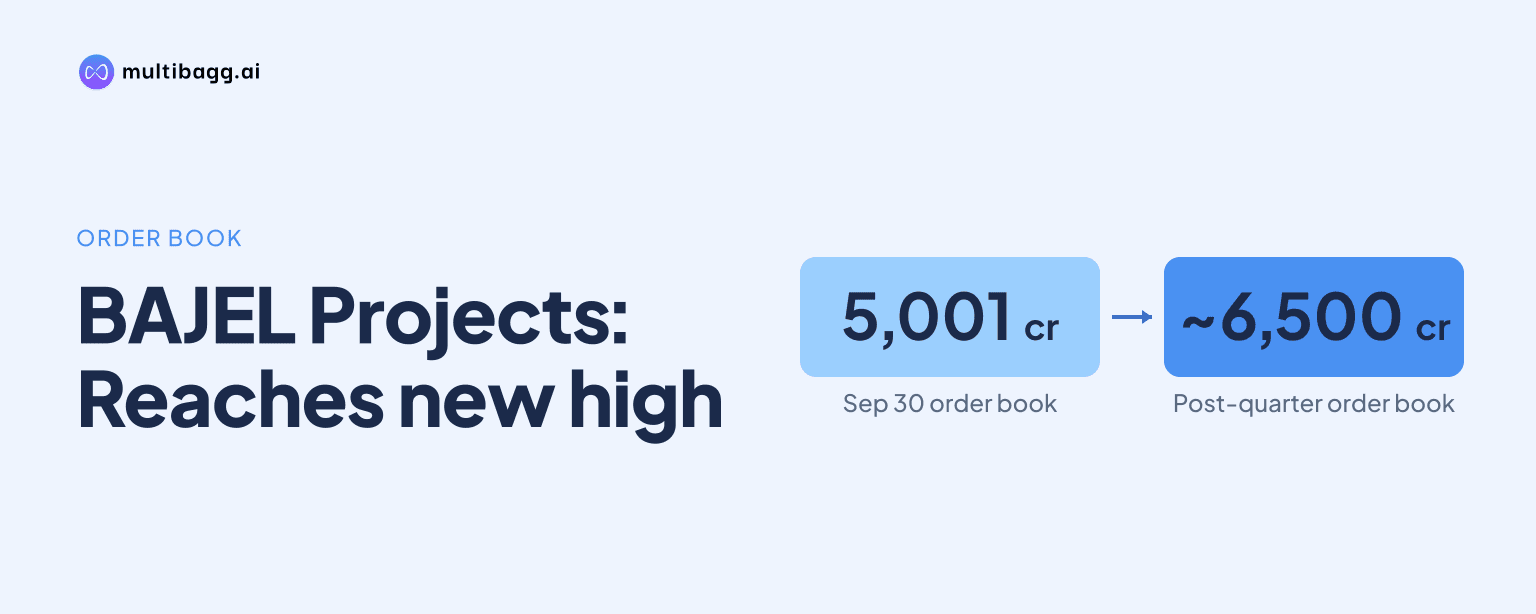
BAJEL Projects ended Q2 FY'27 on September 30, 2026, with a record Rs 5,001 crore unexecuted order book, up 48% from Rs 3,375 crore a year earlier. Management said orders received after the quarter had lifted the figure to about Rs 6,500 crore, even as quarterly revenue from operations fell 16% to Rs 514 crore.
Know Bajel Projects inside out
Results, valuation, peers and who's buying, in one view.
How did BAJEL Projects’ order book grow to Rs 5,001 crore?
BAJEL Projects’ unexecuted order book, or UEOB, rose to Rs 5,001 crore at September 30, 2026, from Rs 2,984 crore at March 31, 2025. The company described the September balance as its highest ever UEOB and showed it as 1.7 times the March 2025 amount. The reported balance is exclusive of goods and services tax and excludes supply orders.
The increase accelerated through FY'27. UEOB moved from Rs 3,442 crore at March 31, 2026, to Rs 4,055 crore at June 30, 2026, and then to Rs 5,001 crore at September 30, 2026. The Rs 1,559 crore rise in the first six months of FY'27 exceeded the Rs 458 crore increase over FY'26, when the balance rose from Rs 2,984 crore to Rs 3,442 crore.
Management said strong order inflow in Q2 FY'27 supported the Rs 5,001 crore quarter-end position. Managing Director and Chief Executive Officer Rajesh Ganesh said the approximately Rs 6,500 crore UEOB reported “as of date” included subsequent wins and reflected future revenue visibility. That later amount is not presented as a September 30 balance.
Which segments make up BAJEL Projects’ order book?
Power Transmission accounted for 85% of BAJEL Projects’ Rs 5,001 crore UEOB at September 30, 2026, making it the largest disclosed segment. New Energies represented 8% and International EPC represented 7%. The presentation says that the former Power Distribution business has been renamed New Energies.
The segment mix means most of the September 2026 contracted pipeline was tied to transmission projects rather than New Energies or International EPC. Since the presentation gives shares rather than separately reported rupee values for the three businesses, it does not disclose their individual order-book balances beyond the 85%, 8% and 7% split.
BAJEL Projects also disclosed its first TBCB order in Q2 FY'27, won in collaboration with NIIF. The project is the Common Transmission System for Evacuation of Power from Lakadia, Jam Khambhaliya and Jamnagar, Part A. The presentation does not state the order value, project schedule or the respective responsibilities of BAJEL Projects and NIIF.
Which orders did BAJEL Projects disclose after Q2 FY'27?
BAJEL Projects disclosed an approximately Rs 1,500 crore order from Lakadia A Power Transmission Limited after Q2 FY'27. The contract covers construction of 270 kilometres of 765 kilovolt double-circuit transmission lines between Halvad and Vadodara in Gujarat, along with additional work at the Halvad, Vadodara and South Olpad substations.
The company also reported two Tata Power orders of more than Rs 200 crore each. One involves 220 kilovolt gas-insulated switchgear work at Salsette and Powai in Mumbai, while the other covers 400 kilovolt gas-insulated switchgear work at Dharavi and Ghatkopar in Mumbai. BAJEL Projects did not disclose exact values, award dates or completion schedules for either Tata Power order.
Management’s about Rs 6,500 crore UEOB statement came after these order updates, compared with the Rs 5,001 crore balance at September 30, 2026. The presentation lists the approximately Rs 1,500 crore Lakadia A order and the two Tata Power awards, but does not provide a reconciliation between the quarter-end amount and the later figure.
Got a follow-up? Ask IRIS
How did BAJEL Projects’ Q2 FY'27 financial performance compare?
BAJEL Projects reported revenue from operations of Rs 514 crore in Q2 FY'27, down from Rs 614 crore in Q2 FY'26 and Rs 567 crore in Q1 FY'27. Earnings before interest, tax, depreciation and amortisation, or EBITDA, was Rs 25 crore, compared with Rs 30 crore a year earlier and Rs 24 crore in the preceding quarter. EBITDA margin was 4.8%, unchanged from Q2 FY'26 and above 4.1% in Q1 FY'27.
Profit before tax was Rs 8 crore in Q2 FY'27, the same as Q2 FY'26 and up from Rs 7 crore in Q1 FY'27. Its margin increased to 1.5% from 1.3% a year earlier, while interest expense declined to Rs 12 crore from Rs 17 crore. Management attributed the stable EBITDA margin amid high commodity prices to operational efficiency and cost optimisation, and cited interest-cost savings for the higher profit-before-tax margin.
For H1 FY'27, revenue from operations was Rs 1,081 crore, down 11% from Rs 1,221 crore in H1 FY'26. BAJEL Projects said delayed project starts related to the war in the Middle East and domestic right-of-way issues affected revenue. H1 FY'27 EBITDA was Rs 49 crore against Rs 55 crore, while profit before tax rose 21% to Rs 15 crore and net profit increased 16% to Rs 10 crore; management attributed the profit growth to working-capital management.
Conclusion
BAJEL Projects’ September 2026 UEOB increased sharply while revenue declined in Q2 FY'27. The Rs 5,001 crore order book was 48% above the Rs 3,375 crore balance a year earlier, with Power Transmission contributing 85% of the total. At the same time, Q2 revenue fell by Rs 100 crore year on year, while EBITDA margin held at 4.8% and interest expense fell by Rs 5 crore.
The next disclosed issue is the conversion of the Rs 5,001 crore September UEOB and the subsequent orders that management said took the amount to about Rs 6,500 crore. Management has identified project delivery, efficiency and sustainable profitable growth as priorities, while delayed project starts linked to Middle East conditions and domestic right-of-way matters remain factors affecting revenue timing.