










Balaxi reports positive operating cash flow in H1 FY27 results
Key highlights
- Balaxi reported Rs 22.9586 crore of operating cash inflow in H1 FY27, versus a Rs 4.4998 crore outflow in FY26.
- Trade receivables declined by Rs 16.0339 crore from FY26 to Rs 120.0679 crore in H1 FY27.
- Inventories increased by Rs 9.0299 crore from FY26 to Rs 92.5098 crore in H1 FY27.
- Balaxi reported H1 FY27 revenue of Rs 162.054 crore, up 27.68% year on year.
powered by IRIS
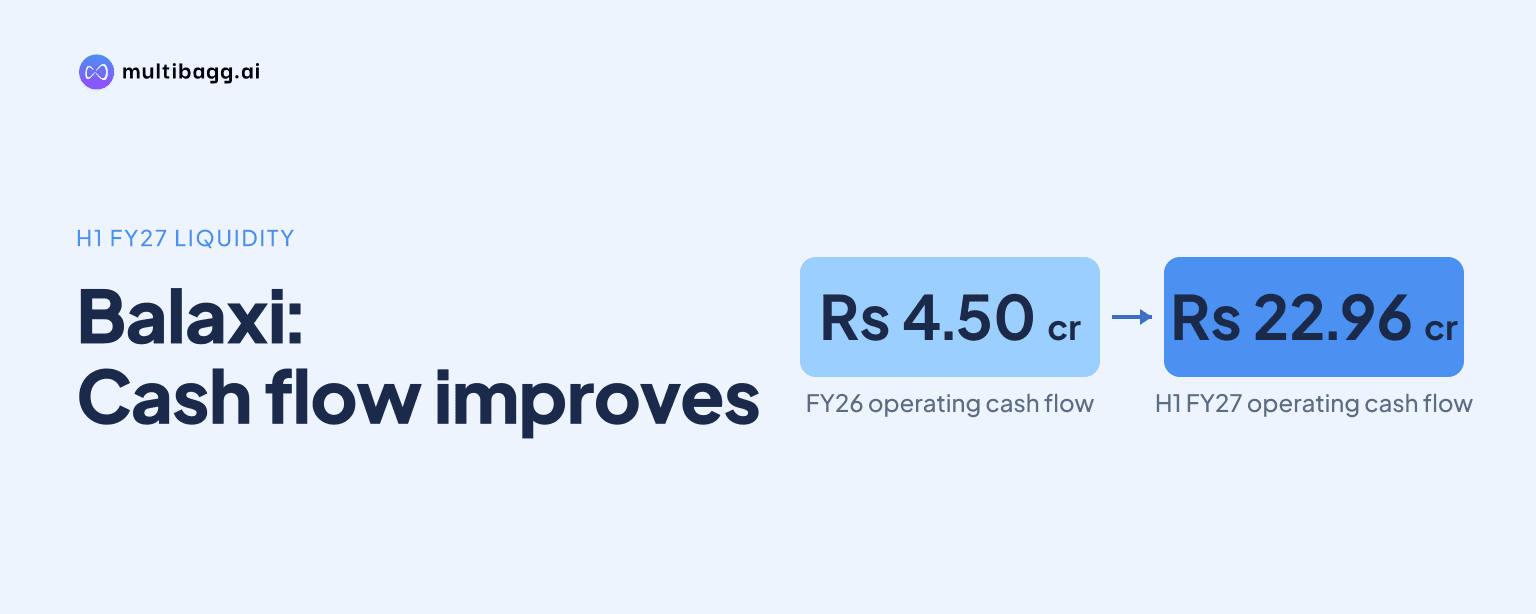
Balaxi Pharmaceuticals Limited reported Rs 22.9586 crore of net cash flow from operating activities in H1 FY27, reversing outflows of Rs 4.4998 crore in FY26 and Rs 35.0034 crore in FY25. Balaxi’s trade receivables declined to Rs 120.0679 crore from Rs 136.1018 crore at FY26, although inventories rose to Rs 92.5098 crore.
Know Balaxi Pharmaceuticals inside out
Results, valuation, peers and who's buying, in one view.
Did Balaxi’s operating cash flow improve in H1 FY27?
Yes. Balaxi reported Rs 22.9586 crore of net cash flow from operating activities in H1 FY27, against net operating cash outflows of Rs 4.4998 crore in FY26 and Rs 35.0034 crore in FY25. This is the only positive operating-cash figure among the three periods shown in the presentation, although H1 FY27 is a half-year period while FY25 and FY26 are full financial years.
The positive cash flow coincided with H1 FY27 revenue from operations of Rs 162.054 crore, which was 27.68% higher year on year, and profit after tax of Rs 2.4476 crore, up 390.40% year on year. The operating cash inflow was larger than reported profit after tax, but the presentation does not provide a reconciliation separating cash collections, inventory purchases, supplier payments, tax payments or other operating movements.
Balaxi’s FY25 comparison also shows that accounting profit and operating cash flow did not move together in every disclosed period. The company reported FY25 profit after tax of Rs 25.0702 crore alongside an operating cash outflow of Rs 35.0034 crore. In FY26, profit after tax fell to Rs 1.4169 crore and the operating cash outflow was Rs 4.4998 crore.
How did Balaxi’s receivables and inventory change?
Balaxi’s trade receivables fell by Rs 16.0339 crore from FY26 to Rs 120.0679 crore in H1 FY27. That lower receivables balance coincided with the reported operating cash inflow of Rs 22.9586 crore, but the presentation does not quantify how much of the cash-flow movement came from receivable collections.
Receivables remained above the Rs 110.7966 crore balance reported for FY25. The H1 FY27 result therefore represents an improvement from FY26 rather than a return to the lower FY25 balance. Revenue from operations was Rs 162.054 crore in H1 FY27, while annual revenue was Rs 270.1735 crore in FY26 and Rs 292.5612 crore in FY25.
Inventories moved in the opposite direction, rising by Rs 9.0299 crore from FY26 to Rs 92.5098 crore in H1 FY27. The inventory balance was also above Rs 83.4799 crore at FY26 and Rs 78.4811 crore at FY25. This means that the lower receivables balance did not result in a broad reduction across the company’s principal current operating assets.
Total current assets increased to Rs 254.3912 crore in H1 FY27 from Rs 251.4287 crore at FY26. Alongside the inventory increase, other current assets declined to Rs 13.9936 crore from Rs 16.8555 crore, while loans and advances increased to Rs 0.7663 crore from Rs 0.4327 crore. These changes provide balance-sheet context, but do not constitute an operating-cash-flow bridge.
What do Balaxi’s current liabilities indicate about working capital?
Balaxi’s trade payables rose by Rs 4.2175 crore to Rs 25.4252 crore in H1 FY27 from Rs 21.2077 crore at FY26. Current borrowings declined by Rs 5.3550 crore to Rs 28.0816 crore over the same comparison, while total current liabilities were broadly unchanged at Rs 61.9144 crore versus Rs 62.1575 crore.
The rise in trade payables occurred alongside the Rs 16.0339 crore reduction in receivables and the Rs 9.0299 crore increase in inventory. The presentation reports these balances at period end but does not identify whether the change in payables contributed to the Rs 22.9586 crore operating cash inflow, or distinguish the effects of trading activity from other operating items.
Balaxi’s current assets of Rs 254.3912 crore exceeded current liabilities of Rs 61.9144 crore at H1 FY27. Cash and cash equivalents accounted for Rs 27.0536 crore of current assets, compared with Rs 14.5588 crore at FY26. Trade receivables and inventories together amounted to Rs 212.5777 crore, showing their continued prominence in the disclosed current-asset base.
The company also reported total shareholders’ equity of Rs 254.1765 crore in H1 FY27, up from Rs 249.0763 crore at FY26. Long-term borrowings declined to Rs 21.5587 crore from Rs 22.3534 crore, while current borrowings fell to Rs 28.0816 crore from Rs 33.4365 crore. These balance-sheet changes occurred during the half in which financing activities used Rs 7.7088 crore of cash.
Got a follow-up? Ask IRIS
Do Balaxi’s cash-flow figures reconcile with its closing cash balance?
No. Balaxi’s cash-flow statement lists H1 FY27 net increase or decrease in cash and cash equivalents as negative Rs 24.8393 crore, while it reports opening cash and cash equivalents of Rs 14.5557 crore and closing cash and cash equivalents of Rs 27.0536 crore. The opening and closing figures instead indicate an increase of Rs 12.4979 crore.
The three H1 FY27 cash-flow categories shown by Balaxi also do not support the stated negative net-change line. Operating inflow of Rs 22.9586 crore, investing outflow of Rs 2.7552 crore and financing outflow of Rs 7.7088 crore total a positive Rs 12.4946 crore, subject to the displayed figures. The difference of Rs 0.0033 crore from the opening-to-closing cash movement may reflect presentation rounding, but it does not explain the stated negative Rs 24.8393 crore figure.
The closing cash balance of Rs 27.0536 crore in the cash-flow statement agrees with the balance-sheet cash and cash equivalents balance for H1 FY27. FY26 has a similar issue in the presentation: it reports opening cash of Rs 39.3951 crore, closing cash of Rs 14.5588 crore and net decrease of Rs 24.8393 crore, which are broadly aligned, but the same net-change figure appears in the H1 FY27 row.
This reported mismatch limits assessment of the statement’s internal linkage, rather than changing the separately disclosed Rs 22.9586 crore operating cash inflow. Balaxi does not explain the discrepancy in the presentation. Any subsequent financial disclosure that restates or clarifies the H1 FY27 net cash movement would provide needed context for the reported closing cash balance.
How did H1 FY27 earnings compare with earlier periods?
Balaxi reported H1 FY27 earnings before interest, tax, depreciation and amortisation of Rs 7.9626 crore, up 55.35% year on year, on revenue of Rs 162.054 crore. Its earnings before interest, tax, depreciation and amortisation margin was 4.97%, an increase of 93 basis points from the prior-year half. A basis point is one-hundredth of a percentage point.
The H1 FY27 margin was above FY26’s 4.16% but below FY25’s 11.60%. Annual earnings before interest, tax, depreciation and amortisation fell to Rs 11.3494 crore in FY26 from Rs 33.4988 crore in FY25, while revenue declined to Rs 270.1735 crore from Rs 292.5612 crore. The H1 FY27 year-on-year earnings increase therefore follows a lower FY26 base.
Profit after tax was Rs 2.4476 crore in H1 FY27, compared with Rs 1.4169 crore in FY26 and Rs 25.0702 crore in FY25. The presentation notes that Balaxi is in the process of exiting non-core business activities, but it gives no timetable, financial target or quantified effect on revenue, margins or cash flow.
Conclusion
Balaxi’s H1 FY27 disclosure shows a return to positive operating cash flow of Rs 22.9586 crore after outflows in FY25 and FY26. Lower trade receivables, improved year-on-year revenue and higher earnings were reported in the same half, but inventory increased and receivables remained above their FY25 level, leaving working-capital commitments material.
The next disclosures should show whether positive operating cash flow continues through FY27 as inventories, receivables and trade payables change. Readers should also watch for Balaxi’s clarification of the H1 FY27 net cash-change line and for further detail on its stated plan to exit non-core business activities.