










Balaxi H1 FY27 revenue rises 26% as PAT reaches Rs 2.45 crore
Key highlights
- Balaxi's H1 FY27 revenue rose 26.44% year on year to Rs 160.23 crore.
- Balaxi's H1 FY27 EBITDA increased 55.35% to Rs 7.96 crore, lifting margin by 93 basis points to 4.97%.
- Balaxi's H1 FY27 PAT rose 390.40% to Rs 2.45 crore and PAT margin reached 1.53%.
- Balaxi's Jadcherla facility commenced in May 2026 and is scheduled for commercial-production ramp-up in FY27.
powered by IRIS
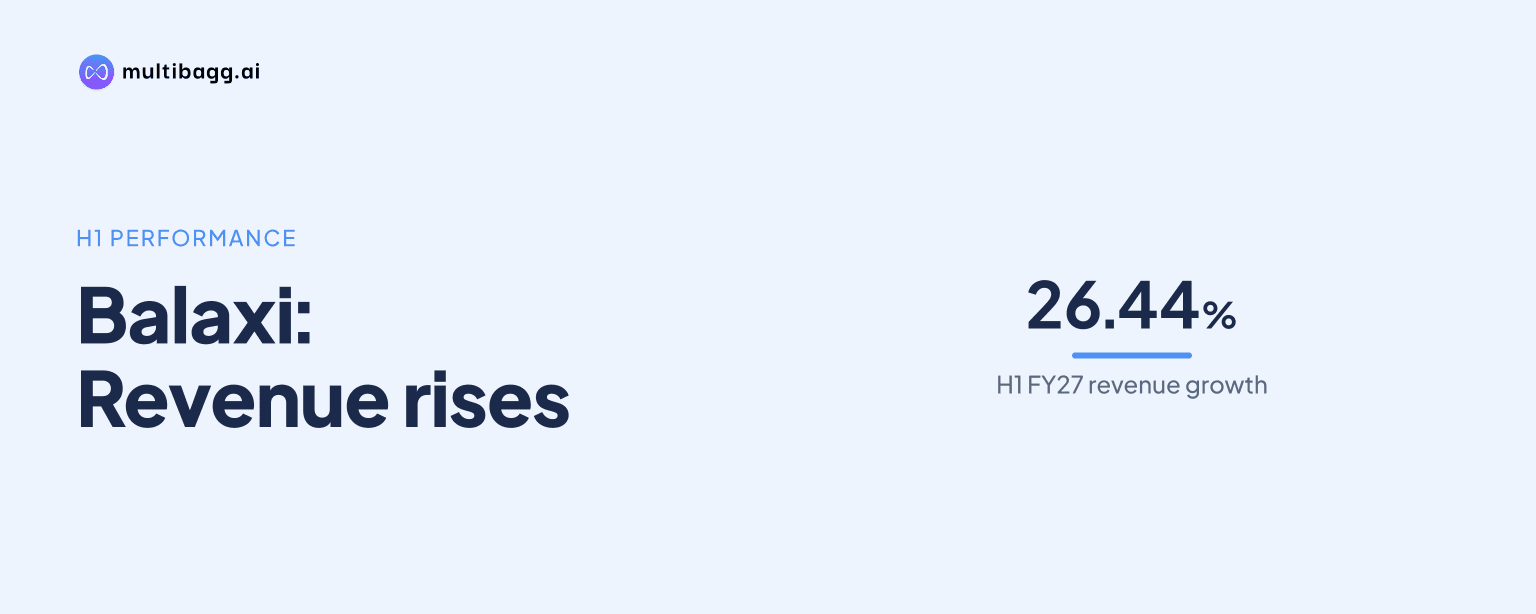
Balaxi reported H1 FY27 revenue of Rs 160.23 crore, up 26.44% year on year, while profit after tax (PAT) rose 390.40% to Rs 2.45 crore. Earnings before interest, tax, depreciation and amortisation (EBITDA) increased 55.35% to Rs 7.96 crore, and EBITDA margin improved 93 basis points to 4.97%.
Know Balaxi Pharmaceuticals inside out
Results, valuation, peers and who's buying, in one view.
How did Balaxi perform in H1 FY27?
Balaxi increased revenue, EBITDA and PAT in H1 FY27, with profit growth exceeding sales growth. Revenue rose to Rs 160.23 crore from Rs 126.73 crore in H1 FY26, while EBITDA rose to Rs 7.96 crore from Rs 5.13 crore. The EBITDA margin moved to 4.97% from 4.04%, and PAT margin increased to 1.53% from 0.39%.
The second quarter contributed Rs 80.54 crore of the H1 FY27 revenue and Rs 4.29 crore of EBITDA. Q2 FY27 revenue was 39.44% above Rs 57.76 crore in Q2 FY26, while EBITDA was 55.88% above Rs 2.75 crore. Q2 EBITDA margin was 5.33%, compared with 4.77% a year earlier, and PAT reached Rs 1.15 crore against Rs 20.9 lakh.
Diluted earnings per share (EPS) rose alongside the reported profit increase. H1 FY27 diluted EPS was Rs 0.44, compared with Rs 0.09 in H1 FY26, while Q2 FY27 diluted EPS was Rs 0.21 against Rs 0.04 in the prior-year quarter. The H1 PAT increase of 390.40% was marginally higher than the 388.89% increase in diluted EPS.
Why did Balaxi's PAT grow faster than revenue?
Balaxi's PAT grew faster than revenue because both EBITDA and PAT margins increased from H1 FY26. EBITDA grew 55.35%, compared with revenue growth of 26.44%, as the EBITDA margin expanded by 93 basis points. PAT grew 390.40% as PAT margin rose by 114 basis points, from 0.39% to 1.53%.
Management linked its H1 FY27 operating priorities to branded, intellectual-property-rights-driven products in Africa and Latin America (LATAM). Balaxi added 31 product registrations during the half and said it was working on operational efficiencies and cash conversion in Angola. The company also said the Jadcherla manufacturing facility was operational during H1 FY27.
The recovery follows FY26, which management described as a transition year rather than steady-state earnings. Management attributed the FY26 earnings dip to a longer institutional working-capital cycle in Angola, the hardware exit, and one-off commissioning and readiness costs at the Jadcherla facility. FY26 revenue was Rs 270 crore, below Rs 293 crore in FY25, while gross profit declined to Rs 119 crore from Rs 127 crore.
Is Balaxi's H1 FY27 EBITDA margin below its FY25 level?
The supplied presentation does not disclose Balaxi's FY25 EBITDA margin, so it cannot establish whether the H1 FY27 EBITDA margin of 4.97% remains below FY25. It does show that H1 FY27 margin was 93 basis points above H1 FY26's 4.04%, while Q2 FY27 margin was 5.33%, 56 basis points above Q2 FY26's 4.77%.
Gross margin is the only margin series provided for FY22 through FY26, and it is different from EBITDA margin because it excludes operating costs beyond the cost of goods. Balaxi's gross margin was 43.4% in FY25 and 44.2% in FY26, an increase of 80 basis points. The FY26 gross margin was also above FY22's 30.0%, FY23's 39.8% and FY24's 46.7% was the highest disclosed level.
The FY25-to-FY26 comparison shows why gross margin cannot substitute for the missing EBITDA-margin figure. Revenue fell by Rs 23 crore from Rs 293 crore in FY25 to Rs 270 crore in FY26, and gross profit fell by Rs 8 crore from Rs 127 crore to Rs 119 crore. Yet gross margin rose because the revenue decline exceeded the fall in gross profit; Balaxi reported FY26 EBITDA of Rs 11.4 crore but no FY25 EBITDA amount.
Got a follow-up? Ask IRIS
What could change Balaxi's earnings in FY27 and FY28?
Balaxi identifies in-house production, Angola cash conversion, a higher branded-product share and the hardware exit as earnings levers for FY27 and FY28. The Jadcherla formulation facility commenced in May 2026, and commercial-production ramp-up is scheduled for FY27. Management says in-house manufacturing can capture costs currently paid to contract manufacturers, but it has not quantified the resulting margin benefit.
The Jadcherla facility has installed annual capacity of more than 1 billion tablets and capsules, based on 25 operating days a month and three shifts each day. It has capacity of 12 lakh tablets or capsules daily per shift and produces oral solid dosage forms, including tablets and capsules. Balaxi has initiated the World Health Organization Good Manufacturing Practices certification process for FY27, which management says could open regulated-market and institutional tenders.
Angola remains Balaxi's largest geography, where management says working-capital normalisation is under way. LATAM revenue was Rs 111.29 crore in FY26, up 11% year on year across five markets. Management's stated geographic focus includes Guatemala, the Dominican Republic, Honduras, El Salvador and Nicaragua, where registrations are being secured.
Balaxi also reported 964 registrations, more than 200 products in its pipeline and 38 warehouses. Its stated branded share is 40%, and management identifies a higher branded share as a lever for better price realisation. Other Rest of World market expansion is under evaluation, while the FY27 plan remains centred on distribution expansion, manufacturing utilisation and pharmaceutical demand in frontier and semi-regulated markets.
Conclusion
Balaxi's H1 FY27 result shows a year-on-year recovery in both sales and reported profitability: revenue rose 26.44% to Rs 160.23 crore, EBITDA rose 55.35% to Rs 7.96 crore and PAT rose 390.40% to Rs 2.45 crore. The 4.97% H1 EBITDA margin was above H1 FY26's 4.04%, but the presentation does not provide the FY25 EBITDA margin needed to assess the stated longer-term margin comparison.
The next disclosed markers are the FY27 commercial ramp-up at Jadcherla, the timing of its World Health Organization Good Manufacturing Practices certification process, Angola working-capital normalisation and the contribution from LATAM markets. Management presents these FY27 and FY28 actions as mechanisms for margin capture, cash conversion and growth, without disclosing a numerical EBITDA-margin target.