










Balaxi ramps Jadcherla in FY27 with 1 billion-unit capacity
Key highlights
- Balaxi’s Jadcherla facility has installed annual capacity of more than 1 billion tablets and capsules.
- Jadcherla is designed to produce 12 lakh tablets and capsules a day per shift under a three-shift schedule.
- Balaxi reported H1 FY27 revenue of Rs 160.2335 crore, up 26.44% year on year.
- WHO-GMP certification for Jadcherla is an FY27 process, according to Balaxi.
powered by IRIS
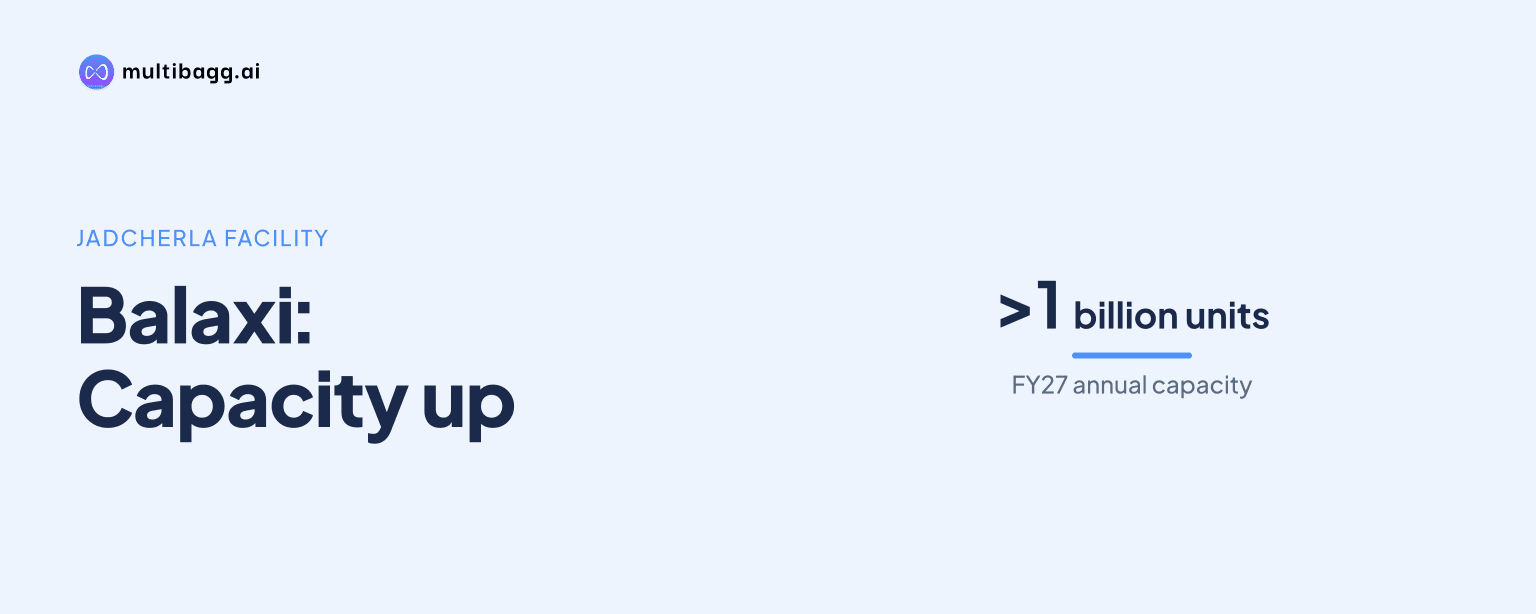
Balaxi is ramping commercial production at its Jadcherla formulation facility in FY27, with installed annual capacity exceeding 1 billion tablets and capsules based on 25 operating days a month and three shifts a day. The plant commenced in May 2026 and is intended to move more formulation production in house.
Know Balaxi Pharmaceuticals inside out
Results, valuation, peers and who's buying, in one view.
What capacity is Balaxi ramping up at Jadcherla?
Balaxi is ramping capacity of 12 lakh tablets and capsules a day per shift at Jadcherla, which equates to installed annual capacity of more than 1 billion units under its stated three-shift operating assumption. Actual output during FY27 will depend on the extent to which the plant operates those shifts, as the presentation does not disclose utilisation or production volumes.
The facility is in the Pharma Special Economic Zone at Jadcherla, Mahabubnagar, Telangana, on 13,855 square metres of land with 3,373 square metres of built-up area. It is configured for oral solid dosage forms, namely tablets and capsules, rather than every product type within Balaxi’s 289-product offering basket.
Balaxi has installed 10 kilogram and 150 kilogram wet-and-dry granulation lines, two double-rotary 37-station compression machines, two blister lines and one strip line. The blister lines support polyvinyl chloride and aluminium, or aluminium and aluminium, packaging formats for the plant’s oral-solid output.
How does Jadcherla change Balaxi’s supply model?
Balaxi says Jadcherla shifts its supply model toward in-house formulation production, with margin capture, reduced contract-manufacturer dependence and faster launches identified as expected outcomes. The company calls this an asset-right transition after building registrations, warehousing and distribution across seven countries in its asset-light phase from 2003 to 2024.
The facility was commissioned and commenced during FY25-FY26, while commercial ramp-up is scheduled for FY27. Balaxi described FY26 as a transition year because of Jadcherla commissioning and readiness costs, a longer Angola institutional working-capital cycle and the exit from its hardware business.
Jadcherla adds captive production to a supply base that includes World Health Organization Good Manufacturing Practice, or WHO-GMP, partners in India, WHO-GMP manufacturers in China and a sourcing partner in Portugal. Balaxi also reported 38 warehouses and more than 500 on-ground professionals across six operating markets.
Existing demand in Angola and Latin America is the stated initial outlet for plant output. Latin America generated Rs 111.29 crore of FY26 revenue, up 11% year on year, across Guatemala, the Dominican Republic, Honduras, El Salvador and Nicaragua; Balaxi identifies Angola as its largest geography.
What quality systems and approvals are planned for Jadcherla?
Balaxi designed Jadcherla to WHO-GMP, Central Drugs Standard Control Organisation and Pharmaceutical Inspection Co-operation Scheme norms, and says the WHO-GMP certification process was initiated in FY27. Management presents certification as a route to regulated-market filings and institutional procurement credentials, not as an approval already granted.
The quality-control laboratory has high-performance liquid chromatography, Fourier-transform infrared spectroscopy, ultraviolet testing, dissolution, microbiology and stability capabilities. These systems support testing of tablets and capsules made at the oral-solid-dose facility.
Balaxi’s FY27 roadmap places commercial production and WHO-GMP certification in H1 FY27, while the capacity slide describes certification as a process initiated in FY27. The presentation does not disclose a completed certification date, plant-specific sales or the quantity of Jadcherla output sold.
WHO-GMP is also relevant to Balaxi’s tender and institutional-business plans. The company says certification can open regulated-market and institutional tenders, while its ongoing strategy includes raising the branded share of its portfolio from 40%.
Got a follow-up? Ask IRIS
What do Balaxi’s FY27 results show during the ramp-up?
Balaxi reported H1 FY27 revenue of Rs 160.2335 crore, up 26.44% from Rs 126.7258 crore in H1 FY26, while earnings before interest, tax, depreciation and amortisation, or EBITDA, rose 55.35% to Rs 7.9626 crore. EBITDA margin increased by 93 basis points to 4.97% while management said the Jadcherla facility was operational.
In Q2 FY27, revenue was Rs 80.5438 crore, up 39.44% from Rs 57.7603 crore in Q2 FY26, and EBITDA was Rs 4.2923 crore against Rs 2.7536 crore. The EBITDA margin rose to 5.33% from 4.77%, while profit after tax increased to Rs 1.1502 crore from Rs 20.9 lakh.
H1 FY27 profit after tax was Rs 2.4476 crore, compared with Rs 49.91 lakh a year earlier, and diluted earnings per share increased to Rs 0.44 from Rs 0.09. The presentation does not quantify how much of the H1 improvement came from Jadcherla rather than market sales, registrations, product mix or other factors.
At the annual level, FY26 revenue declined to Rs 270 crore from Rs 293 crore in FY25 and gross profit declined to Rs 119 crore from Rs 127 crore. Gross margin nevertheless rose 80 basis points to 44.2% from 43.4%, and remained 1,420 basis points above FY22’s 30.0%.
What should investors track as Balaxi scales Jadcherla?
Balaxi identifies the pace of Jadcherla ramp-up and the timing of WHO-GMP certification as FY27 matters to track. Its presentation does not provide a utilisation rate, production-volume target or plant-specific revenue target against which the more than 1 billion-unit installed capacity can be assessed.
Angola institutional-channel normalisation is another FY27 priority because management expects working-capital release, better cash flow and stronger EBITDA. Receivable turnover was 1.05 times in FY26, compared with 0.83 times in FY25, while management continued to identify Angola cash conversion as an operating focus.
Balaxi also plans Latin American expansion and new-market entry in FY27-FY28, and is evaluating expansion in another Rest of World market. The company reported 37 new registrations in H1 FY27 on its product-portfolio slide and more than 200 products filed or in the pipeline.
Conclusion
Balaxi’s FY27 Jadcherla ramp-up creates an in-house oral-solid manufacturing platform with installed capacity above 1 billion tablets and capsules a year. The change accompanies H1 FY27 revenue growth of 26.44% and a 93-basis-point increase in EBITDA margin, but the presentation does not isolate the facility’s contribution to those changes.
The disclosed next milestones are commercial-production progress and the WHO-GMP certification process in FY27, with the roadmap placing both in H1 FY27. Balaxi also identifies Angola working-capital normalisation, Latin American expansion and the planned FY27 hardware-business exit as factors that may affect use of the manufacturing platform.