










Balaxi reports ₹111.29 crore Latin American FY26 revenue
Key highlights
- Balaxi reported ₹111.29 crore of Latin American revenue in FY26, up 11% year on year.
- Balaxi's five Latin American focus markets are Guatemala, the Dominican Republic, Honduras, El Salvador and Nicaragua.
- Balaxi added 31 product registrations in H1 FY27 and reports 964 registrations across the business.
- Balaxi's Jadcherla facility commenced in May 2026 with installed annual capacity above 1 billion tablets and capsules.
powered by IRIS
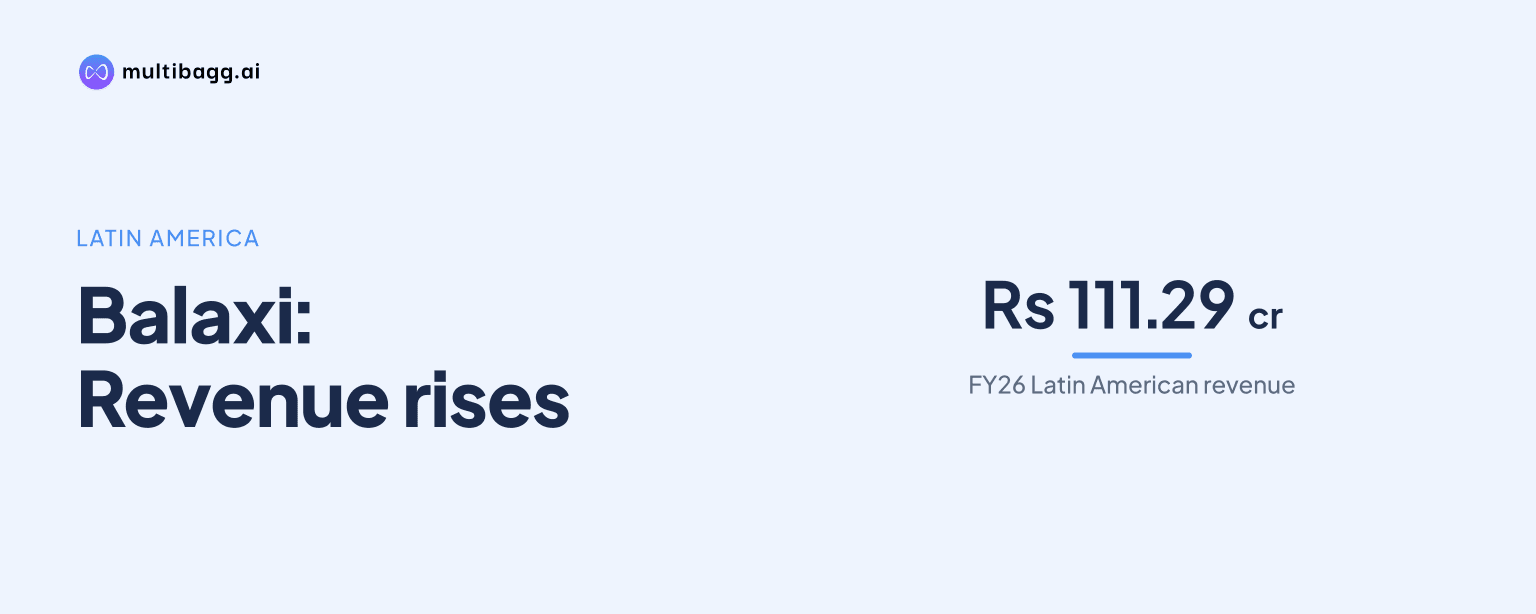
Balaxi reported ₹111.29 crore of Latin American revenue in financial year 2026 (FY26), up 11% year on year across five markets. Guatemala and the Dominican Republic are established operations, while Honduras and El Salvador are in growth stages and Nicaragua remains at the product-registration stage.
Know Balaxi Pharmaceuticals inside out
Results, valuation, peers and who's buying, in one view.
How large is Balaxi's Latin American business?
Balaxi's Latin American business generated ₹111.29 crore in FY26, with the presentation reporting 11% year-on-year growth across five markets. The company calls the region a diversified growth engine, but it does not disclose the revenue, profit, receivables or market share of Guatemala, the Dominican Republic, Honduras, El Salvador or Nicaragua individually.
The FY26 regional result should not be directly compared with Balaxi's latest consolidated half-year revenue because the reporting periods differ. Consolidated revenue rose 26.44% to ₹160.2335 crore in the first half of financial year 2027 (H1 FY27), from ₹126.7258 crore in H1 FY26, while second-quarter revenue increased 39.44% to ₹80.5438 crore from ₹57.7603 crore.
Balaxi's H1 FY27 earnings growth exceeded the disclosed 11% growth in FY26 Latin American revenue, although the presentation does not identify the geographical or product contributors to that difference. Earnings before interest, tax, depreciation and amortisation (EBITDA) increased 55.35% to ₹7.9626 crore in H1 FY27, while profit after tax rose 390.40% to ₹2.4476 crore.
Which Latin American markets is Balaxi prioritising?
Balaxi prioritises Guatemala, the Dominican Republic, Honduras, El Salvador and Nicaragua, with each market assigned an established, growth or nascent stage. Guatemala is described as a key Latin American contributor, and the presentation cites 4.3% gross domestic product growth in Guatemala during 2025. The Dominican Republic is also established, where generic-drug approvals were streamlined in 2025.
Balaxi identifies Honduras as scaling since FY24, placing it further along commercially than Nicaragua, where registrations are still being secured. El Salvador is classified as a growth market because of branded-generics demand, but Balaxi gives no sales value or product count for that country. This means the disclosed stages describe commercial development rather than a measurable ranking of country revenue.
Balaxi added 31 product registrations in H1 FY27, according to management, expanding the regulatory base available for its geographic plans. The presentation reports 964 registrations and more than 200 products in the pipeline across the business, alongside 38 warehouses, but it does not allocate those registrations, pipeline products or warehouses among the five Latin American markets.
Got a follow-up? Ask IRIS
What supports Balaxi's Latin American expansion?
Balaxi's presentation points to market size, import dependence and affordability as the principal demand factors in Latin America. It estimates the regional pharmaceutical market at US$98 billion in 2025 and US$172 billion in 2034E, where E means estimate, equivalent to an indicated compound annual growth rate of about 6.5% through 2034.
Latin America imports about five times more pharmaceutical products than it exports, according to the presentation, which identifies local stockholding and product registrations as important for suppliers. It also says India's pharmaceutical exports to Latin America grew 10% in FY26, compared with 13% growth in Africa. Those regional export-growth figures describe the broader market rather than Balaxi's own sales growth.
The presentation says 30% to 50% of Latin American healthcare spending is paid out of pocket, compared with 13% in high-income countries. Balaxi links that spending pattern to demand for affordable branded generics. Its branded products accounted for 40% of product mix, and management identifies increasing that proportion as an earnings lever for FY27 and FY28.
Balaxi reported a 44.2% gross margin, 1,420 basis points above the FY22 level, as part of its stated product-economics case. The presentation does not report a Latin America-specific gross margin, so it cannot establish whether the five-market business has the same margin profile as the consolidated company or whether the 40% branded share is region-specific.
How could manufacturing affect Balaxi's Latin American business?
Balaxi's Jadcherla formulation facility commenced in May 2026 and is the main disclosed operating lever for supplying Latin American demand. The Telangana facility has installed annual capacity of more than 1 billion tablets and capsules, based on 25 operating days each month and three shifts a day, and a stated daily capacity of 12 lakh tablets or capsules per shift.
Management says existing demand in Angola and Latin America can absorb output from the facility from day one. The presentation says in-house production is intended to capture margin previously paid to contract manufacturers, improve supply-chain efficiency and speed product launches. It does not disclose the volume that will be supplied to Latin America, the facility's utilisation level or a quantified cost saving.
Balaxi plans commercial-production ramp-up during FY27 and has initiated the process for World Health Organization Good Manufacturing Practices (WHO-GMP) certification, also targeted in FY27. Management says WHO-GMP certification could open regulated-market and institutional tenders, but the presentation does not specify a certification date, tender pipeline or Latin American markets that may be affected.
The company also identifies Angola working-capital normalisation, a higher branded-product share and a hardware-business exit as earnings levers for FY27 and FY28. These measures could affect consolidated cash conversion and margins, but Balaxi provides no separate Latin American receivable cycle or working-capital figure. Other Rest of World market expansion remains under evaluation rather than a disclosed entry plan.
Conclusion
Balaxi's ₹111.29 crore FY26 Latin American revenue, up 11% year on year, provides a reported regional base across two established markets, two growth markets and one nascent market. Guatemala and the Dominican Republic provide the established presence, while Honduras has scaled since FY24 and Nicaragua requires further product registrations before broader commercial development.
The next disclosed milestones are the FY27 commercial ramp-up of the Jadcherla facility and the targeted FY27 WHO-GMP certification process. Investors can also track additional registrations after the 31 added in H1 FY27, changes in the 40% branded-product share, Latin American revenue contribution, and progress in Angola's receivable cycle and working-capital normalisation.