










Balaxi links 289 products, 1,001 registrations and 38 warehouses
Key highlights
- Balaxi reported 289 products across 28 therapy categories in H1 FY27.
- Balaxi had 1,001 country registrations and added 37 during H1 FY27.
- Balaxi operates 38 warehouses across six markets with more than 500 on-ground professionals.
- Angola represented 52% of H1 FY27 revenue mix, while Latin America represented 48%.
powered by IRIS
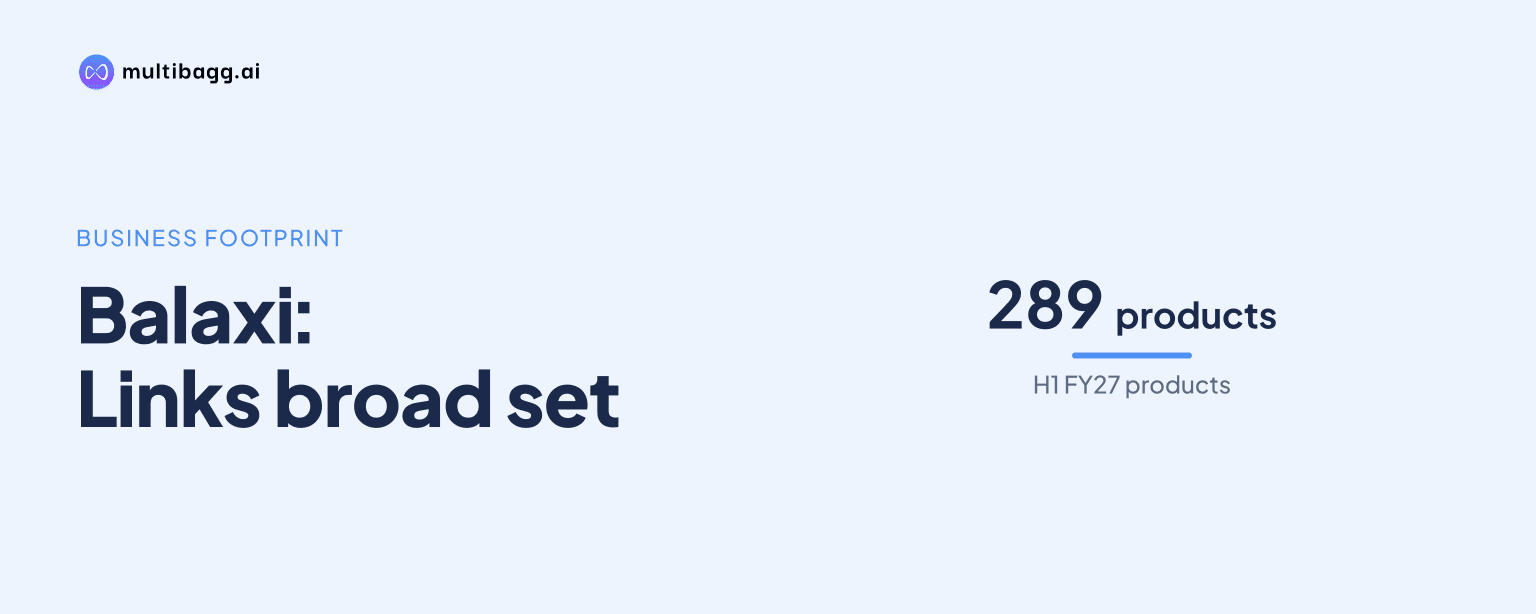
Balaxi Pharmaceuticals Limited had a 289-product offering basket, 1,001 country registrations and 38 warehouses in H1 FY27, linking product approvals with local inventory and delivery across six operating markets. The company added 37 registrations during H1 FY27 and reported more than 200 products filed or in the pipeline.
Know Balaxi Pharmaceuticals inside out
Results, valuation, peers and who's buying, in one view.
How does Balaxi move medicines from dossier to pharmacy shelf?
Balaxi moves medicines through a chain that begins with mapping therapeutic gaps and ends with local sales channels, supported by 38 warehouses and its own delivery fleet. The model covers market research, product selection, registration, manufacturing or sourcing, stockholding, distribution, branding and channel access through pharmacists, healthcare professionals, wholesalers, government tenders and hospitals.
Balaxi selects essential medicines, over-the-counter products, generics and branded generics for this chain. Its supply base includes its Jadcherla formulation facility in Telangana, World Health Organization Good Manufacturing Practices, or WHO-GMP, partners in India and China, and a European sourcing partner in Portugal.
The operating model was built over more than two decades rather than through exports alone. Balaxi supplied white-labelled medicines to Africa in 2003-07, opened its first pharmaceutical wholesale depot in Angola in 2008-10, diversified sourcing to WHO-GMP plants in China in 2011-13, and added a Guatemala warehouse in 2017-19.
During 2020-26, Balaxi added Honduras, El Salvador and Nicaragua and commenced its Jadcherla formulation facility. These additions expanded the company from its initial African activity into Latin America while adding an in-house manufacturing element to the registration, warehousing and distribution model.
How large are Balaxi's product portfolio and registration base?
Balaxi's offering basket contains 289 products across 28 therapy categories, supported by 1,001 country registrations in H1 FY27. It added 37 registrations in the half year and reported more than 200 products filed or in the pipeline, while the presentation says each approval can take 12 to 24 months.
Antibiotics are the largest category by product count, with 75 products, followed by analgesics with 57, medical devices with 32, vitamins with 26 and anti-malarials with 16. Antibiotics and analgesics together account for 46% of the portfolio, while the next five listed categories, including erectile dysfunction with eight products and hypertension with seven, have smaller product counts.
Balaxi reports 51 products across 18 further categories, including hygiene, anti-ulcer, anti-tuberculosis, anti-diarrhoeal and insect-repellent products. This means the 132 products in antibiotics and analgesics exceed the combined 51 products in the 18 additional categories listed separately by the company.
The registration base is central to introducing products in individual markets because approvals are in-country rather than a single group-wide clearance. Management describes the 37 H1 FY27 additions and the 200-plus filed or pipeline products as part of a registration base developed over about 20 years.
Where does Balaxi operate its distribution network?
Balaxi operates in six markets across Africa and Latin America, with 38 warehouses, more than 500 on-ground professionals and more than 80 expatriate managers. Angola is its African market and largest geography, while Guatemala, the Dominican Republic, Nicaragua, El Salvador and Honduras make up its Latin American operations.
The company classifies Guatemala and the Dominican Republic as established markets, El Salvador and Honduras as growth markets, and Nicaragua as nascent. Honduras has operated since FY24 and is scaling, while Nicaragua is securing registrations, showing that commercial development differs across the five Latin American markets.
Angola has wholesale depots and a central distribution warehouse, reflecting Balaxi's presence there since 2008-10. The company says it is optimising Angola's institutional and hospital channels for cash conversion, whereas the Dominican Republic is described as having a central warehouse and being a key Latin American contributor.
The six-market disclosure differs from the company roadmap's description of Phase 1 as building a presence across seven countries during 2003-2024. The presentation does not explain the difference between the historical seven-country reference and the six operating markets reported for H1 FY27.
Got a follow-up? Ask IRIS
Which products and geographies drive Balaxi's revenue mix?
Angola accounted for 52% of Balaxi's H1 FY27 revenue mix and Latin America accounted for 48%, leaving a four-percentage-point difference between the two geographies. The mix places Angola slightly ahead despite Balaxi operating in five Latin American markets and one African market.
Generics represented 60% of H1 FY27 product mix, compared with 40% for branded generics. By therapy, antibiotics generated 41% of revenue, followed by other therapies at 37%, analgesics at 16% and anti-malarials at 6%, making antibiotics the largest revenue category as well as the largest category by product count.
Latin America generated Rs 111.29 crore of revenue in FY26, up 11% year on year. That annual figure cannot be directly compared with the H1 FY27 geographic revenue share because the presentation gives a percentage for the half year rather than a monetary revenue amount for that period.
Balaxi reported a 44.2% gross margin in FY26, compared with 43.4% in FY25 and 30.0% in FY22. The FY26 margin was 0.8 percentage point above FY25 and 14.2 percentage points above FY22; management links the 40% branded-generics share to pricing power in its presentation.
What is Balaxi changing in its operating model?
Balaxi commenced its Jadcherla formulation facility in May 2026, adding oral solid dosage manufacturing for tablets and capsules to its operating model. The site has 10-kilogram and 150-kilogram wet and dry granulation lines, two double-rotary 37-station compression machines, two blister lines and one strip line.
The facility's design standards include WHO-GMP, the Central Drugs Standard Control Organisation and Pharmaceutical Inspection Co-operation Scheme norms. Management says the facility is intended to strengthen supply control, cost efficiency and launch agility, while Balaxi continues to use WHO-GMP supply partners in India and China.
Balaxi describes FY25-FY26 as an asset-right transition after commissioning Jadcherla and initiating a non-core hardware exit. Its FY27 onward plan is an integrated-scale phase involving in-house production, WHO-GMP activity, Latin American scale-up and new markets.
Management's FY27 roadmap lists Jadcherla commercial production and WHO-GMP certification in H1 FY27, Angola institutional-channel normalisation in H1-H2 FY27, and completion of the hardware-business exit in FY27. It also identifies Latin American expansion, other frontier-market activity and new-market entry planning for FY27-FY28.
Conclusion
Balaxi's model combines country-specific registrations, a 289-product portfolio, local warehouses and on-ground distribution rather than relying only on medicine exports. The H1 FY27 figures show a business with 1,001 registrations, 38 warehouses and revenue split 52% from Angola and 48% from Latin America, while generics accounted for 60% of product mix.
The next disclosed items to watch are management's H1 FY27 targets for Jadcherla commercial production and WHO-GMP certification, its H1-H2 FY27 work to normalise Angola's institutional channel, and the planned FY27 hardware exit. The presentation also leaves unresolved the difference between six operating markets in H1 FY27 and the historical reference to seven countries during Phase 1.