










Bank of Baroda Says NSE Gain Lifted Quarterly Profit
Key highlights
- Bank reported Q2 FY 2027 operating profit of Rs 11,430 crore, up 50.9% year on year.
- Management said operating profit excluding NSE-related effects was Rs 7,749 crore.
- The NSE sale and valuation effect was roughly Rs 3,600 crore, including Rs 1,349 crore of cash profit.
- GNPA was 1.78% and net NPA was 0.37% as of September 2026.
powered by IRIS
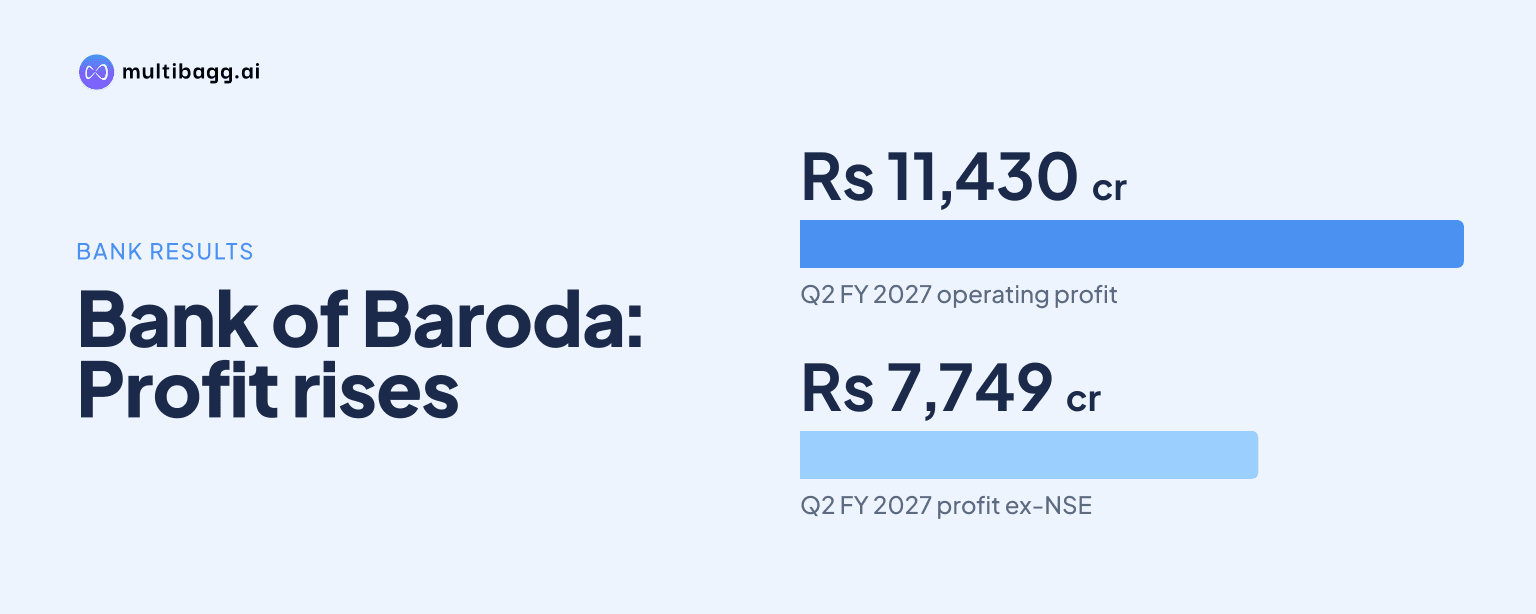
Bank of Baroda reported record operating profit of Rs 11,430 crore in Q2 FY 2027, but management said Rs 7,749 crore remained after excluding the National Stock Exchange, or NSE, sale and valuation effect. The reported result also included Rs 1,600 crore of prudential and contingency provisions, according to management.
Know Bank of Baroda inside out
Results, valuation, peers and who's buying, in one view.
How much did the NSE transaction add to Bank's quarterly profit?
The NSE transaction added roughly Rs 3,600 crore to Bank's Q2 FY 2027 profitability, according to management. This included Rs 1,349 crore of cash profit from the NSE sale and a valuation gain; management identified operating profit excluding the entire NSE effect at Rs 7,749 crore.
Reported operating profit rose 50.9% year on year to Rs 11,430 crore, while net profit increased 35.8% to Rs 6,532 crore. The difference between reported and NSE-adjusted operating profit means the quarterly increase reflected both the Bank's banking operations and a transaction-related gain. Management said the post-tax benefit would have been lower because it used part of the gain to create provisions.
What supported Bank's underlying profitability in Q2 FY 2027?
Bank's underlying profitability was supported by 9% year-on-year net interest income, or NII, growth and a 2.74% net interest margin, or NIM, in Q2 FY 2027. The 2.74% quarterly NIM was 2 basis points below the 2.76% reported for the half year ended 30 September 2026.
Yield on advances increased 4 basis points sequentially to 7.41%, while the cost of deposits was 4.71% in Q2, compared with 4.68% for the half year. Management said 38% of the loan book was linked to the repo rate and began earning higher interest income after the rate increase effective 5 October. It also said recent repricing of non-marginal-cost-of-funds-based-lending-rate corporate loans would be fully reflected in Q3.
Management retained NIM guidance of 2.75% to 2.95% and said it expected an upside in Q3 and Q4 based on interest rates and the asset-liability structure. That is management's outlook rather than a reported outcome. Management also said it expected return on assets to exceed 1% in each of Q3 and Q4, after Q2 return on assets of 1.26%.
Why did Bank raise provisions while asset-quality indicators improved?
Bank said the higher Q2 FY 2027 provisioning was prudential and not caused by deterioration in asset quality. Reported credit cost was 55 basis points, whereas management said it would have been 18 basis points without prudential provisioning.
Management said about Rs 1,300 crore of prudential provisioning was made on the non-performing asset, or NPA, side for potential future effects including expected credit loss, or ECL. It also made roughly Rs 300 crore of contingency provision under other provisions for possible movements in bond and equity valuations in the investment book. Bank said it held about Rs 2,500 crore of floating provisions.
Gross NPA, or GNPA, fell 38 basis points year on year to 1.78% as of September 2026, and net NPA declined 20 basis points to 0.37%. The Q2 FY 2027 slippage ratio was 0.69%, down 22 basis points year on year. Credit Information Companies, or CRILC, special-mention-account 1 and 2 balances were 0.06% of standard advances, compared with 0.39% in September 2025.
Got a follow-up? Ask IRIS
Can Bank meet its revised growth targets without FCNR(B)?
Bank raised FY 2027 credit-growth guidance to 13% to 15% from 12% to 14%, and deposit-growth guidance to 11% to 13% from 10% to 12%. Reported global advances grew 18.3% year on year and deposits grew 16.4%, figures that included foreign currency non-resident bank deposits, or FCNR(B).
Excluding FCNR(B) from both assets and liabilities, management said global business was Rs 31.20 lakh crore, growing 12.3% year on year, against reported global business of Rs 32.58 lakh crore, up 17.2%. On that same basis, deposits grew 11.2% and advances increased 13.5%. Those exclusion-based growth rates were closer to the Bank's earlier guidance ranges.
Management said it had raised nearly US$8.08 billion through FCNR(B) and had not used the liquidity to reduce other deposits. It described the funds as stored liquidity for the December and March busy seasons. For remaining FY 2027 growth, management cited expected incremental retail, agriculture and micro, small and medium enterprise lending of roughly Rs 60,000 crore and a corporate-loan pipeline of roughly Rs 60,000 crore.
What changed in Bank's funding and loan mix?
Bank's domestic credit-deposit ratio declined 323 basis points to 80.08% as of 30 September 2026, while its domestic current account savings account, or CASA, ratio was 36.37%. Management said CASA would have exceeded 38.36% excluding FCNR(B), which had increased term deposits.
International advances grew 39.7% year on year, compared with 13.5% for domestic advances and 6.3% for corporate loans. Organic retail advances rose 18.6%, agriculture loans increased 19.0%, and organic micro, small and medium enterprise loans rose 21.3%. Auto loans grew 27.8%, versus 14.6% for home loans and 6.8% for personal loans.
Management said its CASA plan centred on service delivery, product bundling and more service points. The Bank's total deposits grew 16.4% year on year, with domestic deposits up 16.6% and term deposits rising 20.5%. These trends explain why the CASA ratio changed even as domestic CASA deposits grew 10.4%.
Conclusion
Bank's Q2 FY 2027 result combined a record reported operating profit of Rs 11,430 crore with roughly Rs 3,600 crore of NSE-related sale and valuation effects. Management's Rs 7,749 crore operating-profit measure excluding that effect, alongside 9% NII growth and lower GNPA and net NPA ratios, separates its view of recurring banking performance from the one-off gain.
The next disclosed milestones are Q3 and Q4 FY 2027, when management expects the full benefit of corporate-loan repricing and return on assets above 1% in each quarter. Management has retained NIM guidance of 2.75% to 2.95%, targets credit growth of 13% to 15% and deposit growth of 11% to 13%, and expects credit cost below 0.6%.