










Bank of Baroda lifts FY27 credit target to 13-15% on momentum
Key highlights
- Bank raised FY27 credit-growth guidance by 1 percentage point to 13-15%.
- Bank raised FY27 deposit-growth guidance by 1 percentage point to 11-13%.
- Q2 FY27 global advances rose 18.3% year on year and global deposits grew 16.4%.
- Bank held about Rs 75,000 crore of FCNR(B)-related liquidity at September 2026.
powered by IRIS
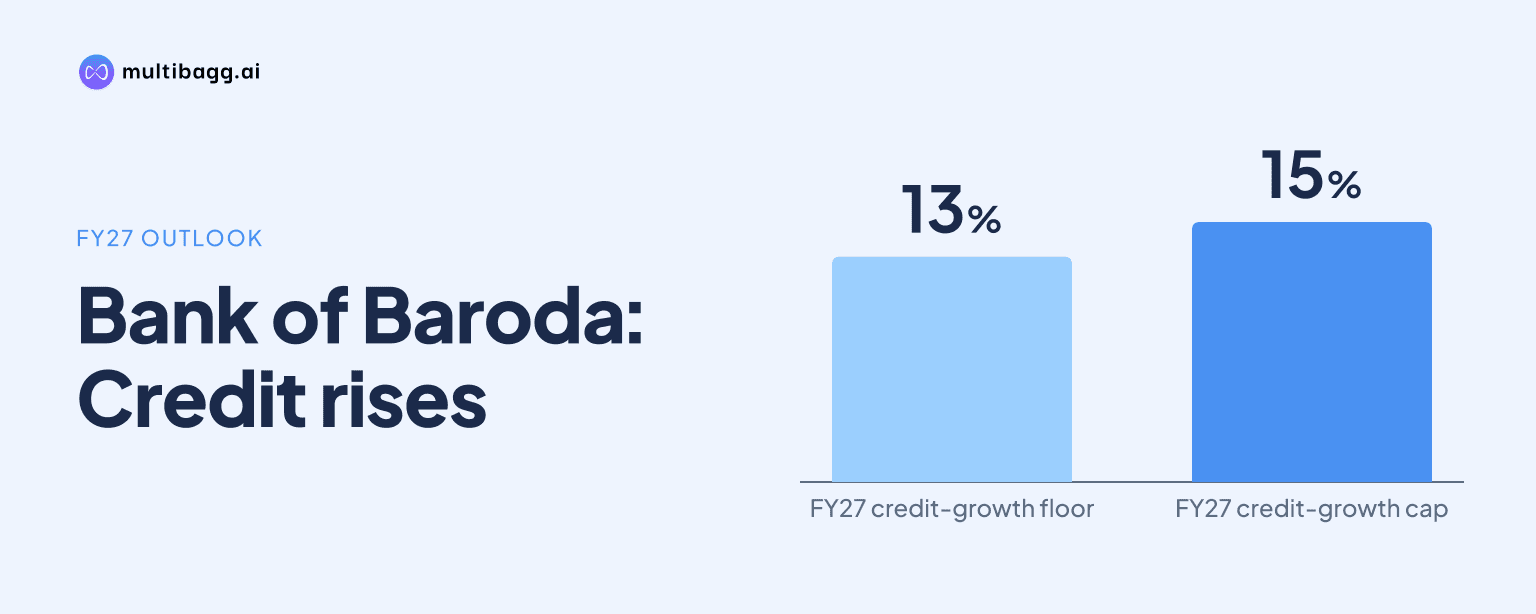
Bank of Baroda raised its FY27 credit-growth target to 13-15% after global advances rose 18.3% year on year in Q2 FY27, while its deposit target increased to 11-13% after deposits grew 16.4%. Management cited two strong first-half quarters, foreign-currency deposit liquidity and expected December-March seasonal demand.
Know Bank of Baroda inside out
Results, valuation, peers and who's buying, in one view.
Why did Bank raise its FY27 growth targets?
Bank raised its FY27 credit-growth guidance by 1 percentage point to 13-15% from 12-14%, and deposit-growth guidance to 11-13% from 10-12%. Management said the June and September 2026 quarters had delivered strong growth, including June, which it described as a historically slower period for the Bank.
The reported Q2 figures included a major Foreign Currency Non-Resident Bank, or FCNR(B), deposit mobilisation. Bank received USD 8.08 billion of FCNR(B) deposits, but management said global deposit growth excluding this programme was still 11.2%, while advances growth excluding its impact was 13.5%. Those adjusted rates were within the previous FY27 ranges of 10-12% for deposits and 12-14% for credit.
Management retained its net interest margin, or NIM, guidance of 2.75-2.95% while increasing the balance-sheet targets. Q2 FY27 NIM was 2.74%, compared with 2.76% for the first half, and management said it expected an upward bias in Q3 and Q4 rather than changing the annual range.
How did Bank's Q2 growth compare with FY27 guidance?
Bank's reported Q2 FY27 global advances growth of 18.3% and deposit growth of 16.4% exceeded both its former and revised full-year ranges. Global business reached Rs 32.58 lakh crore on September 30, 2026, an increase of 17.2% year on year, with advances expanding faster than deposits on the reported basis.
Domestic deposits increased 16.6% year on year in Q2 FY27, compared with 13.5% growth in domestic advances. Domestic current account and savings account, or CASA, deposits rose 10.4%, while term deposits grew 20.5%; the domestic credit-deposit ratio fell 323 basis points year on year to 80.08% at September-end.
International advances grew 39.7% year on year, compared with 13.5% domestic advances growth, while international deposits increased 14.9%. The international advance growth contributed to the 18.3% global figure, whereas the domestic deposit result was marginally above the 16.4% global deposit rate.
Which lending segments support Bank's higher credit target?
Bank expects the higher FY27 credit target to be supported by retail, agriculture, micro, small and medium enterprises, or MSME, and selected corporate lending. In Q2 FY27, its organic retail book grew 18.6% year on year, agricultural loans rose 19%, and organic MSME advances increased 21.3%.
Within retail, auto loans delivered the fastest cited growth at 27.8%, followed by mortgage loans at 20.3% and home loans at 14.6%. Education loans rose 9.9% and personal loans increased 6.8%, showing that the cited growth was spread across secured and unsecured retail categories.
Corporate loans grew 6.3% year on year in Q2 FY27, down from the 15.3% June-quarter growth cited by management. Management said core corporate lending rose about 12% and mid-corporate lending about 26%, while the fine-price asset book saw lower growth because the Bank did not want to contract loans where it could not pass on rates during the rate transition.
Bank said its corporate pipeline exceeded Rs 60,000 crore, covering loans to be processed and sanctioned loans awaiting disbursement. Management retained its expectation for corporate credit growth above 10% for FY27 and said demand in MSME lending remained supported by government guarantee initiatives.
Got a follow-up? Ask IRIS
How will Bank fund the higher lending target?
Bank said it had stored about Rs 75,000 crore of FCNR(B)-related liquidity after converting funds into rupees through swaps as of September 2026. Management plans to deploy this liquidity primarily in the December and March quarters, which it identified as the Bank's busy-season periods.
The liquidity may also replace a portion of higher-cost bulk deposits as those deposits reprice. Bank said bulk deposits had declined by about Rs 10,000 crore by September 2026, but management said outstanding deposits could not simply be reduced before maturity; it may instead decide not to renew some deposits at higher rates in the December quarter.
Management linked the revised growth outlook to this funding position as well as lending demand. It said stored liquidity had not been fully utilised and that the Bank was hopeful of achieving 13-15% credit growth and deposit growth of up to 13% over FY27, subject to the expected December and March trajectory.
What balance-sheet issues could affect Bank's FY27 delivery?
Bank reported gross non-performing assets, or gross NPAs, of 1.78% at September 2026, down 38 basis points year on year, and net NPAs of 0.37%, down 20 basis points. The Q2 FY27 slippage ratio was 0.69%, below its guidance range of 1-1.25%, while the capital-to-risk-weighted-assets ratio, or CRAR, stood at 16.61%.
Provisioning for expected credit loss, or ECL, migration remains a relevant variable. Bank made Rs 1,300 crore of prudential provisions for NPAs and bad debt in Q2 FY27, plus Rs 300 crore of contingency provision, creating a Rs 1,600 crore cushion. Management estimated the one-time ECL impact at about 125 basis points of CRAR, or roughly Rs 12,500 crore, and said its credit-cost guidance of less than 0.6% could absorb the recurring effect.
Conclusion
Bank's higher FY27 targets rest on growth that was above the earlier annual ranges in Q2, even after excluding the FCNR(B) programme. Retail, agriculture and MSME grew between 18.6% and 21.3%, while management also expects the corporate pipeline of more than Rs 60,000 crore to support lending in the second half.
The next focus is deployment of about Rs 75,000 crore of stored FCNR(B)-related liquidity in the December and March quarters, along with the Bank's ability to replace repricing bulk deposits. Management has also maintained NIM guidance of 2.75-2.95%, expects Q3 and Q4 return on assets above 1%, and aims to be near 1% for FY27 as a whole.