










Bank of India’s Rs 87,000 Crore Pipeline Led by Corporate Loans
Key highlights
- Bank of India reported a total credit pipeline of around Rs 86,000 crore to Rs 87,000 crore as of September 30.
- Corporate proposals accounted for about Rs 65,000 crore of the pipeline, while RAM advances contributed around Rs 20,000 crore.
- Renewable energy was the largest named corporate sector at more than Rs 12,000 crore, followed by power at more than Rs 9,000 crore.
- Bank of India’s centralised Mumbai supply-chain branch had built a book exceeding Rs 1,000 crore and is targeting about Rs 1,500 crore in its first year.
powered by IRIS
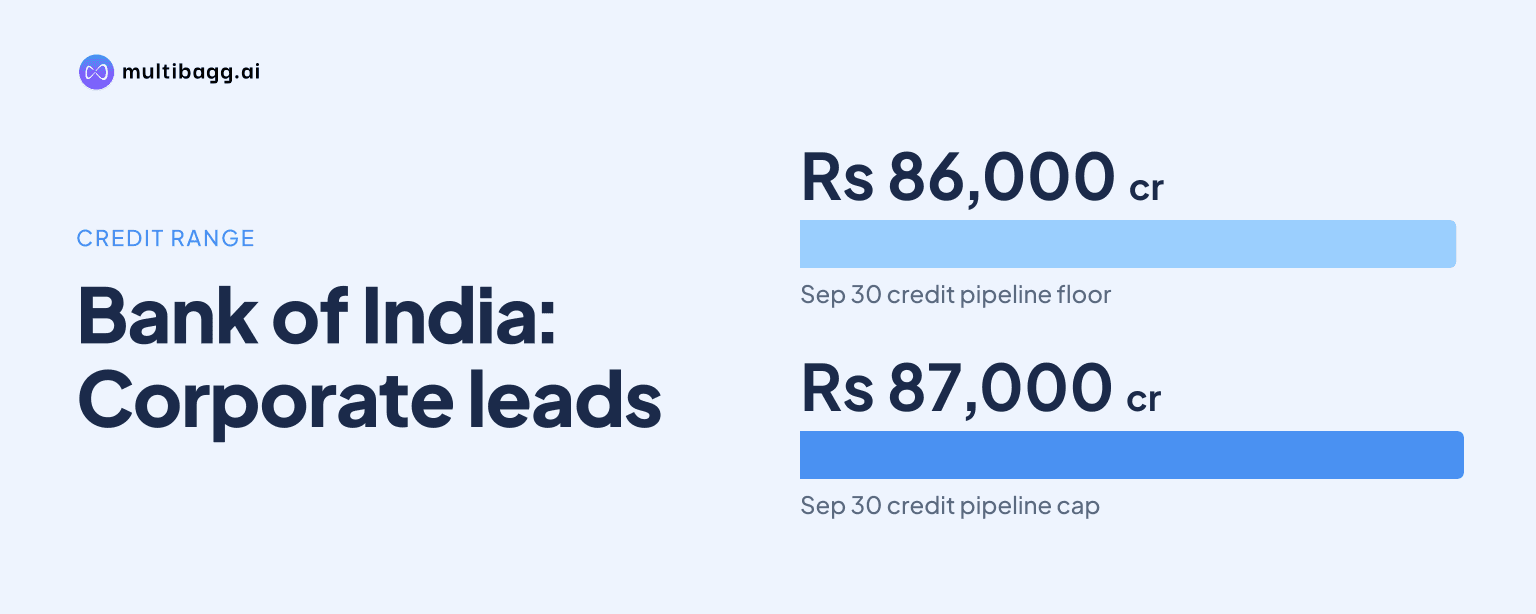
Bank of India reported a total credit pipeline of about Rs 86,000 crore to Rs 87,000 crore as of September 30, with Rs 65,000 crore in corporate proposals. Renewable energy accounted for more than Rs 12,000 crore, while a new centralised supply-chain branch had built a book exceeding Rs 1,000 crore.
Know Bank of India inside out
Results, valuation, peers and who's buying, in one view.
What is Bank of India's current credit pipeline?
Bank of India's stated total credit pipeline was about Rs 86,000 crore to Rs 87,000 crore as of September 30. Management described it as a secular pipeline spanning corporate credit, retail-agriculture-MSME advances, digital lending, pool and co-lending, and supply-chain finance, rather than depending on a single lending category.
Corporate lending was the largest disclosed component at about Rs 65,000 crore. Bank of India also cited a pipeline of about Rs 20,000 crore in RAM, meaning retail, agriculture and micro, small and medium enterprises; about Rs 4,000 crore in pool, co-lending and supply-chain platforms; and about Rs 3,000 crore through a digital platform. The individual rounded figures cited during the October 23 Q2 FY27 earnings call are not presented as a reconciliation to the Rs 86,000 crore to Rs 87,000 crore total.
The corporate pipeline covers transactions at differing stages rather than only immediately disbursable loans. For renewable energy, Bank of India said the more than Rs 12,000 crore amount included loans sanctioned but not disbursed, in-principle approvals, and proposals moving through stages for presentation to a committee. That distinction means the cited pipeline is a view of prospective business, not reported credit growth or disbursements.
Which corporate sectors lead Bank of India's pipeline?
Renewable energy leads Bank of India's disclosed corporate-sector pipeline, at more than Rs 12,000 crore. Power was the next-largest named sector at more than Rs 9,000 crore, followed by roads and oil and gas at more than Rs 5,000 crore each. These four sectors account for the largest named concentrations within the Rs 65,000 crore corporate pipeline.
Cement represented more than Rs 4,000 crore of prospective corporate business. Manufacturing, particularly textiles and other manufacturing activity, accounted for more than Rs 2,700 crore; construction accounted for Rs 2,100 crore; and automobiles accounted for more than Rs 2,000 crore. Bank of India did not disclose a sector-by-sector disbursement timetable or credit approval outcome for these pipelines during the call.
The sector disclosures show a move from a generic corporate-loan figure to identified project and industry channels. Renewable energy alone was more than twice the disclosed construction pipeline of Rs 2,100 crore, while roads and oil and gas were each above the more than Rs 4,000 crore cited for cement. The figures are rounded thresholds, so they cannot establish exact rankings beyond the amounts management provided.
Got a follow-up? Ask IRIS
How is Bank of India building supply-chain finance?
Bank of India has set up a centralised Mumbai branch, called SBB, to handle supply chain, pool lending, co-lending and trade-related business across the country. The unit had already built a supply-chain book of more than Rs 1,000 crore in FY27, according to management on October 23, and Bank of India said the initiative had started only in the current financial year.
The SBB has a dedicated team of around 20 to 25 officers and uses what management called a robust information-technology platform for supply-chain financing. Bank of India has instructed each of its 69 zones to onboard one new vendor every month for supply-chain finance. That operating target ties business sourcing to the centralised unit instead of leaving the activity solely with individual branches.
Management said Bank of India was confident that supply-chain financing through the branch would reach about Rs 1,500 crore in business by the end of the first year, after the branch stabilises. This is a management target, not a reported outcome. Reaching it would mean an increase of roughly Rs 500 crore from the more than Rs 1,000 crore book disclosed during the Q2 FY27 call.
Bank of India also reported almost 10% growth in the relevant business during the current quarter, with most assets booked in medium and small enterprises. An executive said medium enterprises were largely coming through trade-related and supply-chain channels. Management added that the number of users was growing and that the trade-related portfolio was expanding, but it did not provide a separate portfolio value.
What do the pipeline figures mean for Bank of India's funding and margins?
Bank of India said the pipeline supports its need to raise resources for credit growth, including through bulk deposits. Its current account and savings account, or CASA, ratio was 34.16% as of September 30, while CASA deposits had grown 7% year on year and by more than Rs 20,000 crore in absolute terms. Management said taking bulk deposits to fund growth had made the CASA percentage appear lower.
The funding mix cited by Bank of India consisted of around 34% CASA and around 43% retail term deposits, or 77% from its retail franchise, leaving 23% in bulk deposits. This composition provides context for the lending pipeline because management linked its deposit-raising activity directly to meeting corporate and RAM credit demand. It did not provide a planned conversion rate from the Rs 86,000 crore to Rs 87,000 crore pipeline into loans.
Global net interest margin, or NIM, declined by 5 basis points to 2.47% as of September 30 from 2.52%. Management attributed the full 5-basis-point effect to Rs 40,000 crore associated with raising $2.2 billion in foreign currency non-resident, or FCNR, deposits and placing an equivalent $2.2 billion on the asset side of the international book.
Management estimated that the Reserve Bank of India's 25-basis-point repo-rate increase could improve Bank of India's NIM by around 6 to 7 basis points. Bank of India said 66% of domestic advances were linked to the external benchmark, specifically the repo rate, and it passed through the increase on the day of the Reserve Bank of India's decision. Deposit repricing is expected to be staggered because nearly 60% of term deposits have maturities of one year to 18 months.
Conclusion
Bank of India's Rs 86,000 crore to Rs 87,000 crore credit pipeline combines a Rs 65,000 crore corporate opportunity with Rs 20,000 crore in RAM lending and smaller digital, co-lending and supply-chain channels. Renewable energy and power are the largest named corporate sectors, while the supply-chain initiative provides a separate route to medium and small enterprise lending.
The next measures to watch are whether corporate proposals move from sanction, in-principle approval and committee stages into disbursements, and whether the Mumbai SBB reaches management's first-year target of about Rs 1,500 crore. Bank of India's funding mix, including the 34.16% CASA ratio, and management's expected 6-to-7-basis-point NIM benefit from repo-linked loans will also shape how it funds pipeline conversion.