










Bank of India plans Q3 ECL provisions, sees 0.5% CRAR impact
Key highlights
- Bank of India expects to begin ECL provisioning in Q3 FY27 after Board approval and plans to front-load provisions in Q3 FY27 and Q4 FY27.
- Management estimated that ECL provisioning could reduce CRAR by about 0.5% annually over four years, without disclosing a total rupee provision requirement.
- Fresh loan slippages fell to about Rs 1,100 crore in Q2 FY27 from Rs 1,800 crore in Q1 FY27, with Q2 provisions linked to IRAC rules rather than ECL.
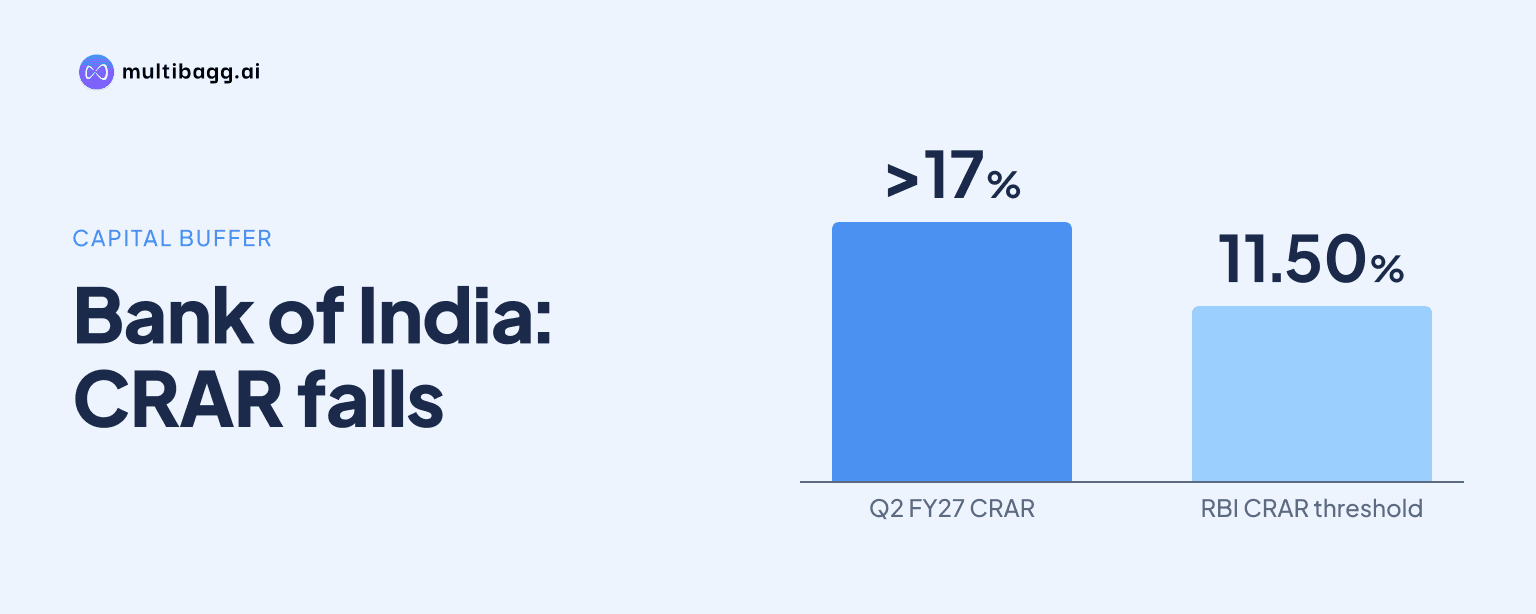
- Bank of India reported CRAR above 17%, compared with the RBI threshold of 11.50%, and a provision coverage ratio above 94%.
powered by IRIS
Bank of India expects to begin expected credit loss, or ECL, provisioning in Q3 FY27 after obtaining Board approval. Management said no ECL provision had been booked through Q2 FY27 and estimated that the transition could affect the capital-to-risk-weighted-assets ratio, or CRAR, by about 0.5% annually over four years.
Know Bank of India inside out
Results, valuation, peers and who's buying, in one view.
When will Bank of India begin ECL provisioning?
Bank of India expects to start ECL provisioning from Q3 FY27, subject to Board approval of its preparedness and implementation plan. On its October 23, 2026, Q2 FY27 earnings call, management said Q3 FY27 and Q4 FY27 should be the two quarters used to front-load ECL provisions before the framework takes effect from April 1, 2027.
Bank of India said it had not made any ECL provision at the time of the call. Its team was working on ECL guidelines with a consultant and was preparing the information-technology platform for ECL computation. Management said it expected Board approval by Q3 FY27 and would then be in a position to provide clearer guidance on the amounts involved.
The stated timetable means Bank of India has not yet disclosed a provision amount comparable with lenders that have begun front-loading. An analyst on the call referred to Indian Bank's disclosure that it had provided for about half of its estimated ECL requirement, but Bank of India said its Q2 FY27 provisions did not include an ECL component.
Why did Bank of India's NPA provision rise in Q2 FY27?
Bank of India said its higher non-performing asset, or NPA, provision in Q2 FY27 was caused by fresh loan slippages under Income Recognition, Asset Classification and Provisioning, or IRAC, rules rather than ECL front-loading. Management cited fresh slippages of about Rs 1,100 crore in Q2 FY27, following about Rs 1,800 crore in Q1 FY27.
An analyst described Bank of India's NPA provisions as having doubled to more than Rs 1,000 crore despite a 0.15% slippage ratio. Management responded that the provision charge reflected the IRAC requirement for newly classified NPAs, separating it from the ECL build-up it plans to undertake in Q3 FY27 and Q4 FY27.
Fresh slippages therefore fell by about Rs 700 crore between Q1 FY27 and Q2 FY27, while the Q2 FY27 provision charge still reflected the application of IRAC rules to new NPAs. Bank of India also reported a provision coverage ratio, or PCR, above 94% and tangible PCR of about 73% during the discussion of its existing NPA coverage.
How large could Bank of India's ECL capital effect be?
Bank of India's ballpark estimate is that ECL provisioning could affect CRAR by around 0.5% each year over the next four years. Management did not disclose a total rupee provision requirement, the calculation supporting the estimate, or the portions expected to be booked in Q3 FY27 and Q4 FY27.
Management linked its assessment to standard-asset monitoring data, saying special mention accounts, or SMA, above Rs 5 crore stood at around Rs 2,500 crore and represented 0.3% of standard assets. It also referred to an SMA figure of more than Rs 6,000 crore as of September 30, 2026, but the transcript does not explain the timing or basis of the two figures sufficiently to establish a like-for-like movement.
Bank of India said its zonal collection centres and credit-monitoring work supported management's expectation that the ECL provision would be at a rational level. That is management's assessment rather than a disclosed ECL model result, and the eventual charge will depend on the Board-approved methodology, data inputs and provisions booked over the planned two-quarter front-loading period.
Got a follow-up? Ask IRIS
What capital buffer did Bank of India report?
Bank of India reported CRAR of more than 17%, compared with a Reserve Bank of India threshold of 11.50%. On those stated figures, its reported CRAR was more than 5.5 percentage points above the threshold before considering management's estimate of a 0.5% annual ECL effect.
Management also said Bank of India had earned net profit of more than Rs 6,000 crore. It said that if this run rate were doubled, profit could reach around Rs 12,000 crore, and argued that profitability would add to CRAR during the ECL transition; this was management's expectation, not a confirmed capital forecast.
Bank of India also maintained a return on assets, or ROA, target of above 1% for the ensuing quarters and for March 2027. Management said ROA exceeded 1% in March 2026, June 2026 and September 2026, compared with a range of about 0.89% to 0.95% over the preceding two to three years.
What should readers watch before April 2027?
Bank of India's next significant ECL disclosure should follow the Board approval expected by Q3 FY27. Management said it would then be able to provide clearer guidance, so the first Q3 FY27 provision charge and any indication of the Q4 FY27 amount will show how the stated four-year CRAR effect is being phased.
Asset-quality indicators will remain relevant because Bank of India attributed Q2 FY27 provisions to Rs 1,100 crore of fresh IRAC-related slippages rather than ECL. Future results can show whether IRAC provisioning continues separately from ECL charges and whether PCR above 94% and tangible PCR near 73% change during the transition.
Conclusion
Bank of India has outlined a transition plan rather than a fully quantified ECL charge: it had booked no ECL provision through Q2 FY27, expects to begin after Board approval in Q3 FY27, and plans front-loading across Q3 FY27 and Q4 FY27. Management's disclosed capital estimate is an impact of around 0.5% on CRAR annually over four years.
The next item to watch is Bank of India's Board approval by Q3 FY27, which management said should allow clearer numerical guidance. The subsequent Q3 FY27 charge, the proposed Q4 FY27 provision and any disclosure of the Board-approved methodology or total provision estimate will determine how the transition compares with management's CRAR projection.