










Bank of India limits developer lending to Rs 3,000-4,000 crore
Key highlights
- Bank of India reported real-estate developer lending of around Rs 3,000-4,000 crore in Q2 FY27.
- Housing and mortgage loans make up most of Bank of India’s real-estate exposure, with average tickets of Rs 50 lakh to Rs 60 lakh.
- Bank of India has a corporate credit pipeline exceeding Rs 60,000 crore across sectors including infrastructure, manufacturing and renewable energy.
- Infrastructure loans can take 7-8 quarters to be fully disbursed, while refinancing after project completion can keep outstanding balances flat.
powered by IRIS
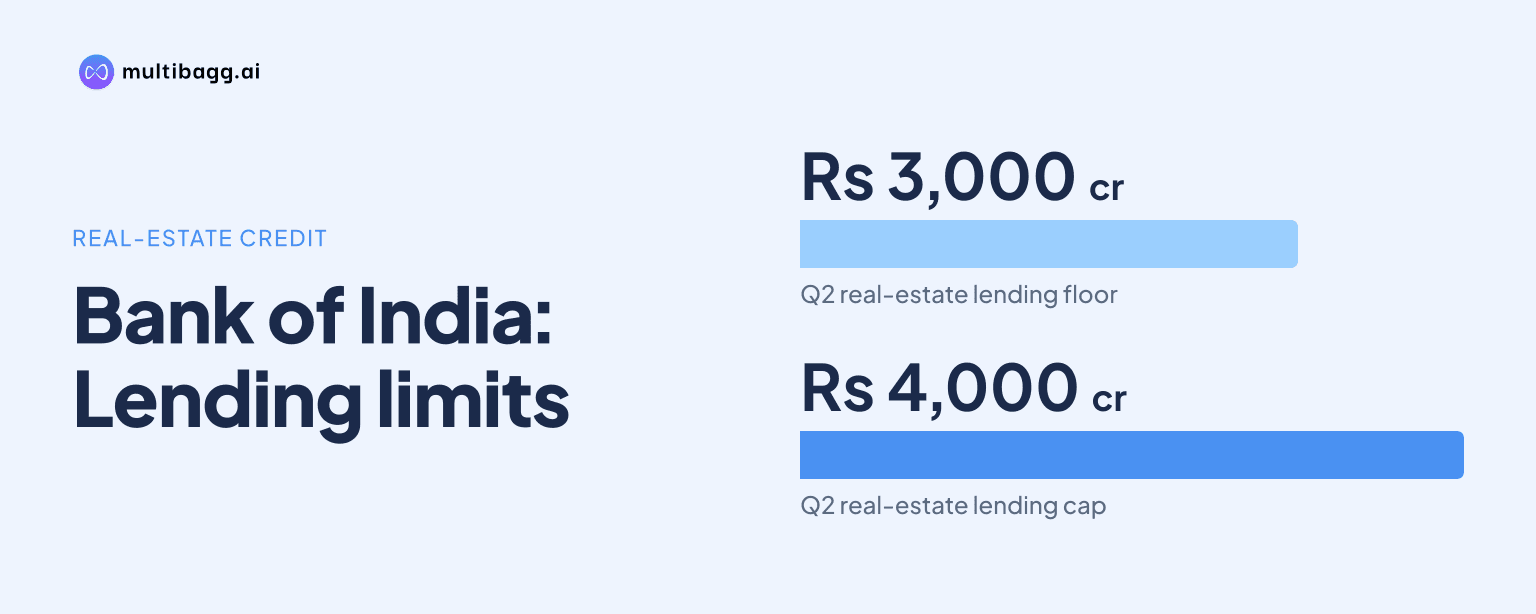
Bank of India said on its October 23, 2026 second-quarter financial year 2027 (Q2 FY27) earnings call that lending to real-estate developers was around Rs 3,000-4,000 crore. Management said the larger real-estate exposure is predominantly mortgage and housing lending, with average loan tickets of Rs 50 lakh to Rs 60 lakh, while unsecured retail accounts for 7% of the retail portfolio.
Know Bank of India inside out
Results, valuation, peers and who's buying, in one view.
What is Bank of India's direct lending to real-estate developers?
Bank of India said lending to real-estate developers was around Rs 3,000-4,000 crore, in response to an analyst asking what proportion of real-estate lending went to developers. Executive Director P.R. Rajgopal described that amount as very minuscule and said he could provide further data subsequently. The call did not provide a percentage of total advances, total real-estate exposure or the outstanding balance split by developer category.
Bank of India's comments also contained two related but differently framed estimates. Before the specific question on developer lending, management said commercial real-estate project lending was not even Rs 2,000-3,000 crore. It then gave the Rs 3,000-4,000 crore figure for lending to real-estate developers. The transcript does not reconcile whether the second range includes exposures beyond commercial real-estate project loans, so the two statements should not be treated as identical measures.
How much of Bank of India's real-estate book is housing loans?
Bank of India said most of its real-estate exposure comes through housing loans rather than commercial real-estate projects. Management referred to houses and mortgage housing as the main source of the exposure, contrasting that portfolio with the Rs 3,000-4,000 crore developer-lending estimate. This distinction was management's response to the concern that real estate represented a large sector exposure.
Bank of India said many housing loans have an average ticket size of Rs 50 lakh to Rs 60 lakh and that most are in tier-one locations. The call did not disclose delinquencies, loan-to-value ratios or geographic concentrations for those housing loans. Management nevertheless said it did not see much problem in this portion of the book, an assessment based on the housing-led composition and relatively granular ticket sizes rather than a reported asset-quality ratio for the segment.
How does Bank of India limit risk in NBFC lending?
Bank of India said unsecured loans account for only 7% of its total retail portfolio, while most pool buyouts and direct assignments it acquires are backed by security. Non-banking financial companies (NBFCs) were discussed separately from the housing book, but management linked its risk approach to the nature of the underlying exposure. It said NBFCs concentrated in personal loans and similar unsecured products can face problems, whereas it did not see much stress in NBFCs focused on small and medium enterprise lending or loan against property (LAP) lending.
Bank of India said it assesses an NBFC's funding profile, asset profile, non-performing asset (NPA) ratios and collection-efficiency ratios before taking exposure. That process is relevant because the bank's 7% unsecured-retail figure does not mean every NBFC-related exposure is unsecured: management specifically said its pool buyouts and direct assignments are mostly security-backed. The call did not disclose the rupee value of NBFC exposure, the number of counterparties or the respective shares of personal-loan, SME and LAP-related pools.
Got a follow-up? Ask IRIS
Why has Bank of India's infrastructure outstanding remained flat?
Bank of India said its infrastructure outstanding has remained more or less flat despite sanctions because completed projects are being refinanced by other institutions at lower interest rates. Management said it chose not to refinance several loans it had made during construction after those projects reached their commercial operation date (COD). In other words, new sanctions have not necessarily translated into a higher outstanding infrastructure balance when post-completion loans have moved elsewhere.
Bank of India said this refinancing activity reflects asset churning in the infrastructure market, rather than lower overall infrastructure spending. It also said infrastructure loans are disbursed in stages and take at least seven to eight quarters to be fully drawn, whether the asset is a road, port, transmission line or another project. That creates a timing contrast: construction-stage sanctions build balances gradually over seven to eight quarters, while COD-stage refinancing can remove completed exposures from the book more quickly.
What does Bank of India's corporate pipeline indicate about future exposure?
Bank of India said it has a corporate credit pipeline of more than Rs 60,000 crore across domestic and international business. Management described the pipeline as spread across infrastructure, manufacturing, renewable energy, data centres, electric vehicles, batteries, steel, cement and textiles. It said these are sanctions or in-principle approvals, not necessarily immediate disbursements, and the transcript did not provide a sector-wise rupee split.
Bank of India also said it had granted some data-centre sanctions and in-principle and final approvals, while remaining mindful of capacity being built in that sector. Management confirmed that its consideration of artificial intelligence-led capital expenditure includes both infrastructure and graphics processing units. This prospective lending area sits alongside the bank's stated practice of staged infrastructure disbursement over seven to eight quarters, rather than representing a disclosed change in outstanding exposure as of Q2 FY27.
Conclusion
The call presents a portfolio distinction rather than a total real-estate ratio: housing and mortgage loans form most of the exposure, with average tickets of Rs 50 lakh to Rs 60 lakh, while the bank said 7% of its retail portfolio is unsecured. For NBFC exposures, management said pool buyouts and direct assignments are mostly security-backed and subject to funding, asset, NPA and collection-efficiency reviews.
The next disclosures to watch are whether Bank of India provides the developer data Rajgopal said could be supplied subsequently, and how its more than Rs 60,000 crore corporate pipeline converts into disbursements. Management said infrastructure loans can take seven to eight quarters to be fully disbursed, while refinancing after COD can keep reported outstanding balances flat even when fresh sanctions continue.