










Bank of India expects 6-7 bps NIM lift after repo hike
Key highlights
- Bank of India expects a 6-7-basis-point NIM lift in a full quarter after the RBI’s 25-basis-point repo-rate increase.
- Bank of India’s global NIM fell to 2.47% from 2.52%, with FCNR deposits contributing around 5 basis points to the decline.
- Bank of India reported an Rs 86,000 crore to Rs 87,000 crore credit pipeline, including about Rs 65,000 crore in corporate loans and Rs 20,000 crore in RAM advances.
- Bank of India is targeting 15-16% global advances growth and 16-17% global deposit growth in FY27.
powered by IRIS
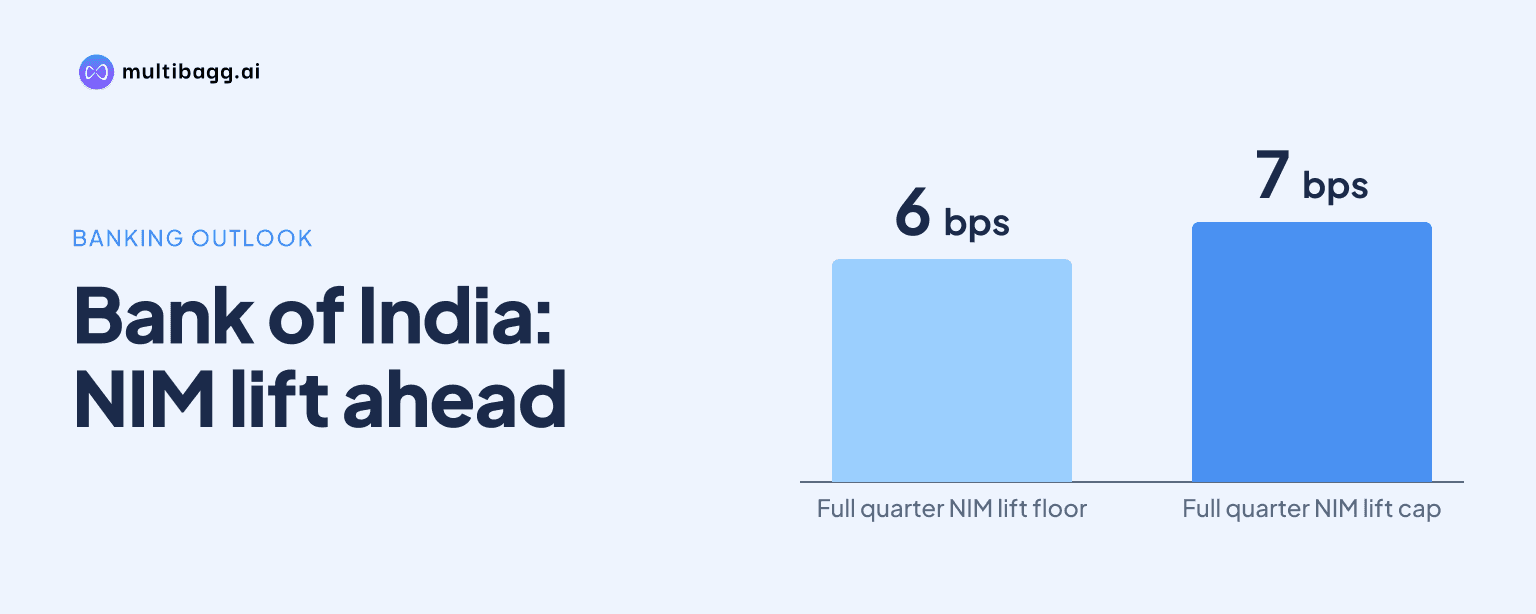
Bank of India expects the Reserve Bank of India’s 25-basis-point repo-rate increase to add about 6-7 basis points to net interest margin (NIM) in a full quarter. Management based that estimate on immediate repricing of 66% of domestic advances, while nearly 60% of term deposits mature over one to 18 months and reprice later.
Know Bank of India inside out
Results, valuation, peers and who's buying, in one view.
Why does Bank of India expect NIM to rise after the repo hike?
Bank of India expects a 6-7-basis-point NIM benefit because 66% of its domestic advances are linked to external benchmarks, which management said are repo-linked. When the Reserve Bank of India raised the repo rate by 25 basis points, Bank of India held a meeting the same day and passed the increase to borrowers covered by that benchmark.
The expected gain depends on the difference in repricing speed between assets and liabilities. Management said the higher lending rate will apply through a full quarter, whereas deposit rates will increase in stages as deposits mature and are renewed. That difference is why management described the 6-7-basis-point estimate as a ballpark calculation rather than a full-year NIM target.
Nearly 60% of Bank of India’s term deposits are in the one-year-to-18-month maturity category. Management said those deposits will be repriced only after maturity, meaning the cost of this funding will not reset at the same time as repo-linked lending rates. The expected NIM improvement therefore rests on the disclosed lag in term-deposit repricing.
How did FCNR deposits affect Bank of India’s NIM?
Bank of India reported global NIM of 2.47% as of September 30, down from 2.52%, a decrease of 5 basis points. Management said FCNR deposit mobilisation was one reason for the decline and estimated that its FCNR activity affected global NIM by around 5 basis points.
Management said the bank raised FCNR deposits of Rs 40,000 crore in its international book, with corresponding assets of Rs 40,000 crore. The bank distinguished this international-book effect from the projected domestic repo-repricing benefit, which management placed at 6-7 basis points for a full quarter.
The comparison shows that management’s projected gain from the 25-basis-point repo increase is 1-2 basis points larger than the 5-basis-point impact associated with FCNR deposits. Bank of India did not provide a revised NIM target or say that the repo benefit would offset all changes in funding costs, lending yields or deposit mix.
What is Bank of India doing to improve its CASA ratio?
Bank of India said its current account and savings account (CASA) ratio was 34.16%, and management acknowledged that the percentage had declined. CASA balances nevertheless grew 7% year on year and rose by more than Rs 20,000 crore, indicating that other deposit categories grew faster than CASA rather than that CASA balances fell.
Management said retail term deposits accounted for about 43% of deposits, alongside CASA at about 34%, taking the retail franchise to 77% of deposits. Bulk deposits made up the remaining 23%. Bank of India said it is monitoring both CASA and retail term deposits and has taken strategic steps to improve CASA balances and their share of deposits.
The bank said it has accepted some bulk deposits to support branch-level credit growth and lending pipelines in corporate loans and RAM advances. Management linked this funding requirement to the current 34% CASA level while saying it continues to work on increasing CASA in both absolute and percentage terms.
Got a follow-up? Ask IRIS
What lending demand could shape Bank of India’s funding needs?
Bank of India reported a total credit pipeline of around Rs 86,000 crore to Rs 87,000 crore as of September 30. Management said this was spread across corporate credit, RAM advances, digital lending, pool and co-lending, and supply-chain finance, with the corporate pipeline at around Rs 65,000 crore and the RAM pipeline at around Rs 20,000 crore.
Within corporate lending, the bank cited a renewable-energy pipeline of more than Rs 12,000 crore, power of more than Rs 9,000 crore, and roads and oil and gas of more than Rs 5,000 crore each. Management also cited more than Rs 4,000 crore in cement, more than Rs 2,700 crore in manufacturing, Rs 2,100 crore in construction, and more than Rs 2,000 crore in automobiles.
Bank of India has also set up a centralised Mumbai branch for pool lending, co-lending, trade and supply-chain business. The supply-chain book had crossed Rs 1,000 crore, and management said it expected around Rs 1,500 crore of business in the branch’s first year after stabilisation. The bank has directed each of its 69 zones to onboard one supply-chain vendor a month.
How does the margin outlook fit Bank of India’s FY27 plan?
Bank of India has guided for global advances growth of 15-16% in FY27 and global deposit growth of 16-17%. The higher deposit-growth target reflects management’s stated need to fund credit growth while managing the mix among CASA, retail term deposits and bulk deposits.
Management’s 6-7-basis-point NIM estimate is tied specifically to the current 25-basis-point repo increase and the immediate repricing of 66% of domestic advances. The estimate does not amount to guidance on the bank’s full-year global NIM, which was 2.47% as of September 30.
The bank’s funding choices will be relevant to the margin outcome because its stated deposit mix included 34.16% CASA, about 43% retail term deposits and 23% bulk deposits. Management said it needs resources for corporate, RAM, digital, pool, co-lending and supply-chain pipelines while seeking to improve the CASA share.
Conclusion
Bank of India’s margin outlook is based on a disclosed repricing mismatch: most repo-linked domestic loans reset immediately after the 25-basis-point policy increase, while a substantial portion of term deposits reprice only at maturity. Management expects that mechanism to add 6-7 basis points to NIM, compared with the 5-basis-point impact it associated with FCNR activity.
Next, investors will watch whether deposit repricing accelerates as nearly 60% of term deposits in the one-year-to-18-month bucket mature. Management’s FY27 plans also set measurable milestones: 15-16% global advances growth, 16-17% global deposit growth, improvement in the 34.16% CASA ratio, and conversion of the Rs 86,000 crore to Rs 87,000 crore credit pipeline.