










BCL channels cash to CBG and malt, not higher dividends
Key highlights
- BCL said it does not expect to become a higher-paying dividend company in the coming years.
- BCL plans a 20-tonne-per-day Fatehabad CBG plant that management expects could generate about Rs 70 crore of revenue at 90% to 95% utilisation.
- BCL’s ethanol supply year 2025-26 order book rose 41% to 1.5 lakh kilolitres from 1 lakh kilolitres.
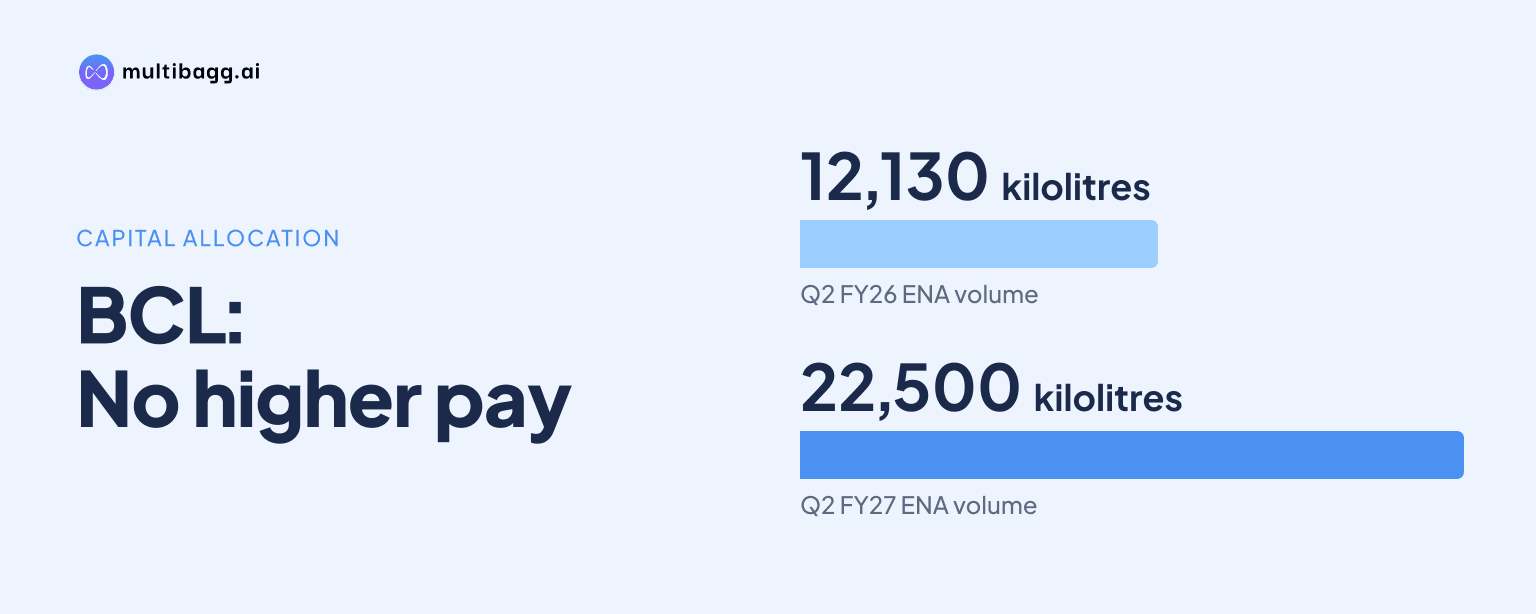
- BCL’s ENA volume increased to 22,500 kilolitres in Q2 FY27 from 12,130 kilolitres in Q2 FY26.
powered by IRIS
BCL Industries Limited will direct cash generation toward compressed biogas, or CBG, malt, Indian-made foreign liquor and flexible distillery capacity rather than raise dividends, management said in its Q2 and H1 FY27 call. The first identified project is a 20-tonne-per-day CBG plant at Fatehabad, which management expects could generate about Rs 70 crore of revenue at 90% to 95% utilisation.
Know BCL Industries inside out
Results, valuation, peers and who's buying, in one view.
Why is BCL retaining cash instead of raising dividends?
BCL is retaining cash because management intends to fund CBG, malt, Indian-made foreign liquor, or IMFL, and potential distillery expansion rather than become a higher-paying dividend company. Joint Managing Director Kushal Mittal said BCL likes to invest cash flows as soon as possible and does not expect to become a higher-dividend payer in the coming years. The statement addressed the company’s capital allocation over the next three to five years.
Management said debt reduction will occur according to the repayment schedule, while working-capital utilisation has declined over the past couple of years and should keep reducing as cash generation rises. BCL reported consolidated revenue from operations of Rs 695 crore in Q2 FY27 and Rs 1,319 crore in H1 FY27. Q2 FY27 earnings before interest, tax, depreciation and amortisation, or EBITDA, were Rs 66 crore, equivalent to a 9.5% margin.
The reinvestment preference comes after BCL expanded to 900 kilolitres per day, or KLPD, of installed distillery capacity. The Sangat distillery in Punjab accounts for 550 KLPD and Svaksha distillery in West Bengal for 350 KLPD. The 200-KLPD Bathinda ethanol unit, temporarily disrupted after a 19 June fire, resumed operations on 28 August after statutory approvals, restoring the full 900-KLPD base.
What is BCL’s first planned use of retained cash?
BCL’s first specified project is a 20-tonne-per-day CBG plant at its Fatehabad facility. Management said it was discussing a letter of intent for long-term offtake with city gas distribution companies, or CGDs, while obtaining the remaining one or two permissions. BCL planned to float a tender for the plant and machinery after Diwali, after which management said the project would begin.
At 90% to 95% capacity utilisation, management expects the Fatehabad plant to generate revenue of about Rs 70 crore and an EBITDA margin of about 40% to 45%. These are management expectations, not a formal company forecast. BCL had not disclosed project capital expenditure, commissioning timing or a confirmed offtake partner during the Q2 and H1 FY27 call.
Management described CBG as an opportunity it intends to approach incrementally. Mr Mittal said BCL wants to start with one plant and then consider a few more, while acknowledging that the business will have challenges. The company cited mandatory CBG blending targets of 3%, rising to 5% by FY29, as part of the sector backdrop, but did not quantify BCL’s future CBG capacity beyond the initial 20-tonne-per-day project.
How will malt and distillery flexibility use BCL’s cash?
BCL plans a malt plant at Bathinda to support an IMFL launch, with the consumer business initially focused on Punjab. Management said it expects to start the IMFL business in FY28 or FY29 and has no current plan to start bottling in West Bengal. BCL already sells country liquor in Punjab, where management said it had become the second-largest player, without providing a current market-share percentage.
The Bathinda malt project had not reached the application stage at the time of the call. Management said Punjab elections were due and that it would move the application after the elections. Mr Mittal said BCL’s experience in the Punjab alcohol market had reinforced the need for competitive pricing, product quality and packaging, including bottles, caps and corrugated boxes.
BCL is also seeking flexibility for Goyal Distillery Private Limited, which was originally cleared only as an ethanol project. The company has applied to add extra-neutral alcohol, or ENA, capacity to the environmental-clearance application. Management said the amended approval requires a public hearing and would take at least nine to 10 months from the time of the call, so BCL would proceed with the plant if the flexibility approval is received.
Existing assets show why that flexibility matters. ENA volumes increased to 22,500 kilolitres in Q2 FY27 from 12,130 kilolitres in Q2 FY26, while ethanol volumes were 39,500 kilolitres in Q2 FY27. Management said each of its two facilities has up to 200 KLPD that can switch to ENA, while 350 KLPD in Bathinda and 150 KLPD in Kharagpur remain dedicated to ethanol.
Got a follow-up? Ask IRIS
What market conditions support BCL’s reinvestment plan?
BCL’s investment plan is being developed while management expects grain-based ethanol margins to remain under pressure. Management said allocations under the new ethanol tender should be broadly similar to the prior year, even after changes in procurement rules. It said maize prices were around Rs 29 to Rs 30 per kilogram before the Diwali market closure, and that increased grain demand could pressure margins.
ENA and industrial alcohol offer BCL a route to manage some of that input-cost exposure. Management said ENA prices were around Rs 68 to Rs 70 per litre during the seasonal demand period, compared with Rs 58 per litre cited by an analyst for Q1. The distillery EBITDA margin improved to 11.9% in Q2 FY27 from 11.0% in Q2 FY26, a 90-basis-point increase despite higher maize prices.
BCL’s ethanol order book has also increased, although management did not expect the wider oversupply situation to disappear. An additional allocation of 4.37 crore litres for the fourth quarter lifted the ethanol supply year 2025-26 order book to 1.5 lakh kilolitres from 1 lakh kilolitres, a 41% increase. Management nevertheless said BCL would continue to rely on ENA because new ethanol allocations were expected to remain similar to last year.
H1 FY27 EBITDA of Rs 132 crore was 5.9% higher year on year, while the EBITDA margin improved by 191 basis points to 10.0%. Management also cited a peak company revenue potential of Rs 2,900 crore with added capacity, but specifically said this was a peak estimate rather than a forecast because results depend on oil and ENA prices. The oil refinery business recorded Q2 FY27 revenue of Rs 188 crore and a 3.7% EBITDA margin.
Conclusion
BCL’s capital-allocation position is clear: it intends to retain cash for operating projects and consumer-business development rather than increase dividends in the coming years. The planned Fatehabad CBG facility, Bathinda malt project, prospective IMFL launch and Goyal Distillery flexibility application would broaden the business beyond ethanol, while the current 900-KLPD distillery platform can shift some production toward ENA when economics warrant.
The next disclosed milestones are the remaining CBG permissions, planned within about three months according to management, and the plant-and-machinery tender after Diwali. Investors will also watch the post-election malt application, the at-least-nine-to-10-month environmental-clearance process for Goyal Distillery, and whether ENA prices of Rs 68 to Rs 70 per litre continue to help offset maize prices of around Rs 29 to Rs 30 per kilogram.