










BCL Industries Limited Sees Flat Ethanol Allocations, Margin Pressure
Key highlights
- BCL expects new-tender ethanol allocations to be broadly similar to last year.
- Management said maize prices were around Rs 29 to Rs 30 per kg before the Diwali market closure.
- BCL's Q2 FY27 distillery EBITDA margin was 11.9%, up from 11.0% in Q2 FY26.
- BCL's ESY 2025-26 ethanol order book rose 41% to 1.5 lakh kilolitres after an additional 4.37 lakh-kilolitre allocation.
powered by IRIS
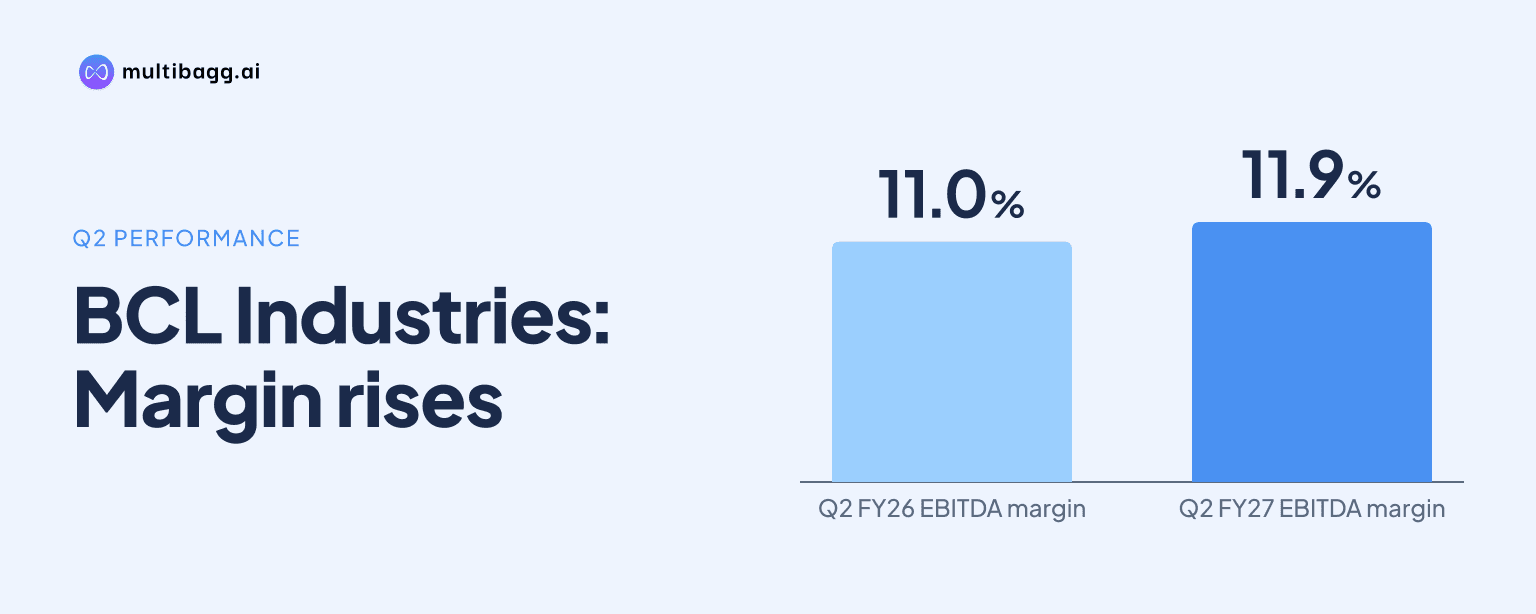
BCL Industries Limited expects ethanol allocations under the new tender to remain broadly unchanged from last year, while maize at Rs 29 to Rs 30 per kg is set to pressure grain-distillery margins. BCL reported an 11.9% distillery EBITDA margin in Q2 FY27, but management said feedstock costs would make the coming year more difficult.
Know BCL Industries inside out
Results, valuation, peers and who's buying, in one view.
Why does BCL expect ethanol allocations to stay flat?
BCL expects allocations under the new ethanol tender to be similar to the previous year because newer plants have added capacity and Oil Marketing Companies, or OMCs, have revised procurement policies. Joint Managing Director Kushal Mittal said restrictions affecting sugar-based ethanol supply would not necessarily create higher grain-based volumes for BCL.
Management does not expect India’s ethanol-blending target to be at risk because the sector has excess production capacity. The implication for BCL is that sufficient industry supply does not assure higher allocations for individual distilleries, making procurement control, operating efficiency and the ability to sell other alcohol products more relevant to margins.
BCL received an additional OMC allocation of 4.37 lakh kilolitres for Q4 of the then-current ethanol year, split between Sangat and Svaksha. The allocation increased its ethanol supply year, or ESY, 2025-26 order book by 41%, from 1 lakh kilolitres to 1.5 lakh kilolitres. Management said it was continuing deliveries against this allocation in November.
How are maize prices changing BCL's margin outlook?
Maize prices of Rs 29 to Rs 30 per kg are squeezing grain-ethanol economics, according to management. Mittal corrected an analyst’s reference to Rs 24 to Rs 25 per kg and said the direction after the Diwali market closure was uncertain, although he did not expect any further increase to last.
Management said policy changes have placed more of the ethanol feedstock burden on grain distilleries, increasing expected demand for maize. In response to an analyst who cited maize-based ethanol pricing of Rs 68 per litre, Mittal said current economics were “definitely hampered” but that some production viability remained. BCL therefore intends to continue ethanol production rather than withdraw from the market.
Additional broken-rice supply is not expected to resolve the margin pressure on its own. Management said the improved-rice programme is largely concentrated in Punjab and Haryana, rather than operating nationwide. Mittal also said the Food Corporation of India, or FCI, specification allowing up to 10% broken rice, compared with 25% earlier, would help supply but would not address the issue at the desired scale.
The reported Q2 FY27 result was more favourable than management’s forward view. BCL’s distillery earnings before interest, tax, depreciation and amortisation, or EBITDA, margin rose 90 basis points year on year to 11.9% from 11.0% in Q2 FY26. Management attributed the improvement, despite higher maize costs, to shared infrastructure and operational efficiencies.
Got a follow-up? Ask IRIS
How much flexibility does BCL have outside ethanol?
BCL can redirect part of its distillery system into Extra Neutral Alcohol, or ENA, and industrial alcohol when ethanol margins tighten. Its installed distillery capacity is 900 kilolitres per day, or KLPD, comprising 550 KLPD at Sangat in Punjab and 350 KLPD at Svaksha in West Bengal. The 200 KLPD Bathinda ethanol unit resumed operations on August 28 following the June 19 fire and statutory approvals.
The flexibility does not cover the entire system. Management said up to 200 KLPD at each of its two facilities can produce ENA, while 350 KLPD at Bathinda and 150 KLPD at Kharagpur remain dedicated to ethanol. BCL can therefore shift a defined portion of production to alternative alcohol markets but cannot fully replace its OMC ethanol business.
ENA volumes increased to 22,500 kilolitres in Q2 FY27 from 12,130 kilolitres in Q2 FY26, while ethanol volumes were 39,500 kilolitres in the latest quarter. Management said ENA demand was good and prices were around Rs 68 to Rs 70 during the peak-demand period, partly because sugar companies were not diverting much output to ENA.
BCL also identified industrial alcohol and denatured spirit as outlets for flexible production. Management expects to sell about 15 lakh litres of denatured spirit in the current month, particularly to active pharmaceutical ingredient companies in Punjab supplied from Bathinda. It is booking this business month to month rather than through forward contracts because of grain-price volatility and movements in Chicago ethanol prices.
What projects could change BCL's business mix?
BCL is planning a 20-tonne-per-day compressed biogas, or CBG, plant at Fatehabad as its first project in the segment. Management said it was discussing letters of intent for long-term offtake with city gas distributors and had one or two permissions remaining. It planned to float a tender for plant and machinery after Diwali, without disclosing a commissioning date.
At 90% to 95% utilisation, management expects the Fatehabad plant to generate about Rs 70 crore of revenue and an EBITDA margin of about 40% to 45%. These are management expectations, not reported earnings. Mittal said BCL intends to begin with one CBG plant before planning further projects, while recognising that the segment will have its own operating challenges.
Management also plans a malt plant at Bathinda to support an Indian-made foreign liquor, or IMFL, launch in FY28 or FY29. BCL said its country-liquor business is already the second largest in Punjab, but it has no current plan to start bottling in West Bengal. Management cited price competitiveness, product quality, packaging and distribution as lessons from its Punjab operations.
BCL’s capital allocation plans include CBG, malt and a potential Goyal Distillery project, rather than a higher dividend payout. The company has applied to add ENA flexibility to Goyal Distillery, which was initially filed as an ethanol-only project. Management said it would proceed with that plant if environmental approval for ethanol-and-ENA flexibility is granted, while debt reduction would follow the existing repayment schedule.
Conclusion
BCL’s outlook combines a stable ethanol-allocation expectation with more difficult feedstock economics. The 11.9% Q2 FY27 distillery EBITDA margin showed the benefit of shared infrastructure, but management expects maize at Rs 29 to Rs 30 per kg to constrain grain-distillery margins. ENA, industrial alcohol and denatured spirit provide outlets for flexible capacity when ethanol economics are less favourable.
The next factors to watch are maize prices after the Diwali market closure, deliveries against the additional 4.37 lakh-kilolitre OMC allocation and settlement of the Bathinda fire insurance claim, which management expected by the end of Q3 FY27. Progress on the Fatehabad CBG tender, long-term offtake arrangements, and environmental approval for Goyal Distillery will determine how quickly BCL can broaden its mix beyond ethanol.