










BCL targets FY29 Punjab IMFL launch after 41.4% sales growth
Key highlights
- BCL expects a Punjab-first IMFL launch in FY29.
- BCL sold 6.42 lakh country-liquor cases in Q2 FY27, up 41.4% year-on-year.
- BCL said it is Punjab’s second-largest country-liquor player, without disclosing market share.
- BCL’s 900 KLPD distillery network was fully operational after the Bathinda unit restarted on August 28.
powered by IRIS
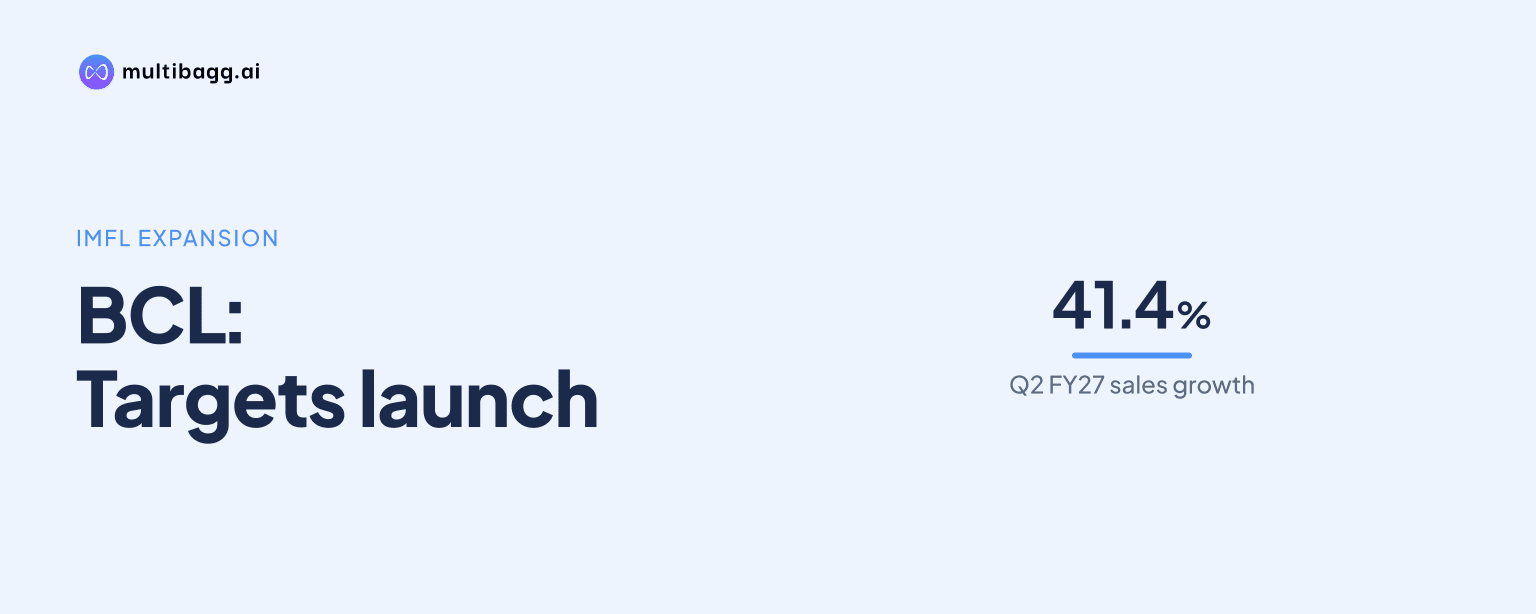
BCL Industries Limited plans to launch Indian-made foreign liquor, or IMFL, in Punjab in FY29, following Q2 FY27 country-liquor sales of 6.42 lakh cases, up 41.4% year-on-year. Management also said BCL is Punjab’s second-largest country-liquor player, although it did not disclose an updated market-share percentage.
Know BCL Industries inside out
Results, valuation, peers and who's buying, in one view.
When will BCL launch IMFL in Punjab?
BCL expects to begin its IMFL business in FY29. Management gave that timing in response to a question on whether the launch would occur at the end of FY27 or in early FY28, answering “’28, ’29”; the call did not provide a launch quarter, brand names, prices or investment amount.
BCL said a proposed malt plant at Bathinda would help support the IMFL launch, but the project remained at an early stage in Q2 FY27. Management said it had not filed the required Punjab application because elections were due and would move the application after the elections. The transcript does not state when construction, commissioning or commercial production would begin.
Management had separately referred to launching IMFL in the “coming year,” but later gave FY29 as its specific timing answer. BCL did not reconcile those references, so FY29 is the clearest disclosed schedule. The proposed launch is a management plan rather than a confirmed commercial start.
Why is BCL moving from country liquor into IMFL?
BCL is planning IMFL after expanding its country-liquor operations in Punjab, where management said it had become the second-largest player. Q2 FY27 sales reached 6.42 lakh cases, compared with an implied 4.54 lakh cases in Q2 FY26 based on the reported 41.4% growth rate, showing a larger sales base over the year.
Management said the Punjab market had demonstrated the importance of product quality, competitive pricing and packaging. It specifically cited bottles, caps and corrugated boxes as commercial requirements, including in country liquor. These are management’s stated operating lessons, not a disclosed IMFL brand or marketing plan.
BCL intends to start the consumer business from Punjab rather than West Bengal. Management said it had no current plan to begin bottling in West Bengal and would first assess growth in Punjab. It added that its distribution network could help as it enters Haryana and Uttar Pradesh, but did not confirm an IMFL launch date, capacity or sales target for either state.
What alcohol capacity and financial base does BCL have?
BCL reported consolidated revenue from operations of Rs 695 crore in Q2 FY27 and Rs 1,319 crore in H1 FY27. Earnings before interest, tax, depreciation and amortisation, or EBITDA, were Rs 66 crore in Q2 FY27, equal to a 9.5% margin, while profit after tax was Rs 29 crore, equal to a 4.2% margin.
H1 FY27 EBITDA rose 5.9% year-on-year to Rs 132 crore, while its margin increased by 191 basis points to 10%. The Q2 FY27 result included a one-time gain of Rs 2 crore from the sale of assets from BCL’s former oil and vanaspati unit at Bathinda, recorded in other income.
BCL’s 900 kilolitres-per-day, or KLPD, distillery network became fully operational when its 200 KLPD Bathinda ethanol unit restarted on August 28 after a June 19 fire. The network comprises 550 KLPD at Sangat in Punjab and 350 KLPD at Svaksha in West Bengal. BCL has filed an insurance claim and expected settlement by the end of Q3 FY27, but did not disclose the expected amount.
Got a follow-up? Ask IRIS
How can BCL shift output between ethanol and ENA?
BCL can use up to 200 KLPD at each of its two facilities for either ethanol or extra-neutral alcohol, or ENA, which is used in alcoholic beverages. Management said 350 KLPD in Bathinda and 150 KLPD in Kharagpur remain dedicated to ethanol, limiting the share of capacity that can switch products.
ENA volume rose to 22,500 kilolitres in Q2 FY27 from 12,130 kilolitres in Q2 FY26, an increase of 10,370 kilolitres. Ethanol volume was 39,500 kilolitres in Q2 FY27. Management said this flexibility helped BCL respond to conditions in ethanol, ENA and industrial alcohol markets.
Distillery EBITDA margin increased to 11.9% in Q2 FY27 from 11.0% in Q2 FY26, despite higher maize prices, according to management. It said ENA prices were about Rs 68 to Rs 70 per litre during the call, compared with Rs 58 per litre mentioned by an analyst for Q1, while maize prices were around Rs 29 to Rs 30 per kilogram.
How will BCL allocate cash before the IMFL launch?
BCL plans to reinvest cash flows in compressed biogas, or CBG, malt and potential distillery expansion rather than become a higher-dividend company in the coming years. Management said debt reduction would continue according to the repayment schedule and working-capital utilisation had declined over the past few years.
The planned Fatehabad CBG project has capacity of 20 tonnes per day. Management said a plant running at 90% to 95% utilisation could generate about Rs 70 crore in revenue with EBITDA margin of 40% to 45%; these are management expectations, not reported financial results. BCL was discussing long-term offtake arrangements with city gas distributors and expected its remaining approvals within three months.
At Goyal Distillery Private Limited, BCL has applied to add ENA capability to a project originally proposed only for ethanol. Management said the revised environmental-clearance process requires a public hearing and would take at least nine to 10 months from the application made in the prior month. BCL said this flexibility would determine whether it proceeds with that plant.
What could affect BCL’s FY29 IMFL preparation?
BCL identified rising grain costs and ethanol-industry oversupply as near-term pressures. Management said ethanol margins would come under pressure as more demand shifted to grain distilleries, but it expects ENA and industrial alcohol to provide an alternative outlet where costs can be passed through.
Oil marketing companies allocated an additional 4.37 crore litres of ethanol to BCL for the fourth quarter, comprising 2.35 crore litres for Sangat and 2.02 crore litres for Svaksha. BCL said its total ethanol supply year 2025-26 order book rose 41%, from 1 lakh kilolitres to 1.5 lakh kilolitres, and that delivery of the additional allocation would continue into November.
Management gave a peak company-wide revenue estimate of Rs 2,900 crore with the added capacity, while stressing that it was not a forecast. It did not provide an IMFL revenue target, first-year case-sales objective or market-share goal, leaving the commercial scale of the FY29 launch undisclosed.
Conclusion
BCL’s planned FY29 IMFL entry is a Punjab-first extension of its country-liquor business, supported by Q2 FY27 case sales of 6.42 lakh and management’s claim of second-largest status in the state. Its ability to switch part of its distillery network to ENA provides operational flexibility while ethanol margins face pressure from maize costs and industry capacity.
The next disclosed milestones are BCL’s post-election application for the Punjab malt project, completion of remaining CBG approvals that management expects within three months, and the Goyal Distillery environmental-clearance process expected to take at least nine to 10 months. Management has not disclosed IMFL brands, launch investment or first-year sales targets, which remain unresolved ahead of FY29.