










BharatRohan says 46.9% of farmers pay for CropAssure service
Key highlights
- BharatRohan had 28,212 paying CropAssure farmers as of September 30, 2026.
- Paying CropAssure farmers represented 46.9% of BharatRohan's 60,196 farmers served.
- BharatRohan's acres under service reached 2,66,537 as of September 30, 2026.
- Crop monitoring services revenue rose 53.8% to Rs 14.17 crore in H1 FY27.
powered by IRIS
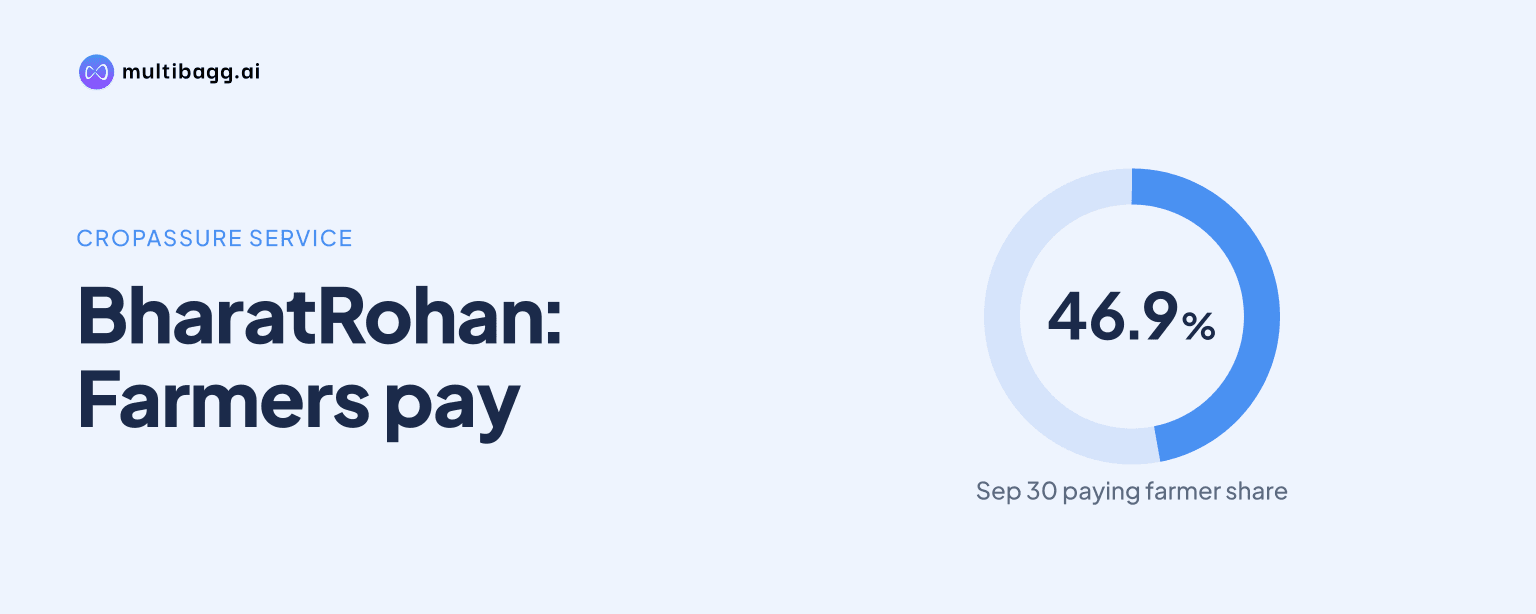
BharatRohan Airborne Innovations Limited reported that 28,212 farmers, or 46.9% of its 60,196 farmers served, were actively enrolled in the paid CropAssure service as of September 30, 2026, within 2,66,537 acres under service. The disclosure identifies the paying component of a network otherwise presented through total farmer and acreage reach.
Know BharatRohan Airborne Innovations inside out
Results, valuation, peers and who's buying, in one view.
How many BharatRohan farmers pay for CropAssure?
BharatRohan had 28,212 farmers actively enrolled in its flagship CropAssure package as of September 30, 2026, representing 46.9% of the 60,196 farmers it served. The company describes these enrolled users as paying for crop advisory, separating them from the full base of farmers reached through its platforms and services.
CropAssure is a drone-based precision-agriculture advisory platform sold through a subscription model priced in Indian rupees per acre per season, alongside agri-input commissions. BharatRohan says the service monitors crop health and is intended to improve farm productivity, while its related SourceAssure platform handles traceable, residue-free produce sourcing and trading.
The 46.9% figure is a disclosed conversion measure rather than an estimate based on rounded operating-scale figures. Elsewhere in the presentation, BharatRohan reports more than 60,000 users and more than 28,000 actively enrolled farmers, but the September 30, 2026 operating highlights provide the precise 60,196 and 28,212 counts.
How has BharatRohan's paying farmer base grown?
BharatRohan's paying CropAssure farmer count rose from 12,729 in March 2025 to 28,212 in September 2026. Over the same stated period, its total user count increased from 50,000 to 60,196 and acreage under service expanded from 2,00,000 acres to 2,66,537 acres.
The company also states that paying farmers increased 10.0% from March 31, 2026 to September 30, 2026. It does not disclose the March 2026 paying-farmer count in this presentation, so the underlying base for that six-month percentage cannot be independently derived from the supplied figures.
The March 2025 to September 2026 comparison shows that CropAssure enrolment increased faster than total users, which rose from 50,000 to 60,196. However, BharatRohan does not disclose subscription pricing, renewal rates, churn, average acres per paying farmer, or the share of CropAssure revenue generated by newly enrolled rather than existing farmers.
What services do CropAssure users receive?
BharatRohan says CropAssure turns drone imagery into field-specific crop recommendations through a six-step workflow that ends with digital advisory delivery and field support. The process begins with mapping field boundaries and mission planning, then uses calibrated drone flights to capture hyperspectral imagery.
The images are processed into geo-referenced orthomosaics and analysis-ready datasets, after which BharatRohan creates prescription maps. Agronomists review those maps and translate them into recommendations for individual farms, providing the mechanism for the subscription advisory offering rather than simply supplying drone flights.
BharatRohan says its data-processing time for 1,000 acres has declined from about eight hours to 2.5 hours. It also reports that automated, artificial-intelligence-driven prescription-map runs can produce 10,000 to 20,000 maps in 20 to 25 minutes, compared with manual batches of 2,000 to 3,000 maps.
The processing capacity is relevant because 2,66,537 acres were under service at September 30, 2026. BharatRohan does not state how many of those acres belong specifically to the 28,212 paying CropAssure farmers, so acreage coverage should not be treated as an average paid-farmer service area.
Got a follow-up? Ask IRIS
How is BharatRohan expanding its farmer network?
BharatRohan served farmers across eight states as of September 30, 2026: Haryana, Rajasthan, Uttar Pradesh, Meghalaya, Madhya Pradesh, Maharashtra, Telangana and Karnataka. It reported more than 300 retail partners, which it says use a scalable agent incentive structure to support adoption and sales of drone services and agri-inputs.
BharatRohan launched three Pragati Kendras in Karnataka, Maharashtra and Barabanki in Uttar Pradesh. These hubs are intended to support agri-input sales and crop monitoring, adding physical points of contact to a network that includes digital advisory and retail-partner distribution.
The wider platform contains several offerings beyond CropAssure. SourceAssure operates on trading arbitrage and premiums on residue-free produce, SeedAssure provides precision-agriculture services for seed-company hybrid trials, SprayAssure offers on-demand drone spraying on a pay-per-use farming-as-a-service model, and SafeAssure is a consumer brand for traceable spices and pulses.
For H1 FY27, crop monitoring services revenue rose 53.8% to Rs 14.17 crore and accounted for 33.5% of revenue, while agri-output revenue increased 19.1% to Rs 26.96 crore. Those segment figures show that crop monitoring was a separately reported revenue stream, although BharatRohan does not state the revenue attributable solely to the 28,212 CropAssure enrollees.
What could change BharatRohan's CropAssure scale next?
BharatRohan's management says it plans to extend crop monitoring to tea, banana, pomegranate and grapes, with tea-estate orders in South India from November 2026 and work in pomegranate and grape orchards in Nashik, Sangli and Rajasthan. These initiatives could broaden the crops addressed by its monitoring platform, but the presentation gives no enrolment or revenue target for them.
Management also says it is developing a drone-guided decision-support system with a leading micro-irrigation company, initially for banana and onion. Separately, BharatRohan plans to deploy its in-house hyperspectral camera and convert solar-inspection pilots into commercial contracts, following proof-of-concept projects in solar asset monitoring.
For the second half of FY27, management's stated priorities include matching rabi procurement from the monitored network with confirmed buyer demand, improving receivables collection and tightening working capital. BharatRohan identifies rabi procurement as important because seed spices and oilseeds are harvested from February to April; in FY26, H2 revenue was Rs 52.49 crore versus Rs 32.92 crore in H1.
Conclusion
BharatRohan's September 2026 disclosure puts a precise paid-user measure beside its broader network metrics: 28,212 farmers were enrolled in CropAssure out of 60,196 served, with 2,66,537 acres under service. The comparison with March 2025 shows that the paid-farmer base increased from 12,729, alongside growth in total users and acres.
The next disclosed milestones are management's planned crop-monitoring expansion into perennial and other crops, expected FSSC 22000 certification for its India processing facility in December 2026, and a planned early-2027 US traceable-spice launch. Management has also identified rabi procurement matched to confirmed buyer demand, receivables collection and tighter working capital as H2 FY27 priorities.