










BharatRohan lifts EBITDA 44.5% as normal tax cuts H1 profit
Key highlights
- BharatRohan’s H1 FY27 revenue from operations rose 28.6% to Rs 42.34 crore.
- BharatRohan’s H1 FY27 EBITDA increased 44.5% to Rs 7.47 crore and margin rose to 17.7%.
- BharatRohan’s H1 FY27 net profit fell 10.0% to Rs 4.15 crore as tax expense reached Rs 202.59 lakh.
- BharatRohan’s H1 FY27 EPS declined 33.5% to Rs 2.08 from Rs 3.13.
powered by IRIS
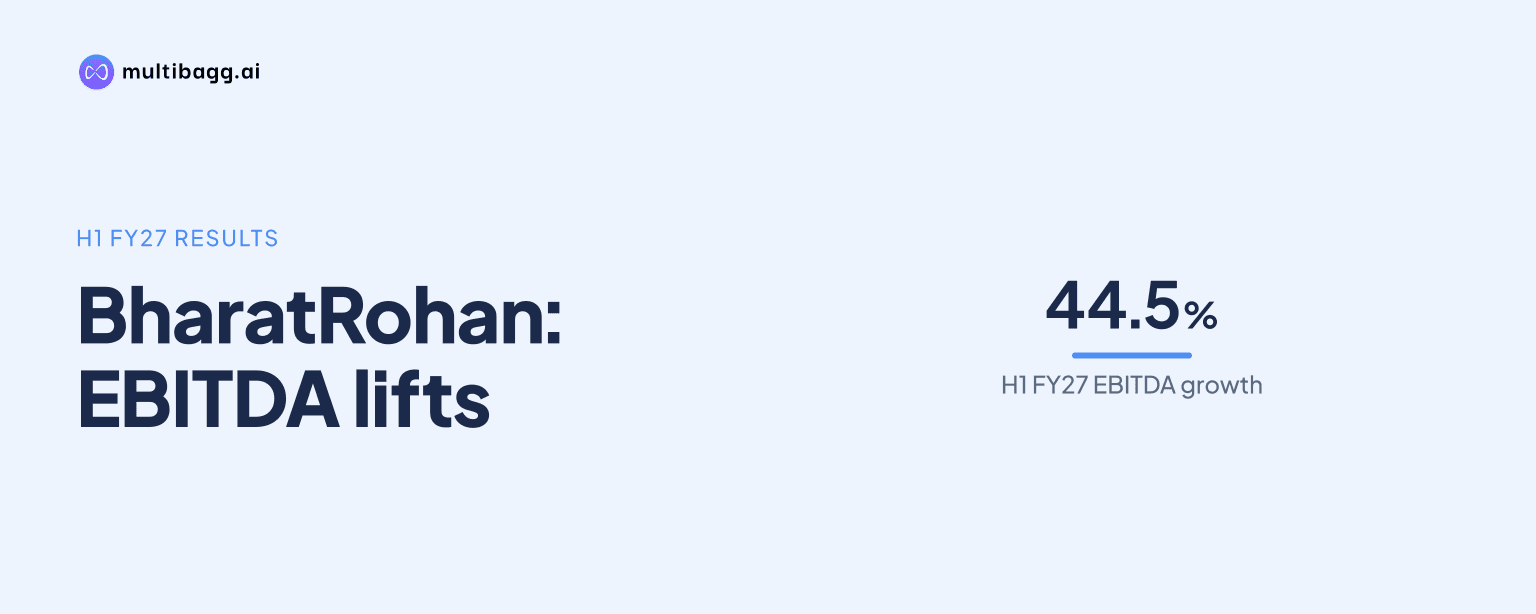
BharatRohan reported a 44.5% rise in H1 FY27 EBITDA to Rs 7.47 crore, but profit after tax fell 10.0% to Rs 4.15 crore as tax expense increased to Rs 202.59 lakh following its shift to normal income-tax provisions after listing. The result separates higher operating earnings from the effect of a changed tax position.
Know BharatRohan Airborne Innovations inside out
Results, valuation, peers and who's buying, in one view.
What drove BharatRohan's H1 FY27 EBITDA increase?
BharatRohan’s earnings before interest, tax, depreciation and amortisation (EBITDA) increased because revenue grew faster than total expenditure in H1 FY27. Revenue from operations rose 28.6% year on year to Rs 42.34 crore from Rs 32.92 crore in H1 FY26, while total expenditure increased 25.8% to Rs 34.94 crore from Rs 27.78 crore. This produced EBITDA of Rs 7.47 crore, compared with Rs 5.17 crore a year earlier. The presentation specifies that EBITDA includes other income.
The resulting EBITDA margin increased by 200 basis points, or 2 percentage points, to 17.7% in H1 FY27 from 15.7% in H1 FY26. Other income rose to Rs 7 lakh from Rs 3 lakh, taking total income to Rs 42.41 crore from Rs 32.95 crore. BharatRohan characterises the 44.5% EBITDA increase as reflecting improved operational performance, while the arithmetic also shows that expenditure growth trailed revenue growth over the period.
How did BharatRohan's H1 FY27 costs change?
BharatRohan’s raw-material expense increased 20.5% to Rs 29.77 crore in H1 FY27 from Rs 24.71 crore in H1 FY26, below the 28.6% growth in net sales. Raw materials remained the largest disclosed expense line and represented most of the Rs 34.94 crore total expenditure. The gap between net-sales growth and raw-material growth contributed to the increase in EBITDA from Rs 5.17 crore to Rs 7.47 crore.
Some other cost lines grew more quickly than sales. Employee benefit expense rose 70.9% to Rs 2.57 crore from Rs 1.50 crore, and other expenses increased 65.8% to Rs 2.60 crore from Rs 1.57 crore. Interest expense rose 53.8% to Rs 24 lakh from Rs 16 lakh, while depreciation increased 276.5% to Rs 1.06 crore from Rs 28 lakh. Despite those increases, profit before tax (PBT) rose 30.4% to Rs 6.17 crore from Rs 4.73 crore.
Got a follow-up? Ask IRIS
Why did BharatRohan's H1 FY27 net profit decline?
BharatRohan’s net profit declined because its tax expense rose sharply after the company became subject to normal income-tax provisions. The presentation reports current and deferred tax expense of Rs 202.59 lakh in H1 FY27, compared with Rs 12.35 lakh in the corresponding previous period. In the profit-and-loss table, tax expense is rounded to Rs 2.03 crore in H1 FY27 versus Rs 12 lakh in H1 FY26.
In H1 FY26, BharatRohan says its tax liability under Minimum Alternate Tax (MAT) provisions was adjusted against accumulated MAT credit entitlement, resulting in lower tax expense. Following listing, the company became ineligible for Section 80-IAC benefits and recognised current and deferred taxes under normal provisions. Management describes the resulting profit effect as a one-time transitional impact from moving out of the special tax regime, rather than a deterioration in underlying operating performance.
The differing paths of PBT and net profit quantify that distinction. PBT increased by Rs 1.44 crore, or 30.4%, to Rs 6.17 crore, but net profit fell by Rs 46 lakh to Rs 4.15 crore. Net profit margin consequently decreased to 9.8% from 14.0%, even as EBITDA margin rose to 17.7% from 15.7%. The source therefore attributes the divergence between operating margin and final profit margin primarily to the tax transition.
What do BharatRohan's margins and per-share earnings show?
BharatRohan’s H1 FY27 EBITDA margin improved while its net profit margin contracted, reflecting the different operating and tax outcomes. EBITDA margin was 17.7%, up from 15.7% in H1 FY26, whereas net profit margin was 9.8%, down from 14.0%. The 2-percentage-point EBITDA-margin increase came alongside revenue of Rs 42.34 crore, while the lower net margin followed the Rs 202.59 lakh current and deferred tax charge described in the presentation.
Earnings per share (EPS) fell 33.5% to Rs 2.08 in H1 FY27 from Rs 3.13 in H1 FY26. This decline was larger than the 10.0% reduction in net profit reported in the same table. BharatRohan’s presentation does not provide a separate explanation for the EPS movement or a share-count reconciliation, so the disclosed result establishes the per-share change but not its components.
The H1 comparison also shows that the Rs 2.30 crore increase in EBITDA exceeded the Rs 1.44 crore increase in PBT because interest and depreciation rose. Interest was Rs 24 lakh and depreciation was Rs 1.06 crore in H1 FY27, compared with Rs 16 lakh and Rs 28 lakh respectively in H1 FY26. The further move from Rs 6.17 crore of PBT to Rs 4.15 crore of net profit was then driven by the tax expense disclosed by BharatRohan.
Conclusion
BharatRohan’s H1 FY27 figures show higher operating profitability alongside lower reported profit. Revenue increased 28.6% to Rs 42.34 crore, EBITDA rose 44.5% to Rs 7.47 crore and EBITDA margin reached 17.7%, while net profit fell 10.0% to Rs 4.15 crore. The company attributes that contrast primarily to Rs 202.59 lakh of current and deferred tax expense after its transition to normal income-tax provisions.
What to watch in subsequent reporting periods is the conversion of PBT into net profit under the normal tax provisions that applied in H1 FY27. BharatRohan has identified the loss of Section 80-IAC eligibility after listing and the prior-year MAT-credit adjustment as the reasons for the comparison, but its presentation gives no tax target, profit forecast or timetable for the effect to end.