










BharatRohan cuts 1,000-acre data processing to 2.5 hours
Key highlights
- BharatRohan says it cut 1,000-acre hyperspectral-data processing time to 2.5 hours from about eight hours.
- Automated AI-driven prescription-map runs handle 10,000 to 20,000 maps in 20 to 25 minutes.
- BharatRohan served 60,196 farmers across 2,66,537 acres as of 30 September 2026.
- Crop-monitoring-services revenue reached Rs 14.17 crore in the first half of fiscal year 2027, up 53.8% year on year.
powered by IRIS
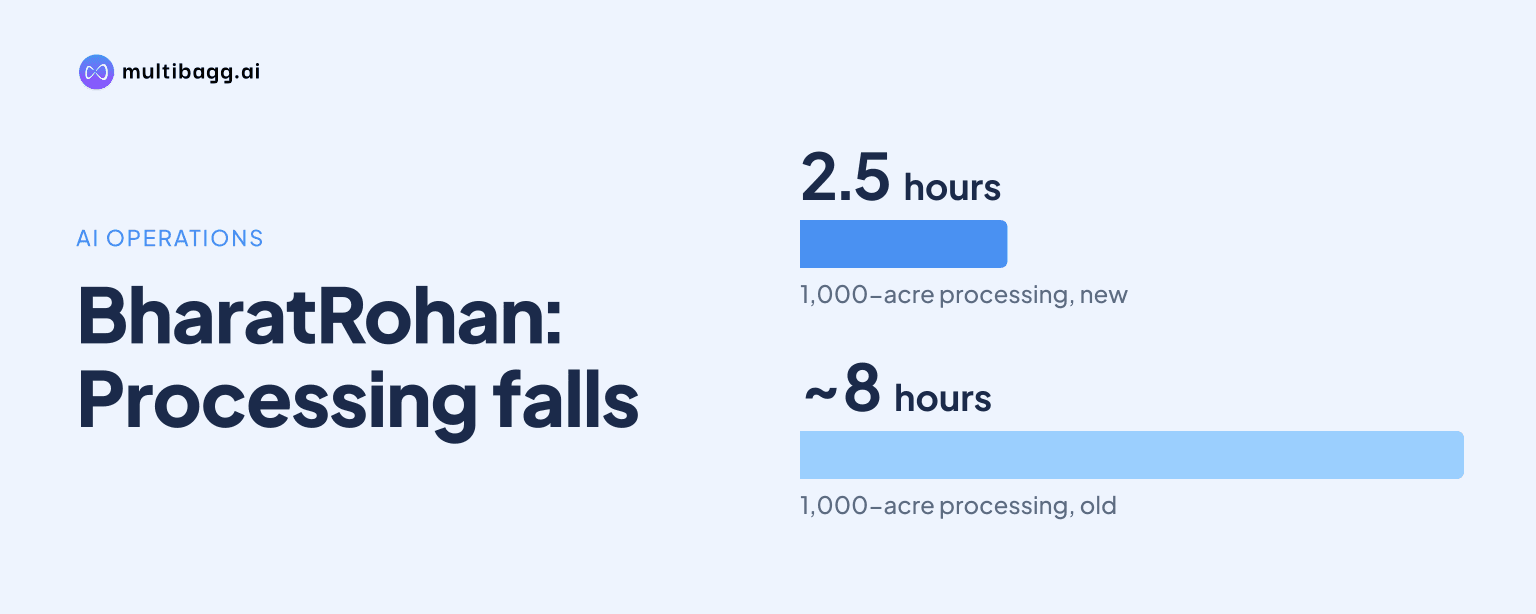
BharatRohan says its next-generation hyperspectral-data pipeline now processes imagery for 1,000 acres in 2.5 hours, compared with about eight hours previously. The 5.5-hour reduction sits alongside automated artificial intelligence, or AI, prescription-map runs of 10,000 to 20,000 maps in 20 to 25 minutes, according to its presentation.
Know BharatRohan Airborne Innovations inside out
Results, valuation, peers and who's buying, in one view.
How much faster is BharatRohan’s hyperspectral-data pipeline?
BharatRohan says processing time for 1,000 acres of hyperspectral imagery has fallen to 2.5 hours from about eight hours. The company describes hyperspectral imaging as producing terabytes of multi-dimensional data, making the processing pipeline part of converting drone flights into farm-level analysis rather than a standalone imaging exercise.
The change is disclosed as part of BharatRohan’s next-generation data pipeline, not as a revenue forecast or a customer-service commitment. The presentation does not specify the dates of the earlier eight-hour benchmark or the 2.5-hour result, and it provides no processing-cost data, utilisation rates or active hyperspectral-camera deployment count.
BharatRohan’s crop-monitoring workflow has six stages: mission planning, image acquisition, data processing, decision support, agronomist review and farmer delivery. Field boundaries are mapped before flights, calibrated drones capture imagery, and processed imagery becomes geo-referenced orthomosaics and analysis-ready datasets before prescription maps are reviewed by agronomists and delivered digitally with field support.
What has changed in BharatRohan’s prescription-map production?
BharatRohan says automation increased prescription-map capacity from manual batches of 2,000 to 3,000 maps to AI-driven runs of 10,000 to 20,000 maps in 20 to 25 minutes. The disclosed change is both a shift from manual batching to automated runs and an increase in the stated batch range.
Prescription maps are the decision-support output of the crop-monitoring process. BharatRohan says the maps are transformed from processed hyperspectral data and then translated by agronomists into field-specific crop recommendations, meaning AI automation remains connected to an agronomist-review stage in the described workflow.
The presentation does not quantify whether faster mapping changed advisory accuracy, crop yields, input use or farmer retention. It instead links the workflow to intended outcomes including faster decisions, higher productivity and stronger farmer outcomes, while reporting 60,196 farmers served across 2,66,537 acres as of 30 September 2026.
What technology underpins BharatRohan’s data-processing model?
BharatRohan’s model is supported by an in-house hyperspectral camera combining optomechanics, on-board computing, user-interface software and telemetry with a proprietary three-axis active-stabilisation gimbal. This is the imaging hardware feeding the pipeline that the company says can process 1,000 acres in 2.5 hours.
The company also describes an in-house unmanned aerial vehicle, or UAV, manufacturing programme that progressed from V1 to V3.1 as it transitions from imported components toward domestic manufacturing. Its Pravir X-6 carries a 10-litre payload and has autonomous flight planning integrated with CropAssure diagnostics, according to the presentation.
BharatRohan also identifies a Hyderabad phenotyping and research-and-development facility that simulates crop stressors. Its stated purpose is to build spectral libraries and vegetation indices, which are data inputs relevant to identifying crop conditions from hyperspectral imagery; the presentation does not give the facility’s capacity, opening date or research budget.
Got a follow-up? Ask IRIS
How does faster processing fit BharatRohan’s operating scale?
BharatRohan presents the faster pipeline against a service network that reached 2,66,537 acres and 60,196 farmers on 30 September 2026. Of those farmers, 28,212 were actively enrolled in the flagship CropAssure package, equivalent to 46.9% of the total farmer base.
The table shows paying farmers increased by 15,483 between March 2025 and September 2026, while acreage rose by 66,537 acres. BharatRohan separately says paying farmers were 10.0% higher than at 31 March 2026, although it does not disclose the March 2026 paying-farmer count.
BharatRohan operates across eight states and reports more than 300 retail partners, alongside three Pragati Kendras in Karnataka, Maharashtra and Barabanki in Uttar Pradesh. The hubs are described as village centres for agri-input sales and crop monitoring, while the retail channel uses an agent-incentive structure to support sales of drone services and agri-inputs.
What commercial targets will test BharatRohan’s scaling plan?
BharatRohan reported crop-monitoring-services revenue of Rs 14.17 crore in the first half of fiscal year 2027, up 53.8% year on year and representing 33.5% of revenue. Total revenue from operations was Rs 42.34 crore, up 28.6%, while agri-output revenue rose 19.1% to Rs 26.96 crore, meaning crop monitoring grew faster than the larger agri-output segment.
Management says the second half of fiscal year 2027 is expected to be the larger, rabi-led half because seed spices and oilseeds are harvested from February to April. As a historical comparison provided by the company, fiscal year 2026 second-half revenue was Rs 52.49 crore, compared with Rs 32.92 crore in the first half, but this does not establish a fiscal year 2027 outcome.
Management’s priorities for the second half of fiscal year 2027 include matching rabi procurement from the monitored network to confirmed buyer demand, improving receivable collections and tightening working capital. It also plans to complete IPO-funded equipment deliveries, deploy the in-house hyperspectral camera, and seek to convert solar and other pilots into contracts.
BharatRohan says it plans to extend crop monitoring to tea, banana, pomegranate and grapes. Management also disclosed tea-estate orders in South India from November 2026 and work on a drone-guided decision-support system with a micro-irrigation company, initially for banana and onion; the presentation does not disclose order values or contract durations.
Conclusion
BharatRohan’s 2.5-hour processing time for 1,000 acres and AI-driven runs of up to 20,000 prescription maps show how it is seeking to increase throughput in its drone-imaging advisory workflow. That capability is being built for a network reported at 2,66,537 acres and 60,196 farmers as of 30 September 2026, with 28,212 farmers enrolled in CropAssure.
The next tests are management’s second-half fiscal year 2027 procurement and collections priorities, deployment of the in-house hyperspectral camera, and conversion of solar pilots into commercial contracts. Investors can also watch the planned early-2027 United States launch of eight to 12 traceable spice products and management’s stated expectation of FSSC 22000 certification for its Indian processing facility in December 2026.