










BharatRohan targets first defence drone orders from FY29
Key highlights
- BharatRohan management targets first defence-drone orders in FY29 after FY27 field trials and qualification steps.
- BharatRohan’s board approved a 15% stake in the proposed BharatRohan Defence Pvt. Ltd.; promoters would hold 85%.
- The proposed defence company may raise up to Rs 100 crore through a separate private placement.
- BharatRohan completed solar proof-of-concepts with 3 companies in Madhya Pradesh, Rajasthan and Gujarat.
powered by IRIS
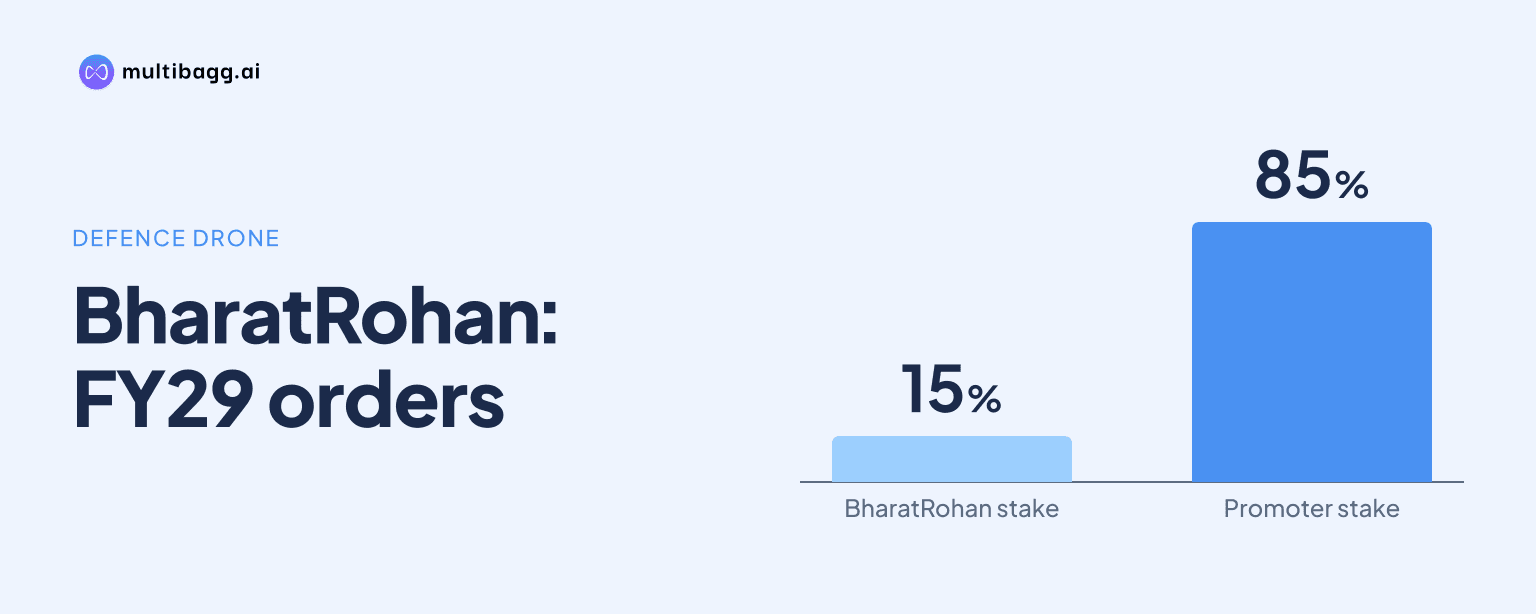
BharatRohan management targets its first defence-drone orders by FY29, after field trials in FY27 and the qualification steps stated in its plan. BharatRohan’s board has approved a 15% stake in a proposed defence venture, while solar, telecom, power, logistics and other inspection applications remain at commercial proof-of-concept, pilot or design stages.
Know BharatRohan Airborne Innovations inside out
Results, valuation, peers and who's buying, in one view.
How is BharatRohan entering the defence-drone market?
BharatRohan is entering defence drones through BharatRohan Defence Pvt. Ltd., a proposed company in which BharatRohan’s board has approved a 15% stake. The promoters would hold the remaining 85%, according to the presentation. BharatRohan says its investment would be funded from internal accruals rather than initial public offering proceeds, separating the proposed defence initiative from the capital raised in its listing process.
The proposed defence company may raise up to Rs 100 crore through a separate private placement. This is a fundraising ceiling rather than a disclosed completed raise, and the presentation does not state a valuation, investor identity, closing date or deployment schedule for those funds. The minority ownership structure means BharatRohan is positioning itself as a participant in the proposed defence venture rather than disclosing full ownership of it.
What defence platforms is BharatRohan planning?
BharatRohan identifies three dual-use drone platforms for the proposed venture: a surveillance and payload-drop platform designed for electronic-warfare resilience, a wide-area hyperspectral surveillance platform, and a mapping platform for areas where satellite-based positioning is unavailable. Hyperspectral imaging is central to one of the three stated platforms and also underpins BharatRohan’s non-agricultural inspection work.
The presentation frames these platforms as products at the design stage, subject to validation, testing and certification. That status matters because BharatRohan has not disclosed defence production, completed qualification, deliveries or order value. Field trials are planned in FY27, followed by the qualification processes cited in the presentation, before management’s FY29 target for first orders.
BharatRohan places this plan against India’s FY27 defence budget of Rs 7.85 lakh crore and says around 75% of capital acquisition is reserved for domestic industry. Those figures describe the market setting cited by management, not BharatRohan’s addressable revenue or a contract pipeline. The presentation provides no estimate of the proposed venture’s share of procurement, manufacturing capacity or annual sales potential.
Which infrastructure inspection markets is BharatRohan pursuing?
BharatRohan is pursuing solar-energy asset monitoring, transmission-line infrastructure, telecom and power towers, wind turbines, warehouses, forestry and commercial plantations. Across these segments, the operating approach combines drones, imaging sensors and analytics to identify physical conditions that may require maintenance, operational action or route planning.
For solar assets, BharatRohan says radiometric drone thermography and hyperspectral imaging can detect hotspots, micro-cracks, bypass-diode failures and potential-induced degradation. These mechanisms are intended to support predictive maintenance and energy-yield management. BharatRohan reports commercial proof-of-concepts with three solar companies in Madhya Pradesh, Rajasthan and Gujarat, and says these projects are being converted into long-term contracts.
For transmission lines, BharatRohan combines high-resolution drone imagery, thermal inspection and artificial-intelligence-driven analytics. The stated inspection targets include thermal anomalies, structural fatigue, electrical faults and right-of-way vegetation encroachment. In telecom and distribution towers, BharatRohan says it has delivered a commercial proof of concept using hyperspectral and thermal imaging, which is a more advanced stage than the internally tested or design-stage applications elsewhere in the presentation.
Got a follow-up? Ask IRIS
How advanced are BharatRohan’s adjacent-sector projects?
BharatRohan’s adjacent-sector projects are at differing stages: solar has completed commercial proof-of-concepts with three companies, telecom and distribution towers have a delivered commercial proof of concept, while pharma, wind and warehouse applications remain at proof-of-concept or development stages. The presentation does not disclose revenue, contract duration, customer names or order values for any of these non-agricultural projects.
In pharmaceutical quality screening, BharatRohan says internal tests showed that its system could distinguish genuine tablets from adulterated or substandard tablets. It explicitly describes that work as proof-of-concept stage and says it has not yet been independently validated. This distinction limits the conclusion that can be drawn from the test result: it establishes an internal capability claim, not an externally validated commercial product.
For wind turbines, BharatRohan is developing drones and image analysis to identify blade cracks, leading-edge erosion, coating damage, and lighting or impact marks. In warehouses, it is conducting a proof of concept with indoor drones that read pallet and carton labels, match labels to rack locations, and flag empty slots or misplaced stock. Neither application has a disclosed commercial contract or implementation timetable.
What role does hyperspectral imaging play in BharatRohan’s expansion?
BharatRohan’s expansion relies on applying hyperspectral imaging and drone-based data collection beyond crop monitoring to assets, materials and terrain. In forestry and commercial plantations, it uses spectral analysis and aerial mapping for automated tree mapping, canopy-health monitoring and diameter-at-breast-height estimation, a measurement used to assess tree size.
The same imaging stack supports solar inspection, tower inspection and the proposed wide-area defence surveillance platform, although each use case requires its own validation and customer acceptance. BharatRohan also launched a 10x10 navigation and route-simulation tool for solar and wind construction logistics. Using digital elevation models and kinematic sweep-path analysis, the tool is intended to identify terrain constraints and support route-safety planning.
The presentation cautions that some client-asset images are illustrative because underlying data cannot be shared under non-disclosure agreements. More importantly, it states that all products are at the design stage and subject to validation, testing and certification. That broad qualification applies to the cross-sector technology narrative and means completed proof-of-concepts should not be treated as equivalent to scaled, recurring contracts.
Conclusion
BharatRohan is extending its drone and hyperspectral capabilities from agriculture into asset inspection, logistics and a proposed defence venture. The clearest commercial milestones disclosed are solar proof-of-concepts with three companies and a delivered telecom and distribution-tower proof of concept, while pharma, wind and warehouse initiatives remain earlier-stage applications. Defence is the longest-dated opportunity, with a planned 15% holding in the proposed venture.
The next disclosed markers are FY27 defence field trials, subsequent qualification steps and management’s FY29 target for first defence orders. Investors can also watch whether the proposed defence company completes any part of its up-to-Rs-100-crore private placement and whether the three solar proof-of-concepts convert into the long-term contracts BharatRohan says it is pursuing.