










BharatRohan targets Q1 2027 US traceable spice launch
Key highlights
- BharatRohan plans to launch 8–12 traceable spice SKUs in the US in Q1 2027.
- BharatRohan expects FSSC 22000 certification for its Jodhpur facility in December 2026.
- BharatRohan’s H1 FY27 gross margin rose to 29.7% from 24.9%.
- BharatRohan served 60,196 farmers across 2,66,537 acres as of 30 September 2026.
powered by IRIS
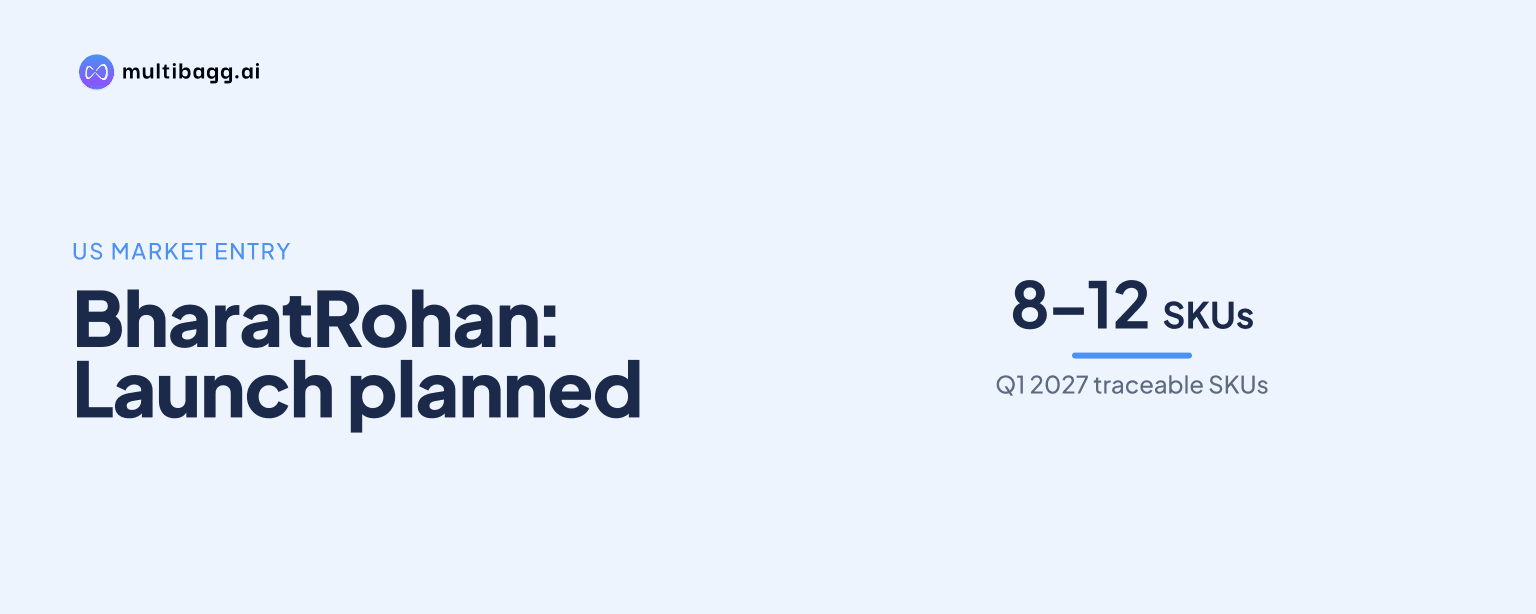
BharatRohan plans to launch 8–12 traceable spice stock-keeping units in the US in Q1 2027 through Amazon and direct-to-consumer channels, supported by its Jodhpur processing facility and expected December 2026 FSSC 22000 certification. The plan follows a domestic rollout across five named digital and offline consumer channels.
Know BharatRohan Airborne Innovations inside out
Results, valuation, peers and who's buying, in one view.
What is BharatRohan planning for the US market?
BharatRohan plans to enter the US in Q1 2027 through BharatRohan Inc., its Delaware entity, with 8–12 traceable spice stock-keeping units, or SKUs, for Amazon and direct-to-consumer sales. The presentation identifies the proposed launch as part of a downstream expansion from farm services and agri-output trading into consumer and export channels.
BharatRohan says a US fundraise is under way for BharatRohan Inc., but does not disclose a completion date, valuation, use of proceeds or US revenue target. The Q1 2027 launch is therefore a stated plan rather than a reported commercial outcome. The presentation also does not specify US product prices, pack sizes, fulfilment arrangements or sourcing volumes.
The presentation displays Kota coriander, Guna Bengal gram, unhusked toor, Marwar fenugreek, Marwar mustard, Marwar fennel and Marwar cumin within its consumer portfolio. These named products show the types of spices and pulses BharatRohan is bringing to market, but they do not establish which of the 8–12 planned US SKUs will be listed.
How is BharatRohan building consumer channels in India?
BharatRohan says it has expanded consumer distribution within six months through Swiggy Instamart, Blinkit, Amazon, its own online storefront and Modern Bazaar. The five routes combine quick commerce, online marketplaces, a company-operated direct store and offline retail for sustainably sourced spices and pulses.
BharatRohan describes customer acquisition in modern retail during the six-month period as organic and says its products gained traction. However, it does not disclose consumer revenue, order volumes, repeat-purchase rates, customer-acquisition costs or the number of Modern Bazaar outlets. The disclosed evidence therefore confirms channel presence but not the financial contribution of the consumer business.
The consumer outlets are separate from BharatRohan’s network of more than 300 retail partners for drone services and agri-inputs. That partner network uses an agent incentive structure to support CropAssure adoption and agricultural-input sales, while the five consumer channels are presented as distribution routes for spices and pulses.
What supports BharatRohan’s traceable export proposition?
BharatRohan identifies its Jodhpur processing facility as the base for consumer and export expansion. The International Fund for Agricultural Development, or IFAD, supported the facility with a grant, and BharatRohan says its processing infrastructure is intended to meet global phytosanitary standards and requirements it cites as FDA-USA and EFSA-EU.
BharatRohan expects Food Safety System Certification 22000, or FSSC 22000, in December 2026. The company says the Global Food Safety Initiative-benchmarked certification would allow the processing unit to supply global retailers directly, naming Walmart, Costco and Tesco as examples. Certification remained an expectation in the H1 FY27 presentation rather than a completed result.
Traceable, lab-verified produce is also part of BharatRohan’s reported H1 FY27 margin explanation. Gross margin rose by 480 basis points to 29.7% from 24.9% in the earlier period, which BharatRohan attributes to a higher share of such produce. The presentation does not separately report gross margin for spices, pulses, the Jodhpur facility or exports.
Got a follow-up? Ask IRIS
How will BharatRohan source produce for consumer and export sales?
BharatRohan plans to source rabi-season produce from its monitored network in H2 FY27 and match procurement to confirmed buyer demand. Seed spices and oilseeds are harvested from February to April, which is why management describes the second half as the larger, rabi-led period.
The company reported Rs 52.49 crore of revenue in H2 FY26, compared with Rs 32.92 crore in H1 FY26. This comparison shows the seasonal difference cited by BharatRohan, but it is not an H2 FY27 revenue forecast. Management’s stated H2 priorities include faster receivable collection and tighter working-capital management alongside buyer-linked sourcing.
As of 30 September 2026, BharatRohan had served 60,196 farmers across 2,66,537 acres, with 28,212 farmers enrolled in CropAssure. Enrolled farmers represented 46.9% of the total farmer base and were up 10.0% from 31 March 2026. BharatRohan identifies this monitored network as the intended base for rabi procurement but does not quantify the acreage or output allocated to consumer or export products.
What financial context frames BharatRohan’s downstream expansion?
BharatRohan reported Rs 14.17 crore of Crop Monitoring Services revenue in H1 FY27, up 53.8%, while agri-output revenue rose 19.1% to Rs 26.96 crore. Crop Monitoring Services represented 33.5% of revenue, showing that farm-service activity and commercial agricultural output remain part of the reported business mix as consumer channels develop.
Profit before tax rose 30.4% in H1 FY27 despite El Niño conditions, while profit after tax fell 10.0%. BharatRohan attributes the decline in profit after tax to the effective tax rate returning to about 33% from about 3% a year earlier. It does not disclose profit by consumer channel, export activity, agri-output product or the Jodhpur facility.
Net worth was Rs 91.60 crore in H1 FY27, compared with Rs 87.45 crore in March 2026, while borrowings were Rs 4.45 crore and debt-to-equity was about 0.05. BharatRohan reported cash flow before working capital of Rs 7.56 crore and said its H2 FY27 plan includes faster collections and tighter working-capital control, both relevant to rabi procurement before sales.
Conclusion
BharatRohan’s planned Q1 2027 US entry brings together an 8–12-SKU traceable spice range, five named domestic consumer channels and Jodhpur-based processing aimed at export readiness. The underlying H1 FY27 results show gross margin of 29.7%, up from 24.9%, as BharatRohan reported a higher share of traceable, lab-verified produce.
The next disclosed milestones are expected FSSC 22000 certification in December 2026, rabi procurement from February to April, progress on the US fundraise and the planned Q1 2027 launch through BharatRohan Inc. The presentation leaves consumer sales, export volumes, certification completion and US launch economics unresolved.