










Bigbloc targets up to 75% H2 utilisation after 68.74% H1 FY27
Key highlights
- Bigbloc reported 68.74% capacity utilisation in H1 FY27 and targets up to 75% in H2 FY27.
- H1 FY27 sales volume rose 22% year on year to 4,46,769 cubic metres.
- H1 FY27 revenue increased about 31% year on year to approximately Rs 162 crore.
- Bigbloc said fresh expansion would be considered at 95% or higher capacity utilisation.
powered by IRIS
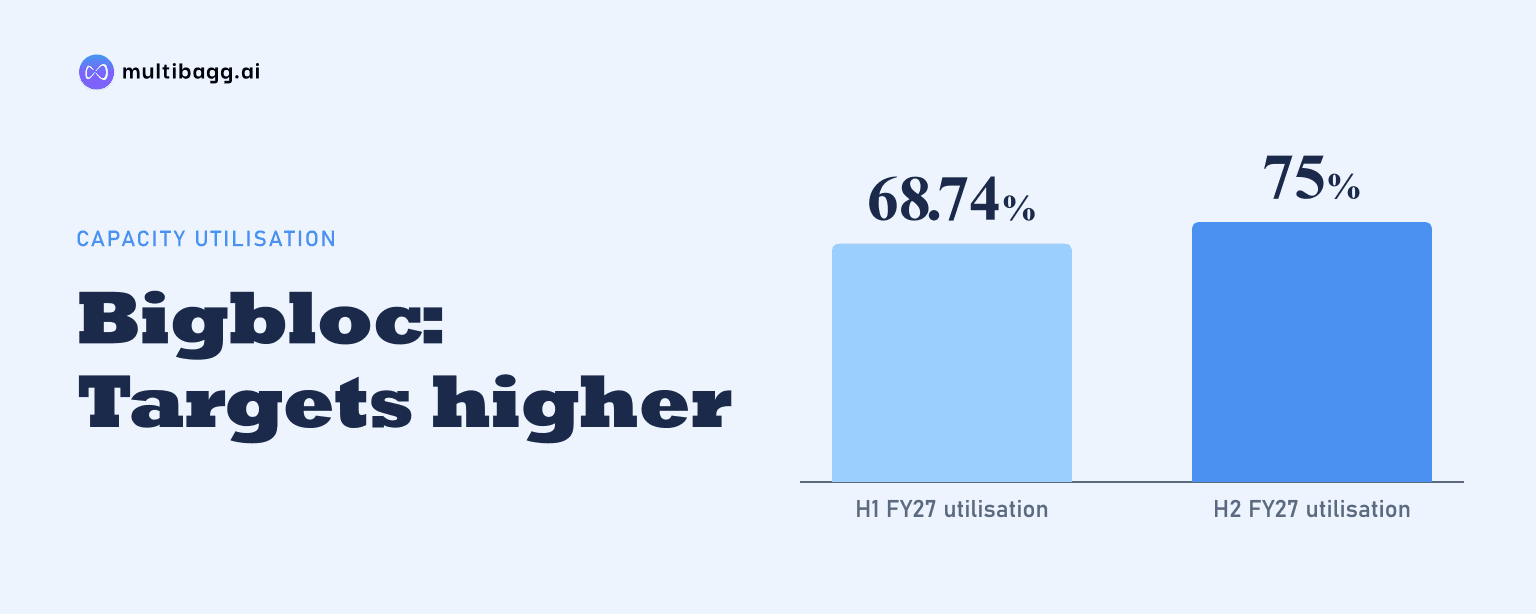
Bigbloc Construction Limited is targeting capacity utilisation of up to 75% in H2 FY27 after reporting 68.74% in H1 FY27, supported by its highest-ever monthly turnover and sales volume in October 2026. Management also expects industrial and construction activity to be stronger in the second half than during the monsoon-affected first half.
Know BIGBLOC Construction inside out
Results, valuation, peers and who's buying, in one view.
Can Bigbloc reach 75% capacity utilisation in H2 FY27?
Bigbloc said it is confident of reaching utilisation of up to 75% in H2 FY27, compared with 68.74% in H1 FY27 and 69.34% in Q2 FY27. Management linked the objective to record October 2026 turnover and sales volume, as well as the usual improvement in construction and industrial activity during the second half. It also said input costs and market conditions would remain relevant factors.
The first-half result was above the prior-year level. Management put H1 FY26 utilisation at about 56%-57%, versus about 68% in H1 FY27, describing the increase as roughly 17%-18%. Sales volume rose 22% year on year to 4,46,769 cubic metres in H1 FY27, while Q2 FY27 volume increased 13% to 2,25,241 cubic metres. Bigbloc said its priority is to translate higher throughput into operating leverage and profitability.
What demand supports Bigbloc’s H2 FY27 utilisation target?
Record October 2026 turnover and sales volume are Bigbloc’s main disclosed demand indicators for the H2 FY27 target. Management did not provide October revenue or volume figures, but said the month reflected product acceptance, customer relationships and a broader market reach. It also said H2 is generally a better demand period than H1, when monsoon conditions disrupted construction activity.
Revenue from operations increased about 31% year on year to approximately Rs 162 crore in H1 FY27, while sales volume grew 22%. Q2 FY27 revenue was approximately Rs 83 crore, up around 23% year on year, and volume reached 2,25,241 cubic metres. Management said it was not aware of major new capacity additions in its operating regions during H1 FY27 and had heard from bankers that some newer autoclaved aerated concrete, or AAC, block units were being offered for sale.
AAC blocks accounted for about 87%-88% of H1 FY27 volume, against about 5%-6% each for AAC panels and construction chemicals. Management said panels were adding customers, including an AdaniConneX data-centre order in Hyderabad and work related to bullet-train stations. It did not disclose an AAC-panel volume target for H2 FY27.
Got a follow-up? Ask IRIS
How are costs and pricing affecting Bigbloc’s H2 plan?
Bigbloc said production costs rose about 8%-12% because of higher lime, coal and other inputs, while it had passed on about 5%-7% to customers. Management attributed the incomplete recovery to monsoon conditions and said it planned to seek the remaining pass-through in the running quarter while staying competitive. This pricing recovery is relevant to profitability as utilisation rises toward the 75% objective.
In Q2 FY27 versus Q1 FY27, lime prices rose around 3%-4% and aluminium-powder prices increased almost 15%-20%, although management cited some reversal in aluminium-powder prices during October. Cement prices were more or less steady, while fly-ash costs rose around 2%-3% because of transportation. Management also cited higher coal, energy and freight costs, and said rain can increase AAC-block density and transport expense during the monsoon.
Q2 FY27 EBITDA, or earnings before interest, tax, depreciation and amortisation, was approximately Rs 3 crore, up 74% year on year, with margin rising 116 basis points to 3.98%. H1 FY27 EBITDA increased to approximately Rs 10 crore from approximately Rs 3 crore in H1 FY26, and margin rose 334 basis points to 5.93%. Bigbloc nevertheless reported a net loss of approximately Rs 2.75 crore in Q2 FY27 and approximately Rs 3.5 crore in H1 FY27.
When will Bigbloc add manufacturing capacity?
Bigbloc said it would look at further expansion in the next one to two quarters when existing facilities reach 95% or higher utilisation. That level is above the 68.74% reported in H1 FY27 and the up-to-75% H2 FY27 target. Management’s stated near-term focus is therefore on increasing loading at the current manufacturing base.
Bigbloc has acquired about 57,000 square metres of land in Madhya Pradesh and completed government approvals and Central Pollution Control Board plan approval for a proposed facility. Construction has not begun, and management said it would decide on expansion in the next one or two quarters after considering the economic environment and geopolitical situation. It did not disclose a project cost, capacity addition or commissioning date.
Management put reported debt-to-equity at about 1.4 times, or about 1.2 times if unsecured promoter loans across the companies were treated as equity. Separately, rooftop solar capacity across facilities totals approximately 3.5 megawatts. Electric forklifts were being installed across all four plants in Q3 FY27, while boiler automation at three plants was expected to be completed in the following quarter; management estimated these efficiency actions could improve EBITDA margin by about 2%-3% over the next one to two quarters.
Conclusion
Bigbloc’s utilisation outlook depends on sustaining the October 2026 demand momentum after H1 FY27 utilisation reached 68.74%, compared with about 56%-57% in H1 FY26. Higher volumes lifted H1 revenue to approximately Rs 162 crore and EBITDA to approximately Rs 10 crore, but management still needs to recover the portion of the 8%-12% input-cost increase not yet passed through to customers.
The next disclosed milestones are H2 FY27 utilisation of up to 75%, completion of electric-forklift deployment in Q3 FY27 and boiler automation in the following quarter. Management also expects to decide within one to two quarters whether to advance the Madhya Pradesh project, while indicating that fresh capacity would be considered at 95% or higher utilisation.