










Bigbloc sees 2-3 point EBITDA margin lift from automation
Key highlights
- Bigbloc said electric forklifts and boiler automation could add 2 to 3 percentage points to EBITDA margin in Q3 and Q4 FY27.
- Electric forklifts were expected to be installed across all four plants in Q3 FY27, while boiler automation at three plants was due in Q4 FY27.
- Bigbloc reported H1 FY27 capacity utilisation of about 68% to 69%, versus about 56% to 57% in H1 FY26.
- Management said production cost increased about 8% to 12%, while customer price pass-throughs were about 5% to 7%.
powered by IRIS
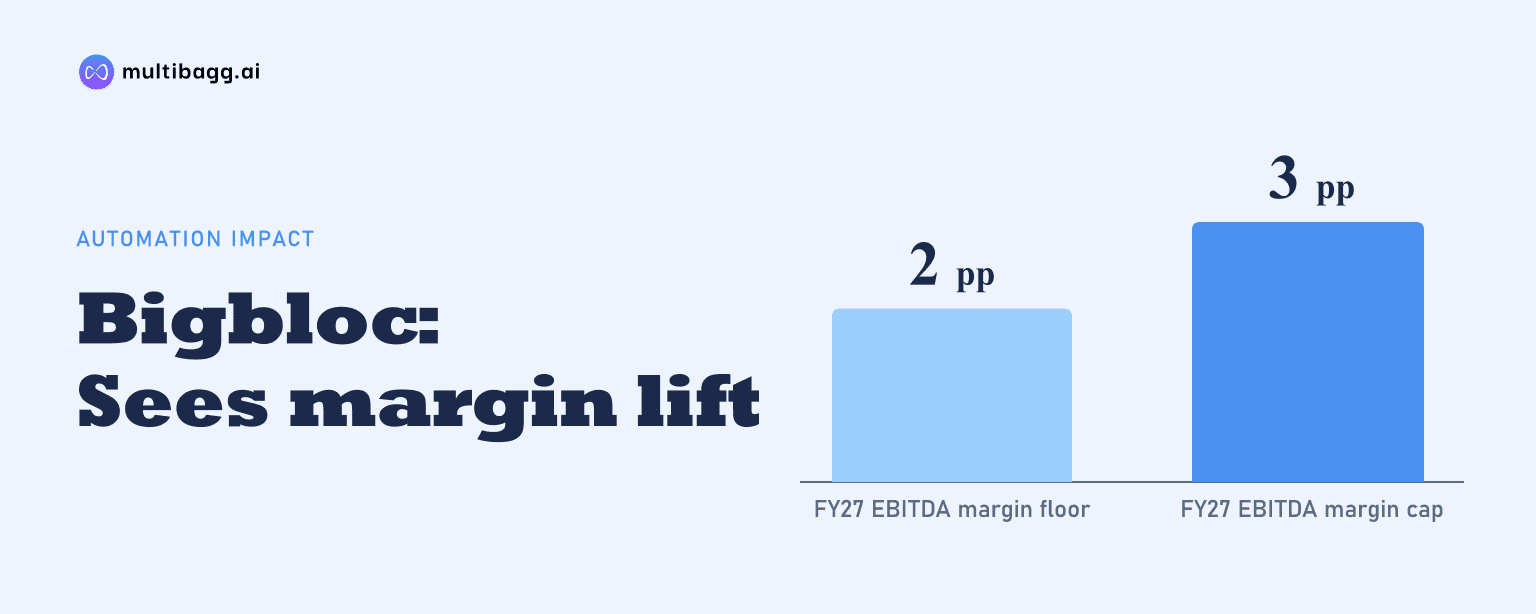
Bigbloc Construction Limited said electric forklifts at four factories and boiler automation at three plants could improve earnings before interest, tax, depreciation and amortisation (EBITDA) margin by about 2 to 3 percentage points in Q3 and Q4 FY27. The programme is intended to supplement customer price increases and higher capacity utilisation after input costs rose during Q2 FY27.
Know BIGBLOC Construction inside out
Results, valuation, peers and who's buying, in one view.
How will Bigbloc improve EBITDA margin?
Bigbloc plans to improve EBITDA margin through electric forklifts, boiler automation, higher plant utilisation and further recovery of input-cost inflation through selling prices. Management said electric forklifts were already being installed in Q3 FY27 and would be deployed across all four plants during that quarter. It linked the remaining operational-efficiency actions to a potential 2 to 3 percentage-point EBITDA-margin improvement.
Boiler automation is being undertaken at three plants and was expected to be completed in the following quarter, or Q4 FY27. Bigbloc said newer plants are already fully automatic and older plants have received automation wherever possible. The current work is therefore an incremental efficiency project rather than a full redesign of its manufacturing network.
Solar power is not part of the additional margin programme because Bigbloc said solar installations are complete at all plants and installed solar capacity cannot be expanded further. Management said Q2 monsoon conditions reduced solar generation, while rainfall also increases AAC block density and therefore transportation costs. These conditions affected operating margins during the quarter.
When will the efficiency programme affect Bigbloc's results?
Bigbloc expects the electric-forklift and boiler-automation measures to be completed over Q3 and Q4 FY27. Forklift deployment across four plants was scheduled for Q3 FY27, while boiler automation at three plants was due by the next quarter. Management did not provide a quarterly EBITDA-margin forecast or separate savings estimate for either project.
The timing coincides with management's expectation of better second-half demand. Bigbloc reported capacity utilisation of about 68% to 69% in H1 FY27 and said it was confident of reaching up to 75% in H2 FY27. Management described October as a record month for turnover in both value and volume terms, although it did not disclose the turnover or volume achieved.
Utilisation has increased from the prior comparison period. Management said H1 FY26 utilisation was about 56% to 57%, compared with about 68% in H1 FY27, which it described as an increase of nearly 17% to 18%. Higher utilisation can spread operating costs over more production, making it a separate margin lever from the planned automation and price increases.
Got a follow-up? Ask IRIS
Which cost pressures is Bigbloc trying to offset?
Bigbloc is seeking to offset higher lime, coal, energy and transportation costs, which management said lifted production cost by approximately 8% to 12%. It said about 5% to 7% of that increase had been passed on to customers, with the remaining 5% to 7% expected to be pursued in the upcoming quarter after monsoon conditions constrained price recovery.
The Q2 FY27 input movements were uneven. Cement prices were broadly steady compared with Q1 FY27, while lime prices rose about 3% to 4% and aluminium powder prices increased about 15% to 20%. Management said aluminium powder prices saw some reversal during October, while fly ash costs had no major rise apart from a transportation-related increase of about 2% to 3% associated with diesel prices.
Bigbloc said fly ash accounts for about 65% of raw-material quantity, followed by cement at 20% to 22% and lime at 10% to 12%. By value, cement is the largest component at about 25% to 30%, while lime represents 15% to 20%, aluminium powder 12% to 15% and fly ash 10% to 15%. That difference means changes in cement, lime and aluminium powder can matter more to input costs than their physical volume shares suggest.
Can pricing and utilisation support Bigbloc's margin plan?
Bigbloc said price recovery and higher utilisation are expected to support the automation-led margin plan in H2 FY27. Management said it had only partly passed on raw-material inflation during the monsoon and was confident of recovering the current increase and any further cost rise in the running quarter, subject to the demand environment.
Logistics remain a significant cost mechanism because Bigbloc said inward transportation of ash and outward delivery of finished goods together account for almost 20% to 30% of its total volumes. Management also said AAC blocks become denser during rains, increasing transportation costs. Electric forklifts target factory material handling, while price increases are intended to address the portion of external input inflation not recovered from customers.
AAC blocks represented about 87% to 88% of H1 FY27 turnover volume, while AAC panels and construction chemicals each contributed about 5% to 6%. Management said AAC panels are produced at only one unit and described the product as a category-creation effort. It cited work or orders involving ITC, bullet train stations, Foxconn factories, Embassy Group and an AdaniConneX data-centre project, without quantifying revenue from those projects.
Management said red bricks were about 10% to 15% more expensive than AAC blocks, although the comparison varies by region because red bricks have three times the density of AAC blocks. Bigbloc also said it was not aware of major capacity additions in its operating regions in H1 FY27 and had heard that some new industrial AAC block units were available for sale. Management said this backdrop had limited pricing pressure while its volumes improved.
Conclusion
Bigbloc's stated 2 to 3 percentage-point EBITDA-margin opportunity depends on completion of its electric-forklift and boiler-automation programme, as well as better utilisation and price recovery. The plan addresses internal operating efficiency while management seeks to recover the 5% to 7% portion of production-cost inflation that it said had not yet been passed on to customers.
The next items to watch are forklift installation across four plants in Q3 FY27, boiler automation at three plants in Q4 FY27 and progress toward up to 75% utilisation in H2 FY27. Management also said it would decide in the next one to two quarters whether to pursue expansion, including at its Madhya Pradesh land where approvals are complete but construction has not begun.