










Blackbuck Says Fastag MDR Impact Should Be Close to Zero
Key highlights
- More than 50% of Blackbuck Fastag transactions are below Rs 2,000.
- Blackbuck piloted the zero-PDN Fastag route in the first week of October 2026.
- Core revenue rose about 31% year-on-year and 11% quarter-on-quarter in the second quarter.
- EBITDA rose 39% to Rs 51 crore and profit after tax rose 42% to Rs 41 crore.
powered by IRIS
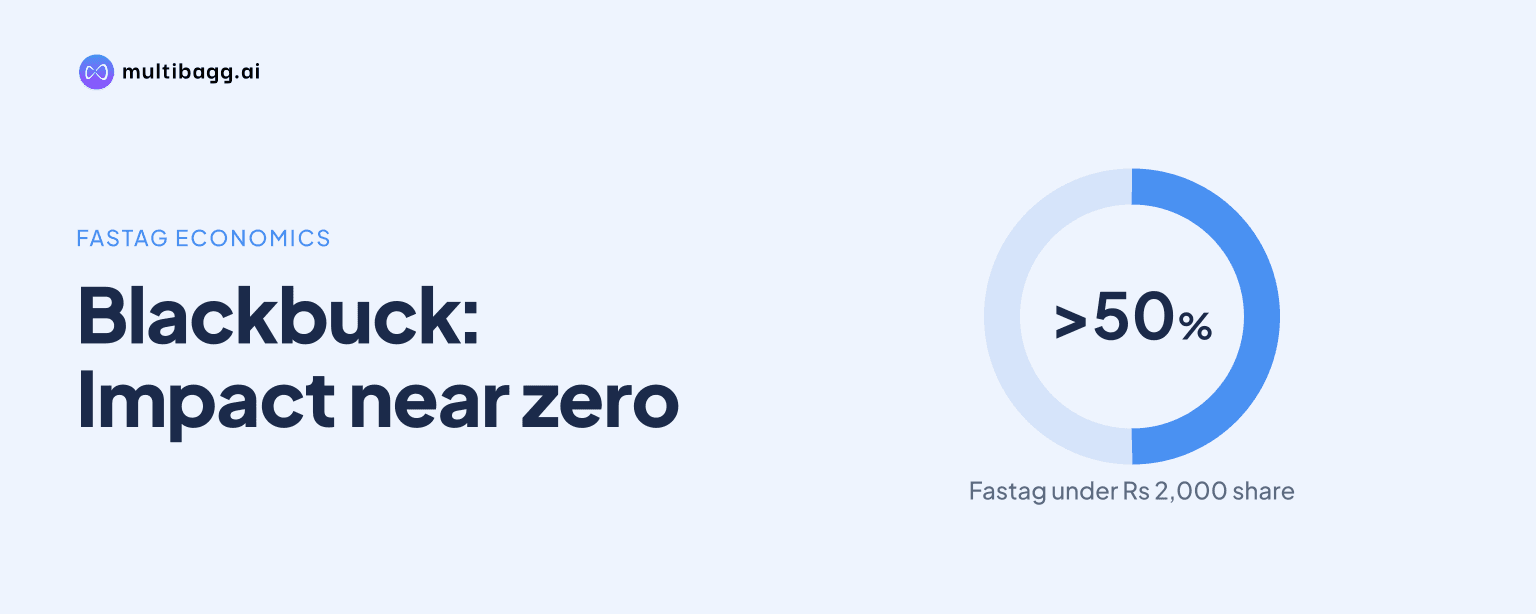
Blackbuck Limited said on its October 29, 2026 earnings call that Unified Payments Interface (UPI) merchant discount rate (MDR) changes should have a significantly close-to-zero impact on its Fastag business, because more than 50% of transactions are below Rs 2,000 and October pilots supported a zero-pre-debit-notification route for larger payments.
Know Blackbuck inside out
Results, valuation, peers and who's buying, in one view.
Why does Blackbuck expect a near-zero Fastag MDR impact?
Blackbuck expects the UPI MDR effect on Fastag to be contained because its payment mix gives it two routes around the potential exposure. More than 50% of Blackbuck Fastag transactions are below Rs 2,000, management said. For the balance above that threshold, management pointed to a Fastag-specific pre-debit notification (PDN) method, also described as the zero-PDN mandate route.
The issue was raised by an analyst in the context of tolling gross transaction value (GTV) of about Rs 7,000 crore and a possible 0.4% MDR. Management did not quantify the share of tolling revenue or margin exposed. Instead, Rajesh Kumar Naidu Yabaji said the combination of sub-Rs 2,000 payments and the PDN mechanism could make the MDR impact “significantly close to zero” for Blackbuck's business.
How would the payment mix and PDN route limit exposure?
Blackbuck's first protection is the transaction-size split: over half of Fastag payments are already below Rs 2,000. That leaves less than half of transactions for which customers may need to use the zero-PDN mandate route. Management said the route is specifically available for Fastag recharges and covers larger payments through a pre-debit-notification mechanism.
The PDN option is relevant because management said it does not operate with a 24-hour latency for debit and credit completion. That distinction is central to Blackbuck's expectation that users making payments above Rs 2,000 can shift without disrupting the Fastag recharge experience. However, management did not give a figure for the share of above-Rs 2,000 payments already using the route.
What evidence does Blackbuck have before implementation?
Blackbuck's evidence is limited to pilots conducted in the first week of October 2026, and management said those pilots broadly followed the expected pattern. Satyakam G N said users either made payments below Rs 2,000 or used the zero-PDN mandate route, supporting management's expectation that the eventual impact should be largely contained.
Management also made clear that the actual effect will be known only after implementation. In response to the concern that customers above Rs 2,000 may need prompting and could adopt slowly, Satyakam said Blackbuck would assess the real impact once the change takes effect. The near-zero assessment is therefore management's view based on the October pilot, rather than a reported post-implementation result.
What changed in Blackbuck's core revenue in the second quarter?
Blackbuck said core revenue rose about 31% year-on-year and 11% quarter-on-quarter in the second quarter, despite tolling GTV being broadly flat quarter-on-quarter and tolling transactions declining about 2%. Management attributed a large part of the core-revenue increase to telematics, where it reported record new-device sales in the quarter.
On tolling, management cited minor one-off revenue benefits during the quarter but said there was no material change in the take rate compared with previous quarters. This created a contrast within the core business: telematics supplied much of the reported revenue acceleration, while tolling activity was affected by a seasonally weaker rains quarter and did not show comparable sequential transaction growth.
Got a follow-up? Ask IRIS
How is Blackbuck expanding Fastag and telematics?
Blackbuck said its long-term Fastag model will remain partner-led, with partners continuing to account for the majority of volumes. The Fastags issued on Blackbuck's own prepaid payment instrument licence are incremental rather than replacements for the existing partner business, and management said it has seen a significant uptick in these Blackbuck Fastags.
Telematics growth has been driven mainly by mandates across states for different use cases, according to management. New products including fuel sensors contributed only a small part of the acceleration, while dash cameras were being piloted as of the October 29 call. Management said higher incremental market share in mandated devices has lifted quarterly device sales.
What costs and financial trends accompanied Blackbuck's growth?
Blackbuck reported total income growth of about 51%, revenue from operations growth of 56%, and net revenue growth of 35%. Adjusted earnings before interest, tax, depreciation and amortisation (EBITDA) increased 29%, while EBITDA rose 39% to Rs 51 crore and profit after tax increased 42% to Rs 41 crore. Total expenses increased 36% year-on-year, which management attributed to core-business growth and investment in super loads.
Management said customer acquisition costs are incurred upfront when Blackbuck sells devices, Fastags or other products, while lifetime value is earned over the customer relationship. It said rising telematics sales therefore increase acquisition costs in the current quarter and can suppress EBITDA before deferred revenue accrues. Deferred revenue on the half-year balance sheet rose 56% year-on-year, while management said depreciation growth is linked to telematics expansion and gave no depreciation or capital-expenditure guidance.
Conclusion
Taken together, Blackbuck's position is that payment-size mix and the Fastag-specific zero-PDN route should prevent UPI MDR changes from becoming a material tolling-business issue. That position sits alongside a second-quarter mix in which telematics drove a large part of 31% year-on-year core-revenue growth, while tolling GTV was broadly flat sequentially and tolling transactions fell about 2%.
The next point to watch is the actual result after implementation, since management said the October 2026 pilots are not a substitute for live adoption by customers paying above Rs 2,000. Management also said the tolling industry typically picks up in the third and fourth quarters after a rains-affected second quarter, while Blackbuck plans to continue investing in super loads and telematics opportunities.