










Blackbuck says upfront spending suppresses EBITDA in Q2 FY27
Key highlights
- Blackbuck said half-year deferred revenue increased 56% year on year.
- An analyst cited Q2 FY27 core-revenue growth of about 31% year on year and 11% quarter on quarter.
- Blackbuck said more than 50% of its transactions are below Rs 2,000.
- Blackbuck said Superloads operates in 14 cities, including 12 newer cities.
powered by IRIS
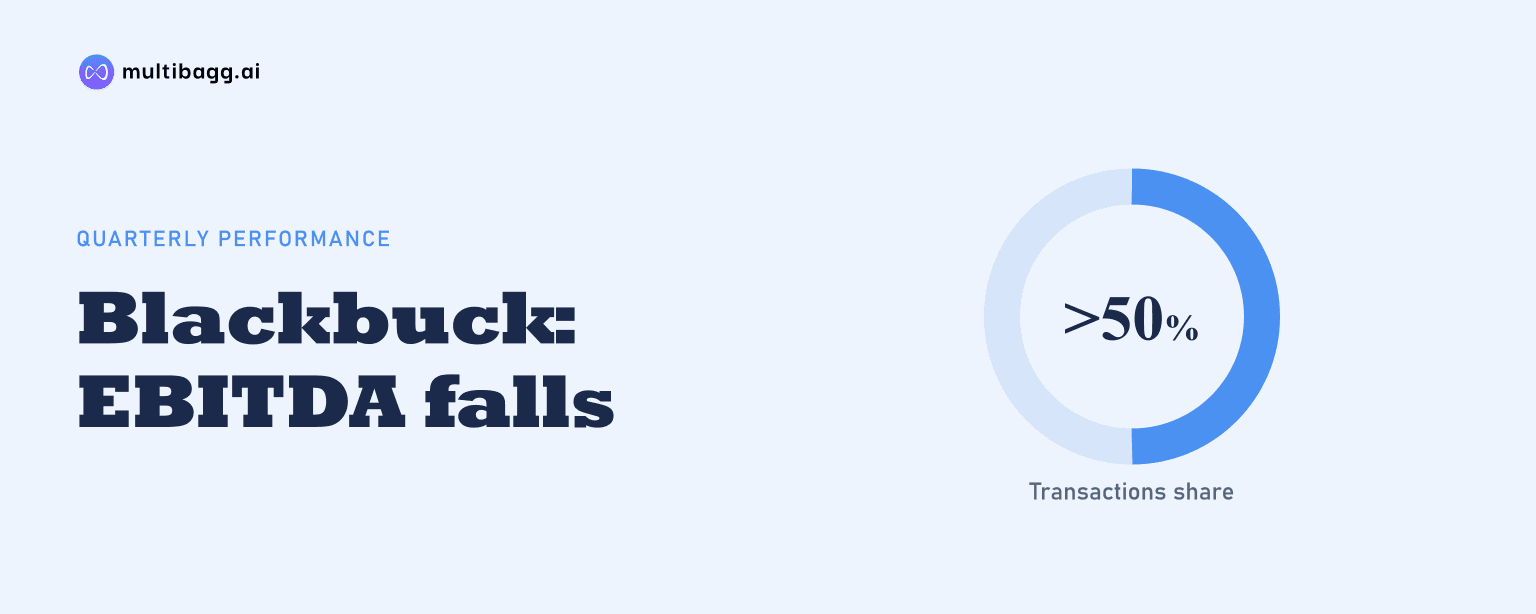
Blackbuck Limited said Q2 FY27 EBITDA was suppressed because faster telematics-device, Fastag and other product sales brought customer-acquisition costs forward, while related customer revenue accrues over time; its half-year deferred revenue rose 56% year on year, four to five times the absolute increase in depreciation.
Know Blackbuck inside out
Results, valuation, peers and who's buying, in one view.
Why is Blackbuck’s EBITDA being suppressed by customer acquisition?
Blackbuck’s EBITDA is being suppressed because it pays customer-acquisition costs when it makes incremental product sales but expects to earn lifetime value, or LTV, over the customer relationship. Management said this applies to devices, Fastags and other products, with a largely variable sales engine causing acquisition expense to rise in the same quarter as sales.
Management said a period of rapid sales can therefore show higher immediate operating expenditure before the associated revenue has accrued over the customer’s lifetime. It characterised the Q2 FY27 effect as a timing difference in its commercial model, rather than disclosing a change in pricing, product mix or tolling take rates.
The company compared the current investment with earlier years, when it had a smaller revenue base and was in a heavy customer-acquisition cycle that produced high losses. Management said EBITDA compounded after acquisition spending was broadly held constant for a few years, while adding that spending was constrained then because further acquisition had become unprofitable.
Blackbuck said it is now increasing acquisition where it sees opportunities to expand and gain market share. It did not provide an EBITDA target, a customer-acquisition-cost amount, an LTV figure or a timetable for EBITDA to catch up on the October 29, 2026 Q2 and H1 FY27 earnings call.
What drove Blackbuck’s Q2 FY27 core-revenue growth?
Telematics was the main driver of Blackbuck’s Q2 FY27 core-revenue growth, according to management, which said it achieved record new device sales during the quarter. An analyst said core revenue rose about 31% year on year and 11% quarter on quarter even though gross transaction value, or GTV, was broadly flat sequentially and tolling transactions declined about 2%.
Management said the contrast between core-revenue growth and tolling activity was principally explained by telematics, rather than by a material change in tolling take rates. It also identified minor one-off tolling benefits in Q2 FY27, but said there had been no material take-rate change compared with previous quarters.
The main source of telematics acceleration was Automotive Industry Standard, or AIS, mandates across states for different use cases, management said. Blackbuck said it was capturing incremental market share in this activity, resulting in higher device sales each quarter.
Fuel sensors and dash cameras were a smaller source of the increase than AIS mandates. Management said it was expanding fuel-sensor sales and piloting dash cameras as of October 29, 2026, but did not give device volumes, revenue contribution or a rollout schedule for either product.
How does deferred revenue affect Blackbuck’s telematics economics?
Deferred revenue indicates that part of Blackbuck’s telematics revenue is recognised over time, and management said deferred revenue in its half-year balance sheet increased 56% year on year. It said the absolute increase was four to five times the absolute growth in depreciation, linking the balance-sheet movement to telematics expansion.
Management said depreciation is largely connected to telematics growth and should follow the direction of that business. An analyst said capital expenditure was around Rs 77.1 crore and depreciation had roughly doubled year on year, but Blackbuck gave neither capital-expenditure guidance nor a forecast for depreciation.
Blackbuck said telematics is comparatively straightforward to assess because it combines immediate acquisition costs with a deferred-revenue component that scales as customer revenue is recognised over a period. It did not disclose the deferred-revenue balance, contract duration, device price, renewal rate or average revenue per device, limiting calculation of the recognition schedule.
The 56% increase in deferred revenue is the disclosed measure supporting management’s view that revenue continues to accrue beyond the initial device sale. Management also said telematics was reaching newer highs and that AIS conditions should allow it to grow faster, although this was an outlook rather than a quantified target.
Got a follow-up? Ask IRIS
What supports Blackbuck’s telematics sales beyond AIS mandates?
Blackbuck said telematics demand is also supported by fleet-management needs, AIS operating requirements and its service network. Management said repeat truck buyers generally already operate fleets and prefer using the same Blackbuck software for incremental vehicles to monitor drivers, locations and customer location-sharing in one system.
Management did not provide data separating new trucks, used trucks and vehicles switching after an original equipment manufacturer, or OEM, subscription ends. It said it lacks data on the number of new trucks entering the market and the proportion of them fitted with its devices.
For AIS devices, Blackbuck cited activation, maintenance, government-portal integrations and state-level execution as operational requirements. Management said it has a pan-India service network and can arrange rapid repairs when a truck is down, while describing AIS devices as among the largest quantities sold in at least 14 cities.
Its Superloads business operates in 14 cities, including two earlier cities and 12 newer cities. Management described Superloads as largely cash-and-carry, with customer advances received around vehicle loading and only a few days of working capital, which is separate from the acquisition-cost dynamics in telematics.
What could affect Blackbuck’s margin progression next?
Blackbuck’s margin progression will depend on the rate of incremental customer acquisition because management said higher device, Fastag and other product sales bring more variable acquisition costs into the sale quarter. Continued telematics acceleration could therefore increase immediate expense before the related lifetime revenue is recognised.
AIS mandate activity across states is a key operating variable because management attributed the larger share of the Q2 FY27 device-sales acceleration to those mandates and market-share gains. Fuel sensors and the dash-camera pilot were only small contributors as of the October 29, 2026 call, and management gave no sales target for either offering.
Tolling revenue could also be affected by merchant discount rate, or MDR, treatment on Unified Payments Interface, or UPI, payments. Management said more than 50% of Blackbuck transactions are below Rs 2,000 and expects a combination of smaller transactions and the zero pre-debit-notification, or PDN, mandate route to make MDR impact close to zero.
Management said pilots conducted in the first week of October 2026 broadly reflected that payment mix. It nevertheless said the actual impact will be known only after implementation, while customers making payments above Rs 2,000 may need to adopt the PDN route.
Conclusion
Blackbuck’s Q2 FY27 explanation is that growth investment and revenue recognition occur at different points: telematics-led sales produce acquisition costs immediately, while related revenue accrues over the customer relationship. The 56% year-on-year deferred-revenue increase is the main disclosed evidence that the telematics revenue base is extending beyond the initial sale period.
The next issue to watch is whether AIS-led device sales continue at the pace management described and how much acquisition spending accompanies them. Management provided no EBITDA, depreciation or capital-expenditure guidance, while dash cameras remained in pilot stage and the actual UPI MDR outcome remained unresolved pending implementation.