










BlackBuck steps up Super Loads after AI gains in 14 cities
Key highlights
- BlackBuck operated Super Loads in 14 cities in Q2 FY27, including 12 newer cities.
- BlackBuck's combined loads and vehicle-finance businesses grew 166% year on year and 25% sequentially in Q2 FY27.
- BlackBuck reported about Rs 55 crore of adjusted EBITDA in Q2 FY27, up close to 30% year on year.
- BlackBuck said Super Loads has a few days of working capital because customer advances are received around vehicle loading.
powered by IRIS
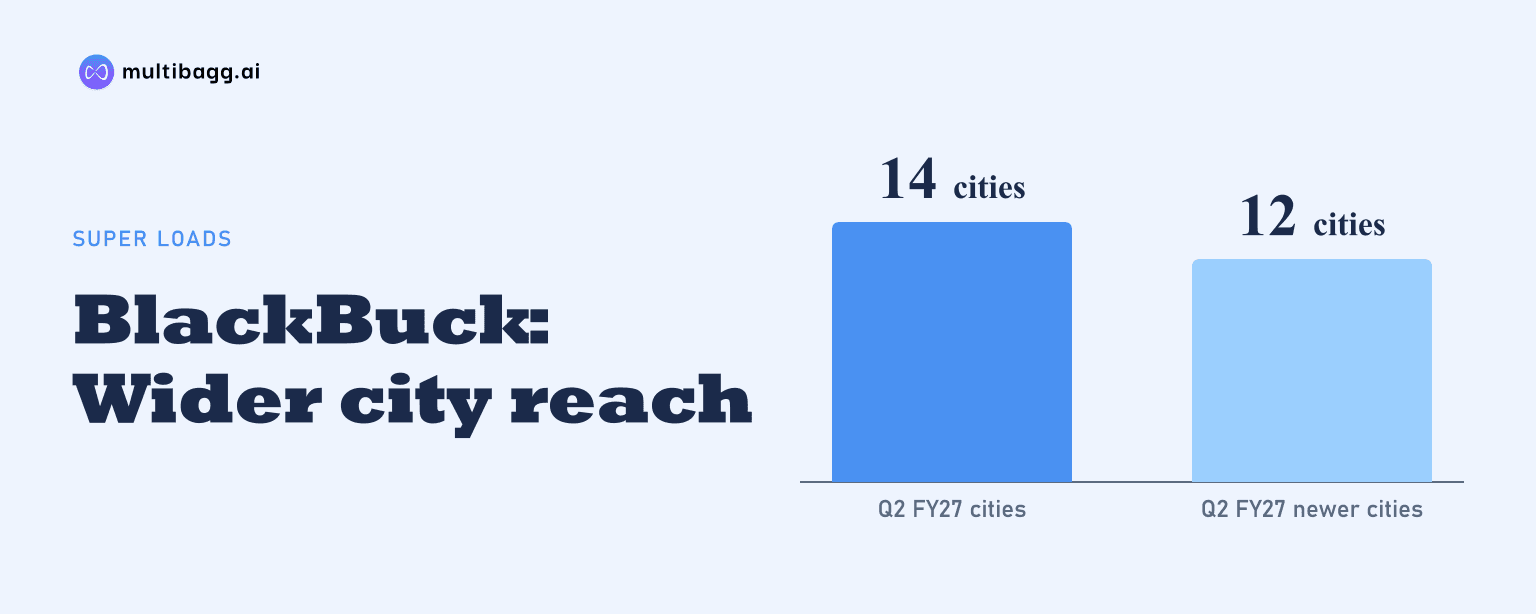
In Q2 FY27, BlackBuck Limited stepped up investment in Super Loads after AI-led freight matching improved productivity across 14 cities, while its combined loads and vehicle-finance businesses grew 166% year on year. Management said Super Loads is largely cash-and-carry, with customer advances received around vehicle loading and only a few days of working capital overall.
Know Blackbuck inside out
Results, valuation, peers and who's buying, in one view.
Why is BlackBuck increasing investment in Super Loads?
BlackBuck is increasing Super Loads investment because management said it has gained greater clarity on the operating playbook as new cities scale and existing cities improve productivity. The company said it would continue to invest and expand Super Loads, which sits within its growth-business category alongside vehicle finance.
Management attributed the improvement to artificial intelligence, or AI, used in freight matchmaking. It said AI had increased the productivity of people and the efficiency of spending in existing cities. Management also said it had tested margin levels in some existing cities and seen results which, in its view, support the business's potential for long-term profitability, although it disclosed no city-level margin or revenue data.
The higher investment is reflected in BlackBuck's expense growth. Total expenses rose 36% year on year in Q2 FY27, compared with what management described as growth in the teens in earlier periods. Management attributed the increase to expansion in core businesses and Super Loads investment, while also citing upfront customer-acquisition spending during the quarter.
How extensive is BlackBuck's Super Loads network?
BlackBuck operates Super Loads in 14 cities, comprising two earlier cities and 12 newer cities. The company did not disclose the city names, number of hubs, freight volumes or a timetable for further launches. The mix indicates that most disclosed locations are recent additions, while management is also working on productivity and margin levels in existing markets.
BlackBuck said the business is largely cash-and-carry because it receives customer advances broadly around the time a vehicle is loaded. Management described Super Loads as having a few days of working capital on an overall basis. This model limits the period between customer collection and the operating cycle, although the company did not quantify working capital in rupees.
The company linked the network expansion to its freight-matching technology rather than to owned freight assets. Management said AI-led matching had improved productivity in existing cities and supported stronger unit economics during Q2 FY27. It did not provide metrics such as match rates, loads per city, cost per shipment or repeat-customer activity.
How quickly are BlackBuck's growth businesses expanding?
BlackBuck's combined loads and vehicle-finance businesses grew 166% year on year and 25% sequentially in Q2 FY27. Management described the year-on-year increase as roughly 2.7 times. The disclosure combines the two businesses, so it does not establish Super Loads' standalone revenue growth or contribution to the increase.
The growth-business category expanded faster than the core on both disclosed comparisons. Management said vehicle finance uses a partner-led model and remains on track for earnings before interest, tax, depreciation and amortisation, or EBITDA, break-even in FY27. It said assets under management, or AUM, managed by partners were steadily increasing, without disclosing an AUM amount.
At the company level, total income was about Rs 253 crore in Q2 FY27, up 51% year on year. Revenue from operations rose 56%, while net revenue was about Rs 183 crore, up about 35%. Management described net revenue as the revenue BlackBuck effectively makes, providing the financial context for further investment in Super Loads.
Got a follow-up? Ask IRIS
Is BlackBuck profitable while funding Super Loads?
BlackBuck reported adjusted EBITDA of about Rs 55 crore in Q2 FY27, up close to 30% year on year, while reported EBITDA was close to Rs 51 crore, up 40%. Profit after tax was about Rs 41.4 crore, up 42%. Management said adjusted EBITDA is a blended metric that includes investment in newer and emerging businesses.
The core business continues to provide profitability and operating cash flow, according to management. It said core operating leverage is now around 50% despite upfront investments, compared with a historic range of 70% to 85% and at times 100%. Management attributed the lower current operating leverage to additional investment opportunities rather than separating the effect of Super Loads.
Core operations also recorded growth in tolling and telematics. Tolling gross transaction value, or GTV, was about Rs 7,070 crore in Q2 FY27, up 17% year on year. Management said telematics recorded its highest new-device sales for a second consecutive quarter, but revenue is recognised across the year rather than fully when devices are sold.
What other platform trends support BlackBuck's strategy?
BlackBuck reported close to 9 lakh transacting customers in Q2 FY27, up about 13% year on year, including close to 4.8 lakh power users who use more than two services. Management said power users grew about 20% year on year and represented more than half of transacting customers, supporting its strategy of adding services for truck operators.
The company said its physical network has 10,000 touchpoints and reaches 80% of districts. Management views the network as important because trucks and their operators are mobile and may require service away from their original purchase location. It said the distribution network supports the use of multiple offerings on the platform.
Telematics was a major contributor to core revenue growth during the quarter, according to the chief financial officer. Management said the main driver of device-sales acceleration was Automotive Industry Standard, or AIS, mandates across states and incremental market-share capture. Fuel sensors and dash cameras were smaller contributors, with dash cameras still being piloted.
Conclusion
BlackBuck's Q2 FY27 update shows that Super Loads is receiving more investment as management applies AI-led freight matching across 14 cities. The business's cash-and-carry structure, with a few days of working capital, is central to management's expansion case. Its combined loads and vehicle-finance category grew 166% year on year while BlackBuck reported about Rs 55 crore of adjusted EBITDA.
The next disclosed milestone is vehicle finance reaching EBITDA break-even during FY27, which management said remains on track. For Super Loads, investors will need to watch for evidence that the 12 newer cities develop the productivity and margin characteristics management said it was testing in existing cities, as BlackBuck did not disclose standalone revenue, margins or shipment volumes for the business.