










BMW Ventures reports operating cash outflow on receivables
Key highlights
- BMW Ventures reported a Rs 10.7569 crore operating cash outflow for the half year ended September 30, 2026, against a Rs 10.1699 crore inflow a year earlier.
- Trade receivables increased by Rs 78.8917 crore and inventories increased by Rs 45.8362 crore in the September 2026 half year.
- BMW Ventures’ revenue rose to Rs 1,340.1592 crore and profit after tax rose to Rs 21.1137 crore in the September 2026 half year.
- Borrowing proceeds of Rs 49.0658 crore helped lift cash and cash equivalents to Rs 17.7982 crore at September 30, 2026.
powered by IRIS
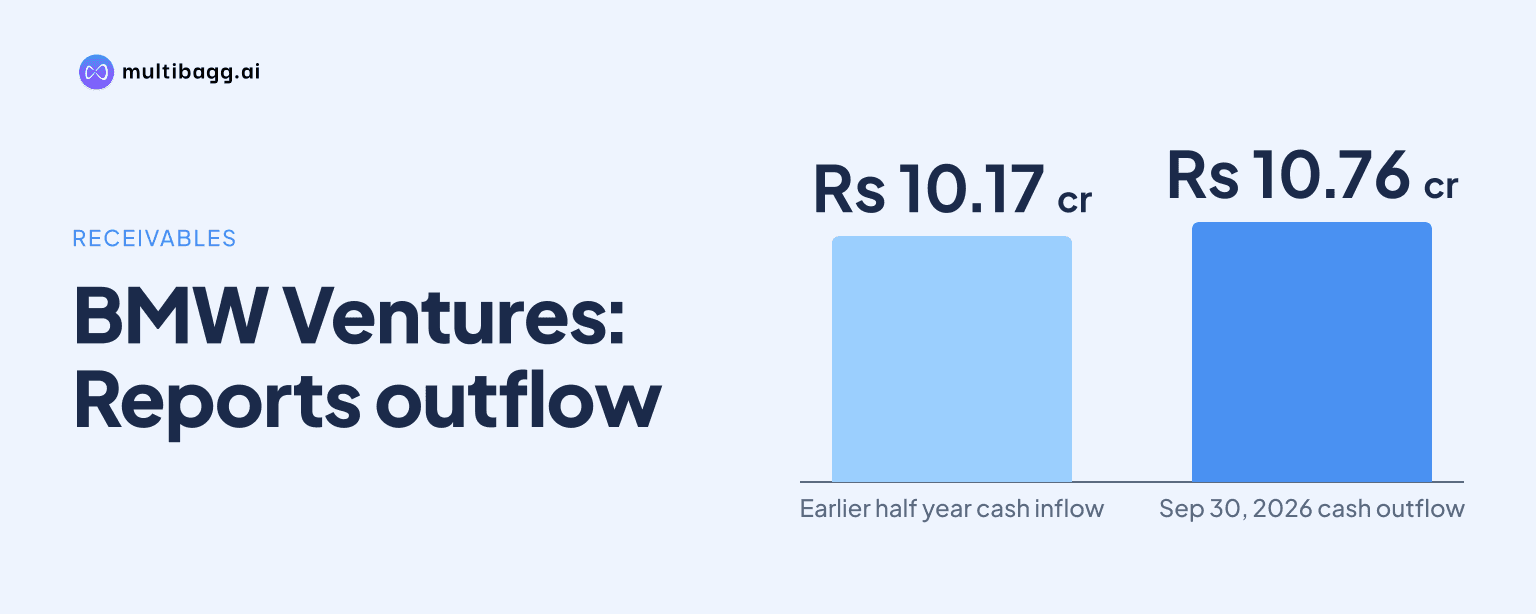
BMW Ventures Limited reported net cash used in operating activities of Rs 10.7569 crore for the half year ended September 30, 2026, compared with a Rs 10.1699 crore inflow a year earlier, as trade receivables increased by Rs 78.8917 crore and inventories by Rs 45.8362 crore despite higher profit.
Know BMW Ventures inside out
Results, valuation, peers and who's buying, in one view.
What caused BMW Ventures’ operating cash outflow?
BMW Ventures’ operating cash outflow was primarily caused by cash being absorbed in trade receivables and inventories in the half year ended September 30, 2026. Operating profit before working-capital changes rose to Rs 45.4178 crore from Rs 39.9108 crore in the half year ended September 30, 2025, but subsequent working-capital movements turned that operating profit into a Rs 5.6572 crore cash outflow before direct taxes.
The largest working-capital use was a Rs 78.8917 crore increase in trade receivables, higher than the Rs 49.5661 crore increase in the comparable 2025 half year. Inventories absorbed another Rs 45.8362 crore, compared with Rs 27.2978 crore a year earlier. These cash uses exceeded increases in trade payables of Rs 15.5939 crore, other financial liabilities of Rs 9.1299 crore and other liabilities of Rs 34.6673 crore.
Direct taxes of Rs 5.0997 crore took net cash used in operating activities to Rs 10.7569 crore. In the prior-year half, direct taxes were Rs 4.3831 crore and operating cash flow was positive at Rs 10.1699 crore. The disclosed cash-flow reconciliation therefore attributes the reversal in operating cash generation to working-capital changes rather than lower operating profit.
How did BMW Ventures’ receivables and inventory change?
BMW Ventures’ balance sheet shows trade receivables of Rs 338.5573 crore and inventories of Rs 343.2540 crore at September 30, 2026, versus Rs 259.6655 crore and Rs 297.4178 crore, respectively, at March 31, 2026. Together, the two closing balances were Rs 681.8113 crore, compared with Rs 557.0833 crore at the start of the financial year.
BMW Ventures’ total current assets rose to Rs 725.9831 crore at September 30 from Rs 598.4404 crore at March 31, an increase of Rs 127.5427 crore. Cash and cash equivalents increased to Rs 17.7982 crore from Rs 65.94 lakh, while loans and advances fell to Rs 25.94 lakh from Rs 6.4127 crore and other financial assets declined to Rs 10.4111 crore from Rs 16.9380 crore.
Current liabilities rose by Rs 36.4798 crore to Rs 339.6636 crore. Other current liabilities increased to Rs 65.4383 crore from Rs 30.7710 crore, and trade payables rose to Rs 23.2061 crore from Rs 7.6122 crore. Those liability movements provided some operating cash, but did not offset the Rs 124.7279 crore combined increase in receivables and inventories.
Got a follow-up? Ask IRIS
Why did BMW Ventures’ profit rise while operating cash fell?
BMW Ventures reported higher profit during the September 2026 half year while operating cash flow moved into an outflow because profit and cash flows reflect working-capital timing differently. Revenue from operations increased to Rs 1,340.1592 crore from Rs 986.4437 crore in the corresponding 2025 half, while profit before tax rose to Rs 29.1091 crore from Rs 20.4981 crore.
Profit after tax increased to Rs 21.1137 crore from Rs 15.1396 crore, even as operating cash flow declined by Rs 20.9268 crore year on year. The company aggregated its activities into one operating segment under Indian Accounting Standard 108, including dealership activities for John Deere India Private Limited tractors in Bihar, PVC pipes, pre-engineered buildings, railway girders and construction-equipment rentals.
Under the indirect method required by Indian Accounting Standard 7, or Ind AS 7, BMW Ventures started with pre-tax profit and adjusted for non-cash and specified items. Depreciation of Rs 3.4591 crore and finance costs of Rs 11.7020 crore were added back, while rent received on investment property of Rs 78.91 lakh and interest income of Rs 25.72 lakh were deducted, producing Rs 45.4178 crore of operating profit before working-capital changes.
The comparison indicates that the issue was cash conversion during the period rather than a decline in the reported income statement result. In the September 2025 half year, the combined inventory and receivables cash use was Rs 76.8639 crore, compared with Rs 124.7279 crore in the latest half, while operating profit before working capital rose by Rs 5.5070 crore.
How did BMW Ventures fund the cash shortfall and investment spending?
BMW Ventures funded its operating and investing cash uses through financing inflows in the half year ended September 30, 2026. Borrowing proceeds were Rs 49.0658 crore and finance costs paid were Rs 11.7020 crore, resulting in net cash from financing activities of Rs 37.3637 crore, against Rs 219.0308 crore in the prior-year half that included Rs 203.8608 crore of share-issue proceeds.
Investing activities used Rs 9.4680 crore, compared with Rs 9.3853 crore in the corresponding 2025 half year. Purchases of property, plant and equipment were Rs 9.0065 crore, capital advances for property, plant and equipment were Rs 3.7194 crore, and investment-property purchases were Rs 1.2258 crore; these were partly offset by Rs 2.0193 crore from changes in investments and Rs 1.4181 crore from asset sales.
The balance sheet shows a changed borrowing mix at September 30, 2026. Current borrowings fell to Rs 230.3079 crore from Rs 257.9436 crore at March 31, while non-current borrowings were Rs 76.7014 crore at September 30, compared with no reported non-current borrowing balance at March 31. Total non-current liabilities rose to Rs 84.5728 crore from Rs 7.0241 crore.
Net financing inflows exceeded the operating and investing outflows, increasing cash and cash equivalents by Rs 17.1388 crore during the half year. BMW Ventures closed September 30, 2026 with Rs 17.7982 crore in cash and cash equivalents, compared with Rs 232.2497 crore at September 30, 2025, when the cash-flow statement included the share-issue proceeds.
Conclusion
BMW Ventures delivered higher half-year revenue of Rs 1,340.1592 crore and profit after tax of Rs 21.1137 crore, but its cash flow did not follow the same direction. A Rs 78.8917 crore rise in receivables and a Rs 45.8362 crore inventory build-up outweighed liability-related cash inflows, producing a Rs 10.7569 crore operating cash outflow that financing inflows covered.
The next disclosed event is BMW Ventures’ interim dividend of Rs 1.50 per equity share for financial year 2026-27, with a total payout of Rs 13.0073 crore. The record date is November 13, 2026 and payment is due on or before December 2, 2026; the company said the dividend was not recognised as a liability at September 30, 2026 under Ind AS 10.