










Cadsys: U.S. Fiber Access Hits 60.5%, BEAD Depends on States
Key highlights
- U.S. fiber access reached approximately 60.5% of households in 2025, up from 56.5% in 2024.
- Record U.S. fiber deployment added approximately 11.8 million fiber passings in 2025.
- Fiber access increased by 39.5 percentage points from 21.0% of U.S. households in 2015 to 60.5% in 2025.
- Full-year 2026 fiber deployment data were not available as of 16 November 2026.
powered by IRIS
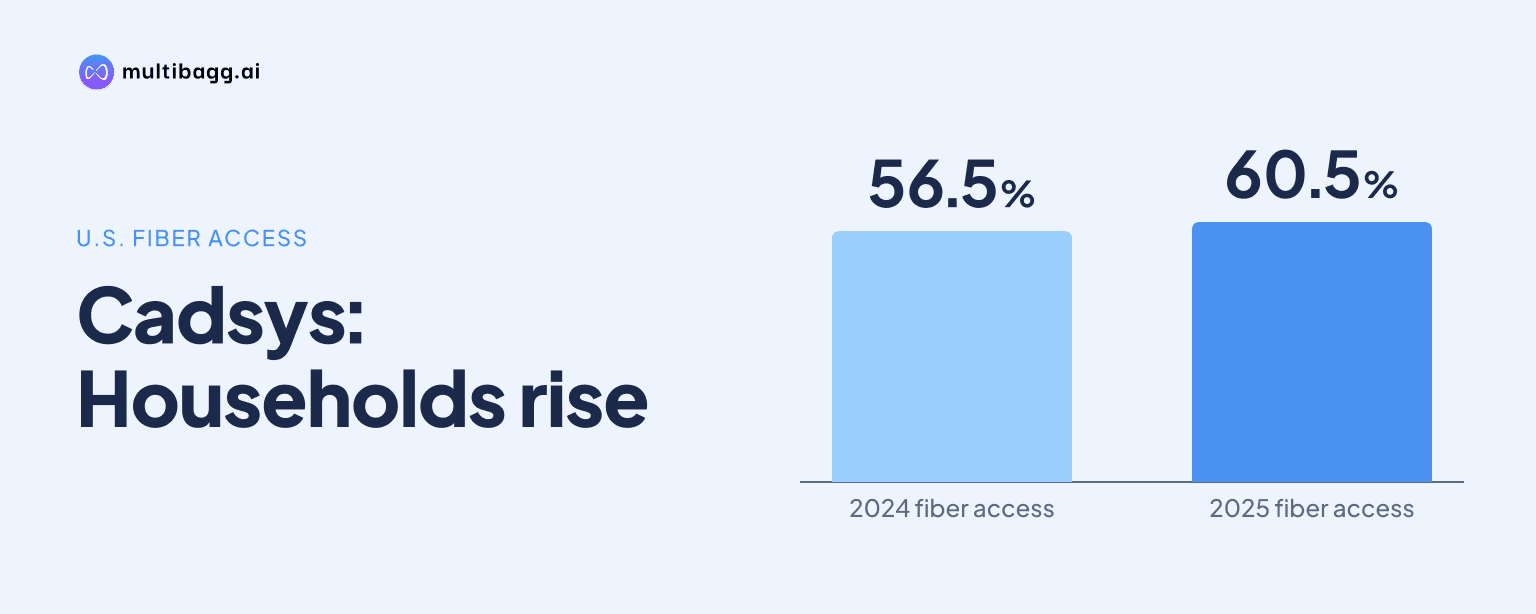
Cadsys (India) Limited says U.S. fiber access reached approximately 60.5% of households in 2025 after about 11.8 million additional fiber passings, but potential work from the Broadband Equity, Access, and Deployment (BEAD) programme depends on state approvals, awards, permitting and construction readiness.
Know Cadsys (India) inside out
Results, valuation, peers and who's buying, in one view.
How did U.S. fiber access change by 2025?
U.S. fiber access rose from 21.0% of households in 2015 to approximately 60.5% in 2025, an increase of 39.5 percentage points over 10 years. Cadsys's annual series shows that access crossed half of U.S. households in 2023, at 50.5%, before reaching 56.5% in 2024 and 60.5% in 2025.
The 2025 result was 4.0 percentage points above the 56.5% recorded in 2024, compared with a 4.5-percentage-point increase between 2022 and 2023. The presentation therefore shows continued expansion after fiber availability passed 50% of U.S. households, but it provides no 2026 household-access forecast.
Cadsys describes 2023 as a year of accelerated deployment, with reported year-on-year growth of approximately 13%. It characterises 2024 deployment as resilient despite inflation, higher financing costs and uncertainty around federal programme implementation, followed by record deployment in 2025.
What drove U.S. fiber deployment in 2025?
Record deployment in 2025 added approximately 11.8 million fiber passings, according to the industry data presented by Cadsys. That reported deployment measure accompanied the rise in fiber access from 56.5% of households in 2024 to 60.5% in 2025.
Cadsys identifies fiber-to-the-home expansion by incumbent telecommunications operators, competitive overbuild activity by alternative fiber providers and cable operators, and rural projects supported by federal and state funding programmes as demand drivers. It also cites higher-capacity network requirements from households, enterprises, data centres and 5G backhaul.
The presentation indicates that the demand base includes several project types rather than only federally supported rural projects. Electric cooperatives are participating in rural broadband expansion through partnerships and grant-supported projects, while municipal and community networks remain part of the U.S. connectivity landscape under state-level legal and regulatory frameworks.
For Cadsys, the relevant services are telecom engineering work for U.S. telecommunications customers, including wireline outside-plant (OSP) and inside-plant (ISP) design and deployment support. The company also identifies engineering design, OSP planning, permitting support, field-data conversion, as-built documentation and project-management services as relevant to broadband projects.
Got a follow-up? Ask IRIS
How does the BEAD programme affect Cadsys's opportunity?
BEAD can create a potential multi-year demand pipeline for Cadsys, but implementation is progressing state by state rather than on one national deployment timetable. The presentation says the U.S. broadband market is moving from programme design and funding allocation toward implementation of large-scale rural broadband projects.
State approvals and award administration are identified as key BEAD milestones. Cadsys says near-term opportunities are linked to engineering design, OSP planning, permitting support, field-data conversion, as-built documentation and project-management services, without disclosing a value for its potential BEAD-related contract pipeline.
The state-level process can vary the timing of assignments because projects must move through award administration and subgrantee selection. Cadsys specifically identifies state timelines, permitting, labour availability and construction readiness as conditions for engineering-service conversion.
Electric cooperatives and grant-supported partnerships provide one route for rural broadband activity, while municipal and community networks operate under differing state legal and regulatory frameworks. These mechanisms mean that a BEAD award or funding allocation does not by itself establish the date on which Cadsys can recognise revenue from a project.
Why might fiber funding not become revenue immediately?
Funding announcements do not automatically produce near-term revenue because Cadsys says conversion depends on customer capital expenditure, grant implementation, permitting and contractor mobilisation. State timelines, subgrantee selection, labour availability and construction readiness are additional requirements before engineering, documentation or project-management work can proceed.
The presentation distinguishes the record 2025 deployment outcome from the timing of future service work. Fiber access of 60.5% and approximately 11.8 million additional passings provide the industry backdrop, while BEAD execution determines when state-supported rural projects become assignable engineering work.
Full-year 2026 fiber-deployment data were not available as of 16 November 2026, according to Cadsys. The absence of that data prevents a direct comparison with 2025's record deployment, although the company says BEAD implementation is progressing through state approval, award administration and deployment stages.
The Affordable Connectivity Program ended in 2024 after its funding was exhausted, Cadsys states. The presentation says it should not be treated as an active subsidy programme, distinguishing it from the current infrastructure and project-execution outlook for broadband work.
Conclusion
Cadsys presents a U.S. fiber market that expanded from 21.0% household access in 2015 to 60.5% in 2025, with approximately 11.8 million additional passings in the latest year. That activity is relevant to its OSP and ISP design, permitting, field-data conversion, as-built documentation and project-management services, but it does not establish the timing or value of contracts.
The next items to watch are state approvals, award administration, subgrantee selection and permitting under BEAD, alongside customer capital expenditure, labour availability and contractor mobilisation. Cadsys also identifies the pending publication of full-year 2026 deployment statistics, which were unavailable as of 16 November 2026, as the next comparison point for the 2025 deployment backdrop.