










Cadsys H1 FY 2026-27 profit hits ₹10.9063 crore as revenue falls
Key highlights
- Cadsys reported H1 FY 2026-27 consolidated PAT of ₹10.9063 crore, versus a ₹13.1127 crore loss a year earlier.
- Cadsys H1 FY 2026-27 revenue fell to ₹39.8538 crore from ₹69.9797 crore in H1 FY 2025-26.
- Cadsys total expense declined to ₹28.0087 crore in H1 FY 2026-27 from ₹91.8434 crore a year earlier.
- Cadsys reported EBITDA of ₹12.6393 crore in H1 FY 2026-27 after a ₹17.4510 crore EBITDA loss in H1 FY 2025-26.
powered by IRIS
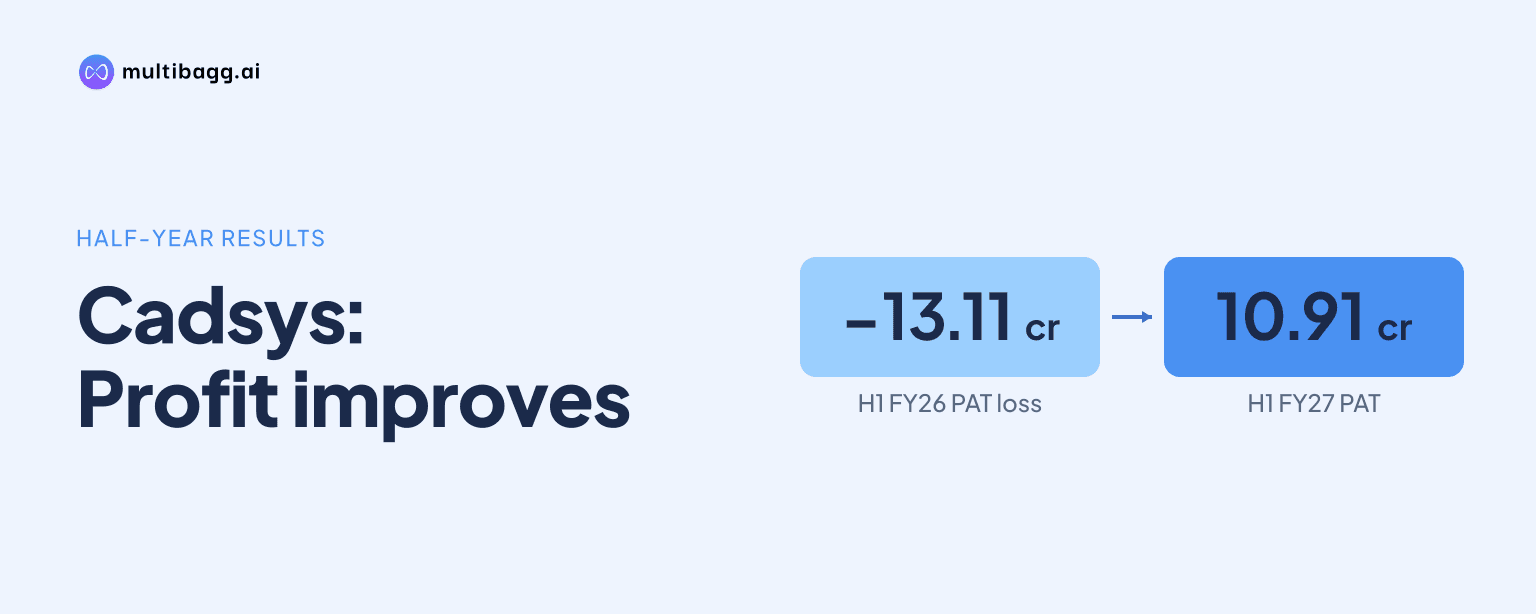
Cadsys (India) Limited reported consolidated profit after tax of ₹10.9063 crore in H1 FY 2026-27, reversing a ₹13.1127 crore loss despite revenue declining to ₹39.8538 crore from ₹69.9797 crore. Cadsys attributed the turnaround to artificial intelligence adoption, cost discipline, operating efficiency, collections focus and profitable work.
Know Cadsys (India) inside out
Results, valuation, peers and who's buying, in one view.
How did Cadsys return to profit in H1 FY 2026-27?
Cadsys returned to profit as H1 FY 2026-27 total expenses fell to ₹28.0087 crore from ₹91.8434 crore, while EBITDA moved to ₹12.6393 crore from a ₹17.4510 crore loss. Profit before tax also turned to ₹11.8451 crore from a ₹21.8637 crore loss, and PAT reached ₹10.9063 crore after the prior-year H1 PAT loss of ₹13.1127 crore.
The reported cost reduction was larger than the revenue decline. Total expenses decreased by ₹63.8347 crore year on year, compared with a ₹30.1259 crore reduction in revenue, creating positive EBITDA despite lower sales. Cadsys recorded tax expense of ₹62.09 lakh in H1 FY 2026-27, compared with ₹33.12 lakh in H1 FY 2025-26; the presentation does not provide a line-by-line bridge for the expense movement.
Why did Cadsys revenue fall while earnings improved?
Cadsys reported H1 FY 2026-27 revenue of ₹39.8538 crore, down about 43% from ₹69.9797 crore in the corresponding prior-year period, while total expenses declined to ₹28.0087 crore from ₹91.8434 crore. The result shows that the profit reversal occurred with lower revenue, rather than through sales growth.
The H1 result was also below the immediately preceding half year on revenue. Cadsys reported ₹47.5960 crore of revenue in H2 FY 2025-26, ₹7.7422 crore more than H1 FY 2026-27, although H2 FY 2025-26 recorded a PAT loss of ₹5.3849 crore. For full-year FY 2025-26, revenue was ₹117.5755 crore and PAT was a loss of ₹18.4976 crore.
Cadsys said exceptional items and prior-year restructuring or write-offs materially affected comparative annual results. The financial table shows exceptional items of negative ₹11.2144 crore in FY 2025-26, while H1 FY 2026-27 and H1 FY 2025-26 each showed no exceptional item. That distinction limits direct comparison between the half-year operational reversal and the annual loss figures.
What role did AI and cost discipline play at Cadsys?
Cadsys said its adoption and use of artificial intelligence contributed to the move from a ₹13.1127 crore H1 FY 2025-26 loss to ₹10.9063 crore PAT in H1 FY 2026-27. Management also identified cost discipline, operating efficiency, working-capital discipline, receivables monitoring and the conversion of customer opportunities into sustainable revenue as elements of its current operating focus.
The presentation does not quantify how much of the ₹24.0190 crore year-on-year PAT improvement came from AI, cost controls or collections. Its financial evidence is the movement to ₹12.6393 crore EBITDA from a ₹17.4510 crore EBITDA loss, alongside the decline in total expense to ₹28.0087 crore. The company’s stated explanation should therefore be read as management’s attribution rather than a separately measured contribution from each initiative.
Cadsys is enhancing ConcordProAI™ with AI-enabled capabilities for telecom infrastructure workflows. The identified applications are AI-assisted engineering design, intended to support faster and more consistent workflows, and AI-supported cost estimation for early-stage budgeting and project cost assessment. Cadsys says these capabilities resulted in measurable benefits evident in its financials, but it does not disclose adoption rates, customer revenue, cost savings or a separate ConcordProAI™ contribution for H1 FY 2026-27.
Got a follow-up? Ask IRIS
What work and market conditions matter most for Cadsys?
Cadsys provides wireline outside-plant (OSP) and inside-plant (ISP) design and deployment support for United States telecommunications customers. Its near-term work areas include engineering design, OSP planning, permitting support, field-data conversion, as-built documentation and project-management services, while repeat business and delivery across multiple regions remain stated priorities.
Cadsys identifies broadband expansion and the Broadband Equity, Access, and Deployment (BEAD) programme as potential sources of engineering and delivery work. However, the company says award-to-revenue conversion depends on state implementation, customer capital expenditure, subgrantee selection, permitting, labour availability, contractor mobilisation and construction readiness. Those mechanisms mean grant awards do not automatically become revenue for OSP and ISP service providers.
The Affordable Connectivity Program ended in 2024 after its funding was exhausted, according to the presentation. Cadsys therefore does not present that programme as an active demand support mechanism. Instead, it links potential work to fibre-to-the-home expansion, alternative-fibre-provider and cable-operator overbuilds, rural deployment and higher-capacity network demand from households, enterprises, data centres and 5G backhaul.
What is Cadsys planning after the H1 turnaround?
Cadsys plans to deepen existing United States telecom customer relationships through OSP and ISP design, engineering and offshore delivery support. It also plans selective entry into new geographies, disciplined project execution and improved utilisation of delivery resources, following H1 FY 2026-27 revenue of ₹39.8538 crore.
The company intends to expand project-management support for construction programmes through as-built documentation, material and production tracking, crew scheduling, issue resolution, milestone monitoring and digital reporting. These services sit alongside its stated aim of converting broadband deployment activity into engineering, permitting and construction-related work when projects reach implementation stages.
Management says Cadsys will prioritise profitable work, disciplined bidding, delivery quality and timely collections to strengthen cash generation. The emphasis follows a period in which H1 FY 2026-27 revenue was ₹30.1259 crore below the corresponding prior-year half and ₹7.7422 crore below H2 FY 2025-26, even as PAT turned positive.
Conclusion
Cadsys produced a substantial H1 FY 2026-27 earnings reversal, with PAT improving by ₹24.0190 crore from a ₹13.1127 crore loss to ₹10.9063 crore profit. Revenue declined by ₹30.1259 crore, but total expenses declined by ₹63.8347 crore, making the lower cost base the principal numerical feature of the reported turnaround. Management attributes part of that change to AI-enabled efficiency and operating discipline.
The next issue is whether Cadsys can convert United States telecom and BEAD-related opportunities into sustainable revenue while maintaining profitable bidding, collections and delivery quality. Its disclosed plan depends on state-level programme implementation, customer mobilisation, permitting, labour availability and construction readiness, and the presentation sets no revenue or profit target for those initiatives.