










Carysil says Q2 costs cut margin by up to 2 percentage points
Key highlights
- Carysil said raw-material and sea-freight inflation reduced Q2 EBITDA margin by 1.5 to 2 percentage points.
- Carysil reported Q2 EBITDA margin of 19.4% on a consolidated basis and 21% on a standalone basis.
- Carysil implemented a 5% price increase last month, with full-quarter benefit expected in the next quarter.
- Carysil plans Rs 25 crore to Rs 30 crore of brand-store investment in 2027 and may spend up to 5% on advertising.
powered by IRIS
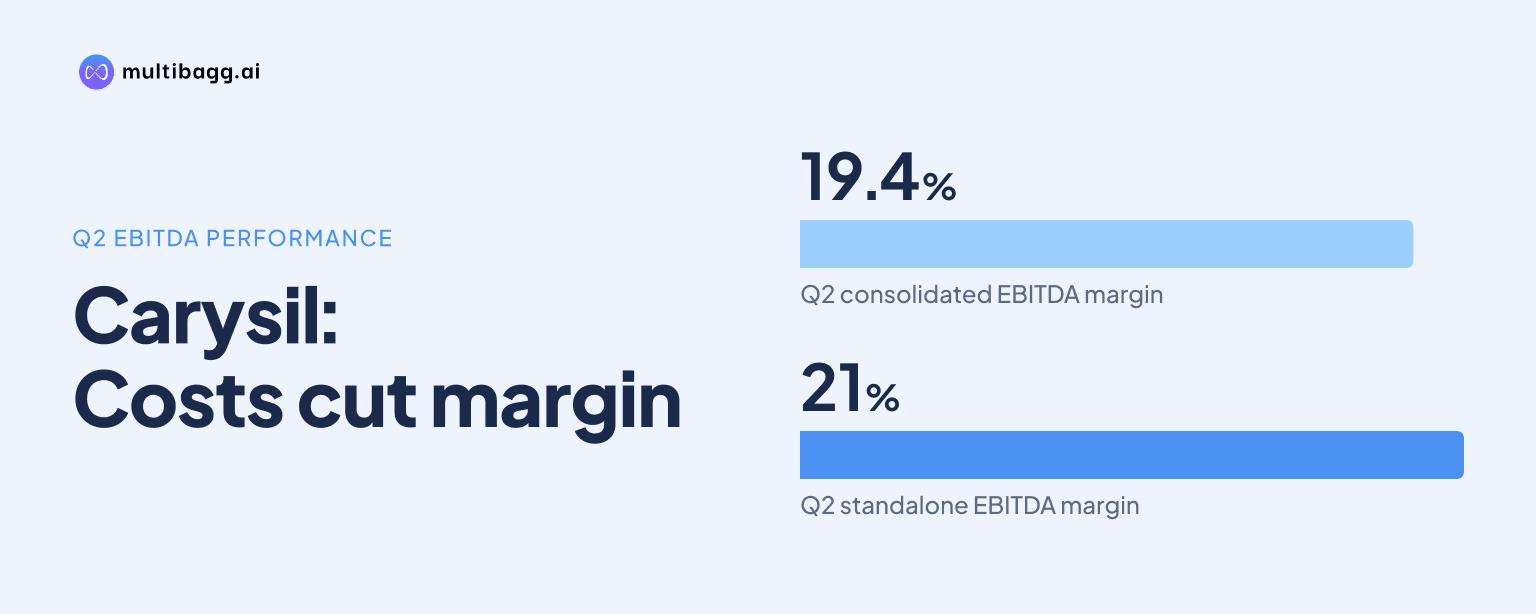
Carysil said raw-material and sea-freight inflation cut its Q2 earnings before interest, tax, depreciation and amortisation, or EBITDA, margin by 1.5 to 2 percentage points, while consolidated EBITDA margin was 19.4%. Management introduced a 5% price increase last month and said the next quarter should receive its full-quarter benefit.
Know Carysil inside out
Results, valuation, peers and who's buying, in one view.
How much did costs affect Carysil's Q2 margin?
Carysil said the combined effect of sea-freight and raw-material inflation reduced Q2 EBITDA margin by about 1.5 to 2 percentage points. Chirag Parekh said the cost increase was a reason the company probably missed its margin target in a quarter he described as its most challenging for freight and other input costs.
Carysil reported a 19.4% consolidated EBITDA margin and a 21% standalone EBITDA margin in Q2. Management said the United Kingdom and United States operations were quite flat, diluting the group result on consolidation even as the standalone business operated at about the 20% level.
Management said it had begun to see raw-material prices decline and freight gradually cool after Q2. That observation was not a numerical forecast, but Parekh said the changing cost trend led him to expect margin improvement moving forward.
When will Carysil's 5% price increase affect earnings?
Carysil implemented a 5% price increase last month, and management said the next quarter will have the positive effect for a full quarter. Parekh confirmed that timing when an analyst asked whether the pricing action would be fully reflected in the subsequent period.
Management said any further rise in raw-material costs would be passed on to customers and that it would work to remain toward the upper end of its 18% to 20% EBITDA margin range. This was management's stated approach, rather than a guarantee of the next quarter's margin outcome.
Carysil said most exports to major customers are sold on a free-on-board, or FOB, basis, which limits its direct exposure to freight costs under those terms. The company did not disclose the share of exports covered by FOB arrangements, so the transcript does not quantify the protection across total group sales.
Why are Carysil's employee costs rising before capacity expands?
Carysil said employee costs are rising because it is recruiting and training ahead of capacity expected to be realised by March 2027. Management said it had hired a chief technology officer, project heads and engineers, creating overlapping payroll costs before the related production and sales ramp.
Carysil expects those costs to be diluted as capacity and sales increase, and Parekh said employee costs as a percentage of revenue should not rise in 2027. That expectation depends on the planned capacity realisation and sales growth, rather than on a disclosed quarterly employee-cost target.
The company is building quartz-sink infrastructure for 500,000 sinks, with an initial mould-and-machinery phase for 250,000 sinks. Management said it could add the further 250,000 sinks in about four months if customer demand supports the move.
Carysil also said it ran above 100% capacity for one month during its highest monthly sales period by offering worker incentives and improving production cycles. Management did not disclose the sales value or sink volume for that month, but cited the episode as evidence for preparing staffing and production capability before new capacity arrives.
Got a follow-up? Ask IRIS
Can Carysil maintain its stated 18% to 20% margin range?
Carysil said it aims to stay toward the upper end of its 18% to 20% EBITDA margin range through the 5% price rise, potential raw-material pass-throughs and easing input-cost trends. Q2 consolidated margin of 19.4% fell within that range, while standalone margin of 21% exceeded it.
The principal uncertainty remains global supply-chain disruption and freight costs, particularly on routes from the Far East to Europe and the United States. Management said it was receiving increased stainless-steel inquiries, but did not quantify potential orders or their margin contribution.
Carysil said its 15-radius and 25-radius pressed stainless-steel sink technology is expected to begin in Q4. It also received first orders under its Hafele arrangement for New Zealand and Australia, with dispatch expected next month and management expecting annual volumes of 25,000 to 30,000 sinks.
What spending could affect Carysil's India growth plan?
Carysil said it plans to invest Rs 25 crore to Rs 30 crore in brand-store expansion in 2027 as part of its route toward Rs 500 crore of India revenue. Management said Carysil currently has 20 brand stores, compared with more than 150 to 200 stores cited for peers.
The company has hired PwC for a leadership restructuring process and plans to separate India operations into e-commerce, business-to-business and business-to-consumer units. Management said it would also create category accountability for sinks and faucets, and appliances, with updates on the team and structure expected within 30 to 60 days.
Carysil said it may spend as much as 5% on advertising and branding, including television commercials, social media and billboards. Management plans to stop an additional 5% distributor discount and redirect that amount to brand building, with the objective of avoiding a margin disruption.
Conclusion
Carysil's Q2 margin pressure was a quantified cost event, with management putting the combined raw-material and sea-freight impact at 1.5 to 2 percentage points. The 19.4% consolidated EBITDA margin versus 21% standalone margin also showed that flat United Kingdom and United States operations affected the group outcome.
The next items to watch are the full-quarter effect of the 5% price increase, management's observation that freight and raw-material costs are cooling, and the first Hafele-related dispatches expected next month. Carysil also plans capacity realisation by March 2027 and said it could provide an India restructuring update within 30 to 60 days.