










Carysil Limited reports record Q2 revenue of Rs 275.7 crore
Key highlights
- Carysil Limited's Q2 FY27 revenue reached a record Rs 275.7 crore, up 14.6% year-on-year.
- H1 FY27 revenue rose 15% to Rs 537.9 crore, while H1 earnings per share increased to Rs 21.02.
- The domestic business grew 30% in H1 FY27 and contributed 21% of revenue, versus 19% a year earlier.
- Carysil plans Rs 25 crore to Rs 30 crore of FY27 brand-store investment and about 5% of revenue for advertising and branding.
powered by IRIS
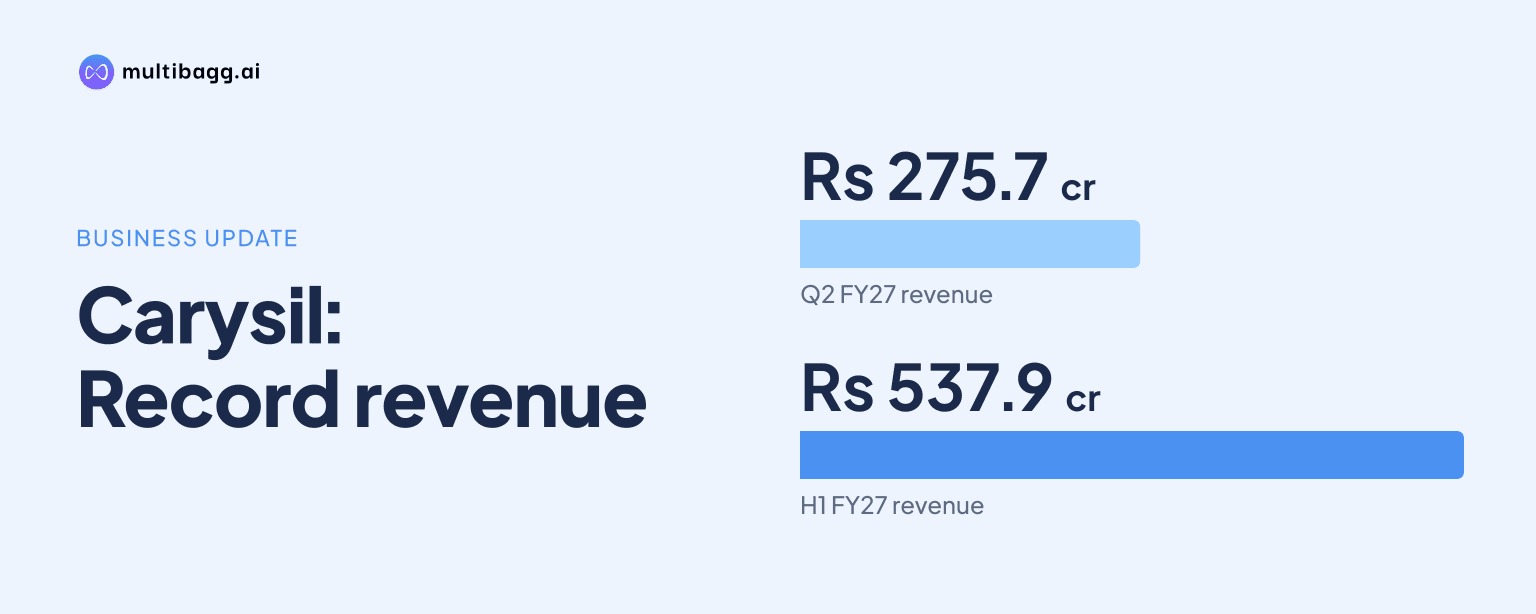
Carysil Limited reported its highest-ever second-quarter revenue of Rs 275.7 crore in Q2 FY27, a 14.6% year-on-year increase, while consolidated H1 revenue rose 15% to Rs 537.9 crore. The result matters because the company is pursuing faster domestic expansion while retaining FY27 revenue-growth guidance of 15% and EBITDA-margin guidance of 18% to 20%.
Know Carysil inside out
Results, valuation, peers and who's buying, in one view.
What did Carysil Limited report for Q2 FY27?
Carysil Limited reported consolidated revenue from operations of Rs 275.7 crore for the quarter, up 14.6% year-on-year and 5.2% sequentially. Total income increased 13.9% year-on-year to Rs 278 crore. Management described the quarterly revenue as the company’s highest second-quarter revenue to date.
For the first half of FY27, Carysil reported revenue from operations of Rs 537.9 crore, representing growth of 15% from the corresponding period a year earlier. H1 total income was Rs 542.8 crore, up 15.2% year-on-year. Earnings per share for the half year rose to Rs 21.02 from Rs 17.59 in the previous year’s first half.
The company said it was maintaining its FY27 guidance of 15% revenue growth and an EBITDA margin in the range of 18% to 20%. This guidance indicates that management expects the second-half operating environment to remain consistent with its stated annual targets, although the company also flagged cost pressures during the quarter.
Why did Carysil's Q2 EBITDA margin decline?
Carysil’s EBITDA margin was 19.4% in Q2 FY27, compared with 20.3% in Q2 FY26 and 21.2% in Q1 FY27. The company attributed the margin decline to higher raw-material costs and sea freight expenses.
Even with the margin reduction, EBITDA increased 9.3% year-on-year to Rs 54.1 crore. Gross profit rose 16.8% to Rs 149.7 crore, while gross margin improved by 133 basis points to 53.9%. The difference between gross-margin improvement and EBITDA-margin movement reflects the company’s reported cost pressures beyond the cost of goods sold.
Profit before tax increased 10.3% year-on-year and profit after tax grew 5.8%, according to the earnings call. The lower pace of profit-after-tax growth relative to revenue growth is relevant for investors assessing whether higher input and freight costs are affecting operating leverage and bottom-line conversion.
No share-price movement or immediate market reaction was disclosed in the material provided. The reported financial data instead provide the main basis for evaluating the quarter: revenue continued to expand at a double-digit rate, while the EBITDA margin remained within the company’s 18% to 20% FY27 guidance range.
How is Carysil expanding its India business?
Carysil’s domestic business grew 30% during H1 FY27 and represented 21% of revenue, compared with 19% in the prior-year period. Management has set a target of reaching Rs 500 crore in domestic revenue within three years and identified India as a growth engine for the company.
Chairman and Managing Director Chirag Parekh said Carysil was underperforming as a brand in India and had engaged PwC for a leadership restructuring. The proposed domestic structure will split operations into e-commerce, B2B and B2C verticals, with further separation by sinks and appliances to establish accountability and KPI-based monitoring.
Management plans to build teams around the eight to 10 strongest-performing regions. Parekh said the company expected to announce the new team and organisational structure within 30 to 60 days of the earnings call. The plan is intended to give the India operation more focused ownership across sales channels and product categories.
Carysil also plans to expand its brand-store network. The company has about 20 brand stores in India, compared with the 150 to 200 stores cited by management for peers. This gap is central to its stated plan to increase consumer-facing presence in the domestic kitchen-products market.
Got a follow-up? Ask IRIS
What will Carysil spend on brand stores and advertising?
Carysil plans to invest Rs 25 crore to Rs 30 crore in FY27 to expand its brand-store network in India. Alongside this network investment, the company intends to allocate about 5% of revenue to advertising and branding.
Management said the advertising and branding allocation would be funded by discontinuing a 5% additional discount previously offered to distributors. Parekh stated that this approach was designed to prevent the planned brand expenditure from disturbing margins. The outcome will depend on implementation of the distributor-discount change and the effectiveness of the revised channel structure.
Actor Bobby Deol is scheduled to appear in Carysil’s television, social-media and billboard campaigns from December. The company has presented this campaign as part of a wider effort to improve brand visibility as it builds domestic distribution and retail presence.
For customers and channel partners, the strategy points to greater brand communication and a broader store footprint. For investors, the key operating measures are domestic revenue growth, progress towards the Rs 500 crore domestic target, store additions, advertising spend and the effect of the revised distributor economics on margins.
What other operational developments did Carysil disclose?
Carysil’s investor presentation referred to capacity expansion across quartz sinks, kitchen appliances and faucets, as well as international operations through subsidiaries in Germany, the UK and the UAE. The company said it planned to double capacity by the end of FY27.
The company also highlighted partnerships with brands including IKEA and Grohe in its presentation. These international and capacity-related initiatives sit alongside the domestic restructuring, giving Carysil separate routes for growth through exports, overseas subsidiaries and the Indian market.
The company disclosed that Executive Director and Group CFO Anand H. Sharma would resign effective November 16, 2026, citing relocation constraints. Carysil stated that there were no material reasons beyond personal reasons, and said further intimations would be made when applicable.
Separately, ICRA’s monitoring report found no material deviation in the use of funds from Carysil’s July 2024 qualified institutions placement. The report noted that net proceeds were revised to Rs 121.65 crore due to higher issue-related expenses, while deployment continued to align with disclosed objectives covering capital expenditure, working capital and general corporate purposes.
Conclusion
Carysil’s Q2 FY27 results combined record second-quarter revenue of Rs 275.7 crore with 15% H1 revenue growth and a domestic business that grew faster than the consolidated business. At the same time, EBITDA margin declined to 19.4% because of higher raw-material and sea-freight costs, although it remained within the company’s full-year guided range.
Investors will watch for the domestic leadership structure expected within 30 to 60 days of the November 5 call, implementation of brand-store and advertising plans, and progress towards capacity doubling by end-FY27. The company’s ability to convert domestic expansion into growth while managing margins will remain a key disclosed operating measure.