










Choice Consultancy advisory order book falls to Rs 710 crore
Key highlights
- Choice reported a Rs 710 crore advisory order book in Q2 FY27, compared with Rs 777 crore in Q1 FY27.
- Choice’s Q2 FY27 advisory order book was Rs 44 crore above the Rs 666 crore reported in Q2 FY26.
- Maharashtra represented 29% of Choice’s Q2 FY27 order book, followed by Bihar at 17% and Rajasthan at 11%.
- Choice reports 48 project offices and more than 2,100 on-roll team members in advisory services.
powered by IRIS
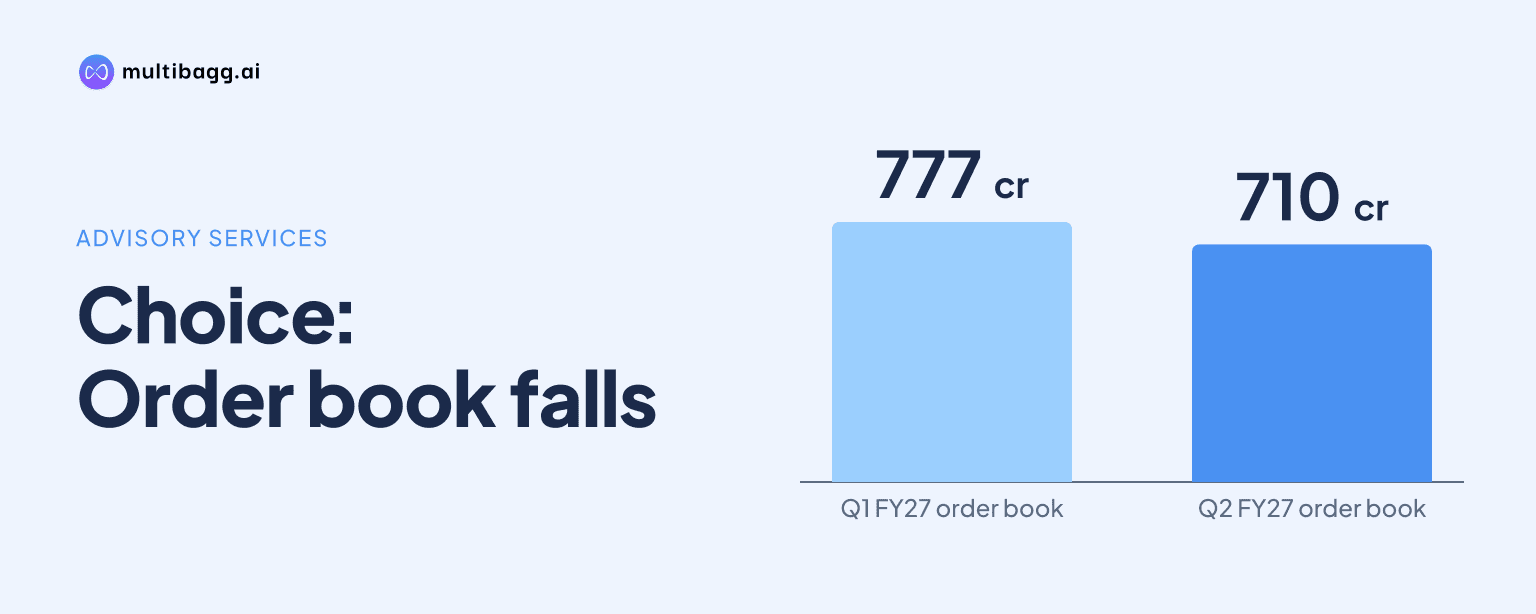
Choice Consultancy’s advisory-services order book fell to Rs 710 crore in Q2 FY27 from Rs 777 crore in Q1 FY27, although it remained Rs 44 crore above Q2 FY26; inclusive growth and project implementation represented 50% of the backlog, while Maharashtra accounted for 29%.
Know Choice International inside out
Results, valuation, peers and who's buying, in one view.
What is Choice’s current advisory order book?
Choice’s advisory order book was Rs 710 crore in Q2 FY27. The balance was Rs 67 crore lower than the Rs 777 crore reported in Q1 FY27, following a rise from Rs 666 crore in Q2 FY26 to Rs 748 crore in Q3 FY26 and a decline to Rs 698 crore in Q4 FY26.
The Q2 FY27 balance was Rs 44 crore above Q2 FY26, while the sequential decline followed the five-quarter high of Rs 777 crore in Q1 FY27. The presentation identifies the figure as an advisory-services order book and does not disclose a project-completion timetable, revenue-recognition schedule or reasons for the quarter-on-quarter movement.
How is Choice’s order book split by state and service?
Choice’s Q2 FY27 order book was most exposed to Maharashtra, which represented 29% of the Rs 710 crore balance. Bihar accounted for 17% and Rajasthan for 11%, meaning the three named states together represented 57%, while all other states accounted for 43%.
Inclusive growth and project implementation was Choice’s largest service category at 50% of the Q2 FY27 order book. Digital transformation and e-governance represented 17%, institutional strengthening another 17%, and strategy consulting and project planning 16%, creating a disclosed mix across four service lines.
The 50% share for inclusive growth and implementation is larger than the combined 33% share of digital transformation, e-governance, strategy consulting and project planning. The presentation does not provide separate contract values, margins or delivery dates for the four service categories.
Which sectors is Choice developing for future work?
Choice identifies urban development, rural development and Panchayati Raj Institutions, water management, cooperatives and public financial management as matured sectors. The presentation calls these areas the current revenue engine and says they have established execution and recurring business, but it provides no sector-level revenue or order-book figures.
Choice lists railways and metro, irrigation, waste management, industrial infrastructure, building and habitat, information technology and e-governance, skill development, industries and small and medium enterprises, and advisory and institutional strengthening as emerging sectors. Management describes these as next revenue drivers with rapidly scaling capabilities and a strong order pipeline, without quantifying that pipeline or setting a conversion date.
Ports and airports, power, defence, disaster management, agriculture and healthcare are classified as potential sectors. This category is presented as a foundation for future scale, rather than evidence that Choice has won contracts in each of the six sectors.
Got a follow-up? Ask IRIS
What delivery scale supports Choice’s advisory platform?
Choice reports 48 project offices and more than 2,100 on-roll team members for advisory services. Its disclosed delivery footprint includes more than 150 central-government and state-government departments, more than 1,000 urban local bodies and more than 50,000 Panchayati Raj Institutions.
The presentation says Choice was selected to lead the digitalisation of more than 13,000 Primary Agricultural Credit Societies. It also reports more than 2 lakh affordable houses under Pradhan Mantri Awas Yojana in four states, more than 3,000 kilometres of highway design or supervision, and more than 5.5 crore citizens benefited under Jal Jeevan Mission in four states.
Choice also reports training more than 15,000 trainees through more than 10 lakh training hours in over 13 states. Its health-survey assignments, including National Family Health Survey VI and Global Adult Tobacco Survey work, covered more than 75,000 families and 15,000 villages across more than 15 states and union territories.
How large is the consulting market Choice is targeting?
Choice estimates the Indian addressable consulting market it targets at Rs 90,000 crore to Rs 1,35,000 crore annually in FY2026E. The presentation expects this government, infrastructure and digital consulting market to grow at a compound annual growth rate of 11% to 14%; this is a market assessment, not Choice revenue guidance.
Information technology and e-governance is the largest listed segment, with an estimated annual opportunity of Rs 18,000 crore to Rs 25,000 crore. Railways and metro follows at Rs 12,000 crore to Rs 18,000 crore, while roads and highways is estimated at Rs 10,000 crore to Rs 15,000 crore.
The presentation also compares core-infrastructure investment across two periods. Roads are shown at Rs 18.3 lakh crore in 2017-2023 and Rs 37.3 lakh crore in 2024-2030, while railways rise from Rs 12.4 lakh crore to Rs 25.6 lakh crore; the table lists urban infrastructure twice without explaining the distinction between its two entries.
Conclusion
Choice’s Rs 710 crore Q2 FY27 advisory order book remained above the Rs 666 crore reported in Q2 FY26 despite declining from Rs 777 crore in the preceding quarter. The disclosed backlog combines a 50% concentration in inclusive growth and project implementation with 57% exposure across Maharashtra, Bihar and Rajasthan.
The next issue to watch is whether the emerging-sector pipeline converts into reported orders, particularly in railways and metro, irrigation, waste management, industrial infrastructure and e-governance. Under its Vision 2030 plan, Choice aims to build an integrated government, infrastructure and development consulting platform supported by artificial-intelligence-driven project management units, geographic information systems, analytics, Internet of Things tools and decision-support platforms, without numerical targets or dates for those initiatives.