










Choice's demat accounts reach 1.379 million in Q2 FY27
Key highlights
- Choice reported 1.379 million demat accounts in Q2 FY27, up 14% from 1.205 million in Q2 FY26.
- Tier-III and smaller locations accounted for 69% of Choice clients, while tier-I cities represented 6%.
- Choice's retail ADTO market share increased to 1.54% in Q2 FY27 from 1.31% a year earlier.
- Choice reported more than 3.30 million app downloads and more than 10.8 million API requests served per day.
powered by IRIS
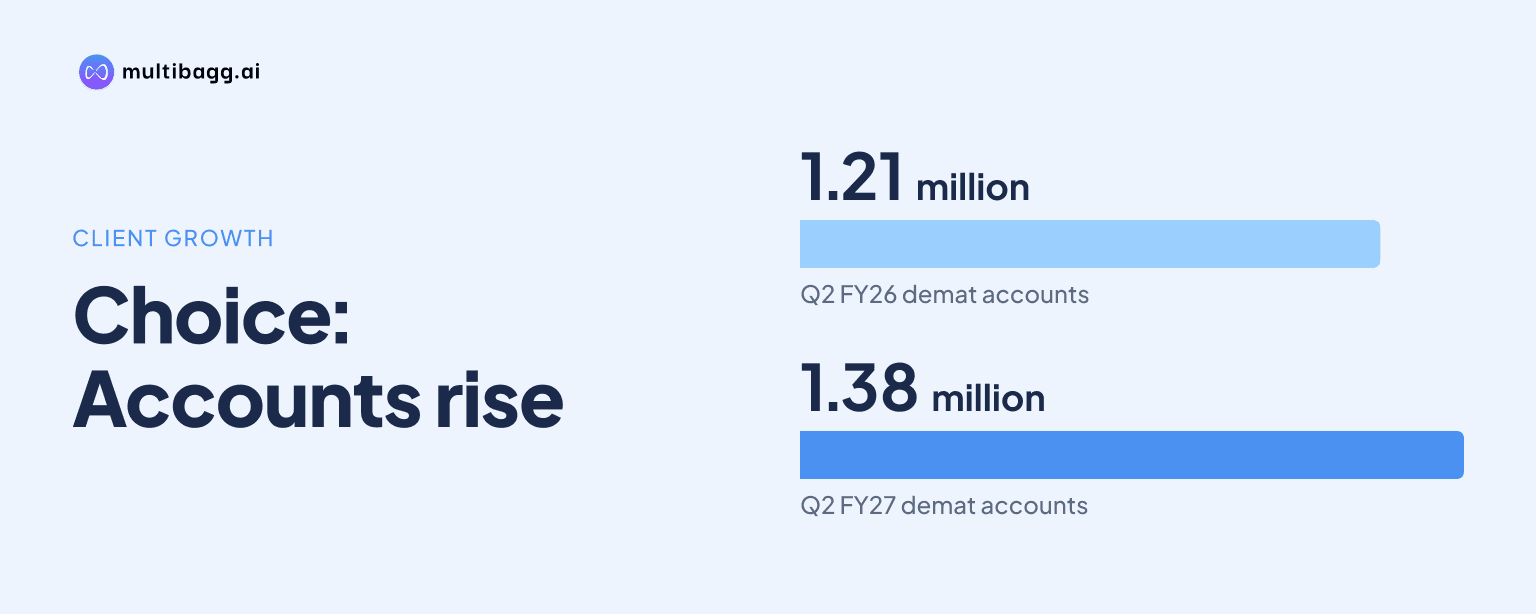
Choice International reported 1.379 million demat accounts in Q2 FY27, up 14% from 1.205 million a year earlier, while 69% of its clients were in tier-III and smaller locations. Choice also raised retail average daily turnover market share to 1.54% as of 30 September 2026, from 1.31% in Q2 FY26.
Know Choice International inside out
Results, valuation, peers and who's buying, in one view.
How many demat accounts does Choice have?
Choice had 1.379 million demat accounts in Q2 FY27, compared with 1.294 million in Q1 FY27 and 1.205 million in Q2 FY26. The base therefore increased by 85,000 accounts during the quarter and by 174,000 accounts over 12 months. The presentation identifies the year-on-year increase as 14%, following 48% growth in the comparable prior-year period.
The account base increased in each of the four quarters preceding Q2 FY27. Demat accounts rose from 1.234 million in Q3 FY26 to 1.263 million in Q4 FY26, then reached 1.294 million in Q1 FY27 before advancing to 1.379 million. This sequence shows that net additions accelerated to 85,000 in Q2 FY27 from 31,000 in Q1 FY27.
India's broader demat-account base grew from 192 million in FY25 to 225 million in FY26, according to CRISIL data presented by Choice. CRISIL projects 796 million Indian demat accounts by FY30P, where FY30P denotes a projected figure. Choice cites digital platforms, financial literacy, young investor participation, initial public offerings, regulatory reforms and shifts in economic assets as factors supporting industry growth.
Where are Choice's broking clients located?
Choice reported that 69% of its clients were in tier-III and below locations, 25% were in tier-II cities and 6% were in tier-I cities. That places 94% of the disclosed client mix outside tier-I locations, consistent with the company's stated effort to expand its pan-India reach and client demographic.
The distribution gives the smaller-city cohort a substantially larger representation than the 6% attributed to tier-I cities. However, Choice does not disclose the number of accounts in each city tier, account additions by geography, or turnover and revenue generated by those cohorts. The presentation therefore establishes client distribution, rather than profitability or activity by location.
Choice's disclosed age mix also points to a predominantly younger customer base. Clients aged 35 and below represented 52%, followed by 21% aged 36 to 45, 14% aged 46 to 60 and 12% above 60. These percentages total 99% because of rounding, and Choice does not provide absolute client counts for the age bands.
How has Choice's retail trading share changed?
Choice's retail average daily turnover, or ADTO, market share reached 1.54% in Q2 FY27, up from 1.45% in Q1 FY27 and 1.31% in Q2 FY26. The year-on-year increase was 0.23 percentage points, while the sequential increase was 0.09 percentage points. Choice dates the ADTO and market-share figures to 30 September 2026.
Reported ADTO moved differently from market share during the quarter. ADTO was Rs 1,598.9 crore in Q2 FY27, down from Rs 1,801.9 crore in Q1 FY27, but above Rs 1,202.3 crore in Q2 FY26. Thus, ADTO declined by Rs 203 crore sequentially while retail market share increased, and rose by Rs 396.6 crore year on year.
Choice reported Rs 178.2 crore of broking and distribution segment revenue in Q2 FY27, including wealth products and insurance. The segment generated Rs 172.3 crore in Q1 FY27 and Rs 160.7 crore in Q2 FY26, making the reported Q2 FY27 figure 11% higher year on year and Rs 5.9 crore higher sequentially. The segment measure is broader than trading revenue because it includes wealth products and insurance.
Got a follow-up? Ask IRIS
How important are digital channels to Choice's broking business?
Choice reported that online channels accounted for 70% of its revenue split, while offline channels accounted for 30%. The company presents this split alongside its Q2 FY27 broking metrics, but does not specify the precise period covered by the split or disclose separate revenue values for online and offline activity.
Choice reported more than 3.30 million app downloads and more than 10.8 million application programming interface, or API, requests served per day. Its app lists stocks, futures and options, mutual funds and bonds as investment categories. The platform also includes recommendations, curated baskets, a multilingual interface and algorithmic trading, although the presentation does not state adoption rates or revenue generated by individual features.
The current product range supports a broader investment proposition than equity trading alone. In the wealth-distribution business, Choice reported total wealth-products assets under management of Rs 6,047.1 crore in Q2 FY27, comprising Rs 4,108.1 crore in mutual funds and Rs 1,938 crore in other products. Total wealth-products assets under management were Rs 4,806.7 crore in Q2 FY26, compared with Rs 6,047.1 crore in Q2 FY27.
What is Choice adding to its investing app?
Choice has launched Trader Mode, which lets users place buy and sell orders directly on charts, adjust targets and stop-losses, and monitor real-time positions and profit and loss. The feature set also includes one-click order execution, dual charts, multi-tab access to trading tools and automatic selection of the better last traded price across the National Stock Exchange and BSE.
Choice is also building a unified investment platform for web and app users. The company says this platform enables tracking of net worth, investments and returns across asset classes, along with colour-coded asset allocation and artificial intelligence-based fundamental and technical insights for Nifty 50 stocks. These are product capabilities disclosed by Choice rather than separately reported financial segments.
Management's roadmap, described as “one app, every wealth decision”, includes Account Aggregator-based consolidation of stocks, mutual funds and bonds. It also lists portfolio analysis covering allocation, concentration and performance within FinX, access to National Stock Exchange commodity derivatives, chart-based buy and sell order flow, and separate tracking of day and overlay derivatives profit and loss. Choice provides no launch dates or financial targets for these planned additions.
Conclusion
Choice's Q2 FY27 disclosures show growth in its client base alongside a client mix concentrated beyond the largest cities. Demat accounts reached 1.379 million, up 14% year on year, while 69% of clients were in tier-III and smaller locations. Retail ADTO market share increased to 1.54%, although reported ADTO declined sequentially from Rs 1,801.9 crore to Rs 1,598.9 crore.
The next disclosures will show whether Choice can sustain account additions and convert its 70% online revenue mix and 3.30 million-plus app downloads into further trading and distribution activity. Management's stated platform plan includes Account Aggregator-based asset consolidation, portfolio insights and commodity-derivatives access, but the presentation does not provide target dates for these releases or targets for accounts, turnover or market share.