










Choice targets ₹3,500 crore AUM by 2030 as NIM declines
Key highlights
- Choice targets ₹3,500 crore of MSME-finance and green-finance AUM by 2030.
- Choice reported total AUM of ₹936 crore and retail AUM of ₹609 crore at Q2 FY27.
- MSME business loans represented 75.84% of Choice's retail AUM at Q2 FY27.
- Choice's Q2 FY27 NIM was 10.76%, down 49 basis points year on year.
powered by IRIS
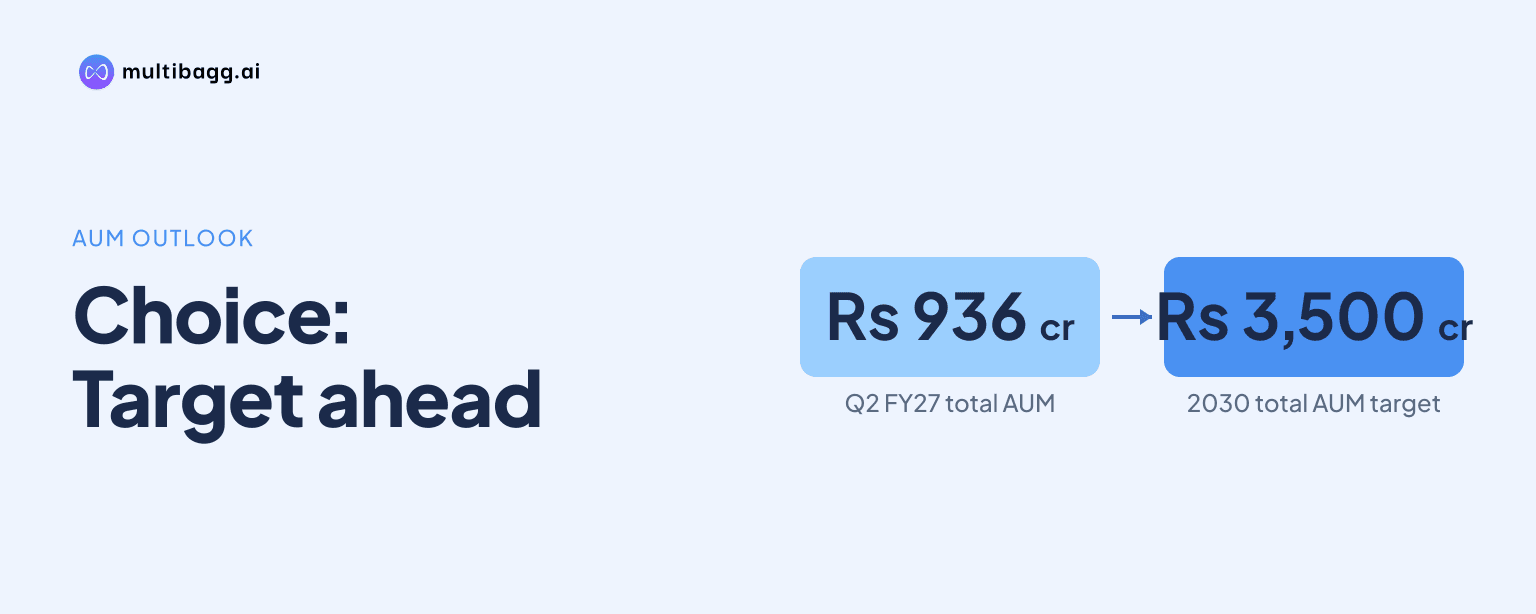
Choice targets ₹3,500 crore of micro, small and medium enterprise, or MSME, and green-finance assets under management, or AUM, by 2030, against ₹936 crore of total AUM at Q2 FY27, while net interest margin, or NIM, declined 49 basis points year on year to 10.76%. The plan centres on secured MSME loans and solar finance for semi-urban and rural markets.
Know Choice International inside out
Results, valuation, peers and who's buying, in one view.
What is Choice's 2030 AUM target?
Choice targets ₹2,500 crore of MSME-finance AUM and ₹1,000 crore of green-finance AUM by 2030, totalling ₹3,500 crore. Its stated green-finance categories are commercial, co-operative housing society and residential lending, while the MSME-finance plan includes loan against property and machinery loans.
The ₹3,500 crore target is set against total AUM of ₹936 crore at Q2 FY27, including retail AUM of ₹609 crore. The presentation does not disclose annual AUM milestones, a disbursement target, a required growth rate or a funding requirement between the Q2 FY27 base and the 2030 objective.
Choice describes its NBFC lending approach as retail finance tailored to MSMEs in semi-urban and rural landscapes. Solar finance and MSME business loans are listed as current offerings, meaning the 2030 target is based on product categories already identified in the portfolio rather than on a newly disclosed lending product.
The strategy separates green finance from MSME finance, although the presentation does not disclose whether individual solar borrowers overlap with the MSME customer base. It identifies commercial, co-operative housing society and residential segments for green finance, while MSME lending is supported by loan against property and machinery loans.
What does Choice's retail loan book contain at Q2 FY27?
Choice's retail AUM of ₹609 crore at Q2 FY27 was led by MSME business loans, which accounted for 75.84% of the portfolio, compared with 3.63% for solar finance. Other products made up 20.53%, showing that MSME business loans were the principal retail product at the reported date.
The solar-finance share provides the disclosed starting mix for Choice's ₹1,000 crore green-finance AUM target. The presentation does not state solar-finance AUM in rupees separately, nor does it provide an earlier retail-mix comparison, so it does not show whether the 3.63% solar share rose or fell before Q2 FY27.
Choice offers secured MSME business loans with ticket sizes of up to ₹50 lakh and tenors of up to 120 months. Solar loans also have ticket sizes of up to ₹50 lakh, but their maximum tenor is 60 months, making the disclosed solar repayment term half the maximum term of the MSME business-loan product.
The stated ROI range is 16% to 22% for secured MSME business loans and 18% to 24% for solar loans. Choice lists security coverage of 40% to 80% for MSME business loans and 100% for solar loans; average ticket sizes are ₹8 lakh and ₹7 lakh respectively, with monthly repayment and processing fees of up to 2% for both products.
What happened to Choice's net interest margin?
Choice reported NIM of 10.76% in Q2 FY27, down 49 basis points from 11.25% in Q2 FY26. A basis point is one-hundredth of a percentage point, so the reported year-on-year movement equals 0.49 percentage points; the presentation does not identify the cause of the decline.
The reported quarterly sequence shows NIM increasing to 12.25% in Q3 FY26, then declining in each of the following three quarters to 10.76% in Q2 FY27. This comparison records the margin trend but does not establish whether funding costs, lending yields, product mix, credit costs or any other factor drove the movement.
Choice reported net worth of ₹475 crore and a capital risk adequacy ratio, or CRAR, of 37.36% at Q2 FY27. It also lists a liability profile involving banks and financial institutions, including AU Small Finance Bank, ICICI Bank, State Bank of India, Shriram Finance and Small Industries Development Bank of India, but gives no borrowing-rate or repayment-maturity data.
Got a follow-up? Ask IRIS
How does Choice control underwriting and collections?
Choice says its underwriting uses real-time credit-bureau checks together with an internal scorecard for individual clients and deduplication checks across more than 15 databases. Its centralised credit team handles know-your-customer, or KYC, verification, interactive voice response and tele-verification to maintain uniform processes.
Choice also reports geo-tagging of 100% of branches and centres and 100% of customers' houses. Its stated cashless process uses penny-drop verification and KYC compliance, while 100% digital documentation and an in-house collection team are among the lending capabilities cited for its retail model.
At Q2 FY27, Choice reported gross non-performing assets, or GNPA, of 3.22%, net non-performing assets, or NNPA, of 2.44%, and a provision coverage ratio, or PCR, of 24.73%. Collection efficiency was above 95%, with 11,707 active loans, 75 branches and operations in eight states.
These figures provide the disclosed asset-quality and operating snapshot as Choice pursues the ₹3,500 crore 2030 AUM target. The presentation does not provide prior-period GNPA, NNPA, PCR or collection-efficiency data, so it does not support a period-on-period conclusion on whether credit performance or collections have improved or deteriorated.
How do Choice's products support the stated strategy?
Choice's secured MSME business loans combine ticket sizes up to ₹50 lakh, maximum tenors of 120 months and security coverage of 40% to 80%, while solar loans have the same maximum ticket size but 60-month tenors and 100% security coverage. These product terms align with the separate ₹2,500 crore MSME-finance and ₹1,000 crore green-finance AUM targets.
The company identifies artificial intelligence and machine learning-based systems, robust underwriting, diversified geographical reach and a balanced liability profile as its stated propositions. These are supported in the presentation by more than 15 database checks, 100% geo-tagging and lending operations across eight states, rather than by disclosed automation or approval-rate metrics.
Choice's product comparison also shows a higher stated ROI range for solar loans, at 18% to 24%, than for MSME business loans, at 16% to 22%. The presentation does not disclose product-level disbursements, defaults, funding costs or NIM contributions, leaving the earnings effect of a larger solar mix unspecified.
Conclusion
Choice's disclosed strategy combines a ₹2,500 crore MSME-finance target and a ₹1,000 crore green-finance target by 2030, compared with ₹936 crore of total AUM at Q2 FY27. MSME business loans formed 75.84% of retail AUM, whereas solar finance represented 3.63%, while NIM fell from 11.25% in Q2 FY26 to 10.76% in Q2 FY27.
The next measures to watch are progress toward the 2030 AUM targets, changes in solar finance's 3.63% share of retail AUM, and the NIM trend following the 49-basis-point year-on-year decline. Choice has not disclosed annual target milestones, funding-cost data or prior-period asset-quality comparisons, leaving those matters unresolved as the planned loan book expands.