










Chola Finance targets 20%-22% Q3 growth as drought risk eases
Key highlights
- Chola Finance targets around 20%-22% year-on-year disbursement growth in Q3.
- Chola Finance said October growth was tracking at approximately 18%-20% year on year.
- Tractors account for about 3% of Chola Finance's Vehicle Finance portfolio.
- Management said the rainfall deficit was around 13%, while sowing remained broadly in line with the previous year.
powered by IRIS
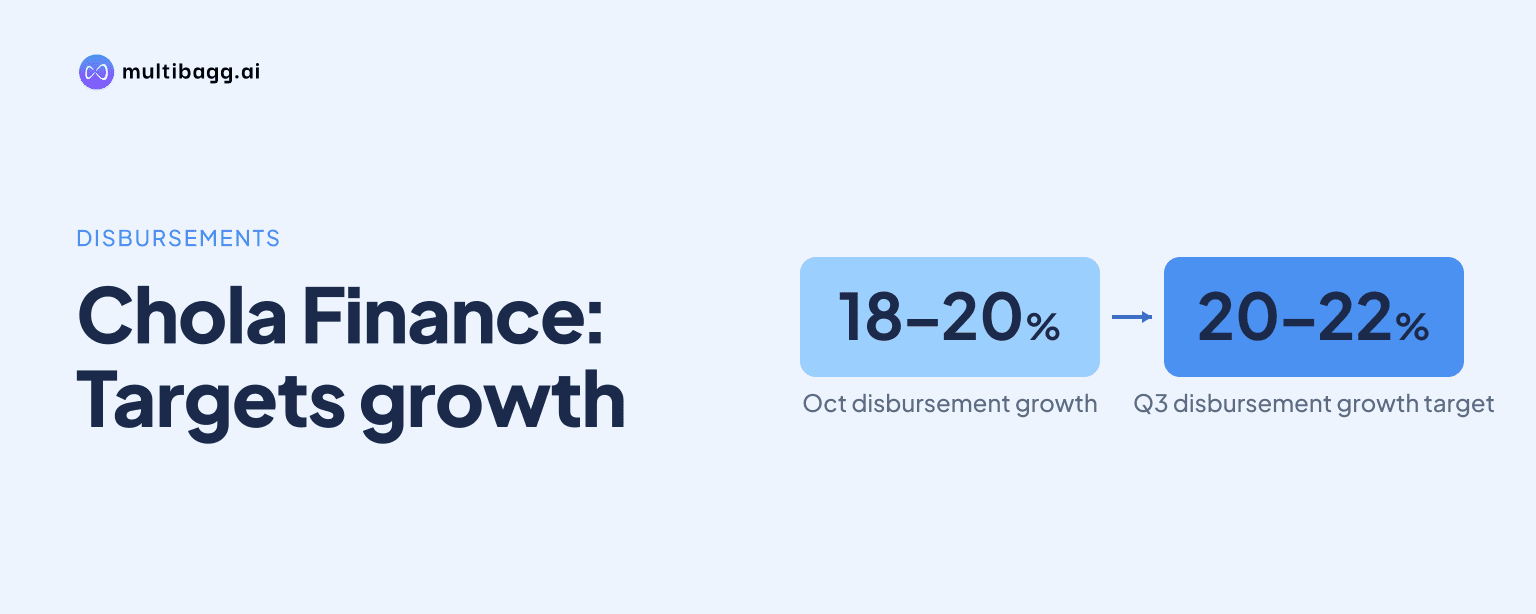
Chola Finance is targeting around 20%-22% year-on-year disbursement growth in Q3 after October growth tracked at approximately 18%-20%, while management said drought risk is contained by lower exposure in recurring stress markets and tractors accounting for about 3% of the Vehicle Finance portfolio.
Know Cholamandalam Investment & Finance Company inside out
Results, valuation, peers and who's buying, in one view.
What is Chola Finance targeting for Q3 disbursement growth?
Chola Finance is targeting around 20%-22% year-on-year disbursement growth in Q3, based on October trading and management's expectation that festive momentum will extend through November. Balraj Menon said October disbursements were expected to grow by about 18% from a year earlier, while Ravindra Kundu put the October trend at approximately 18%-20% across businesses.
Chola Finance has not raised its full-year objective of around 25% growth and net credit costs of approximately 1.4%, although Kundu said both metrics had been achieved in the first half. Management said Q3 and Q4 have historically been stronger than Q1 and Q2, but it does not consider it prudent to revise guidance before seeing the scale of the second-half improvement.
The gap between the October trend and the Q3 target reflects this year's festival calendar. Management said festive demand was concentrated mainly in October last year, whereas it is spread across October and November this year. It expects November disbursements to be comparable with October levels, despite November having been relatively subdued in the prior year.
Why does Chola Finance expect festive momentum to continue?
Chola Finance expects the longer October-November festive period to support growth through November, rather than produce a single-month October spike. Kundu said management had reviewed business trends through October and was encouraged by the momentum, while Menon said the timing provides a longer runway for disbursements.
Management said the outlook does not depend solely on an easy comparison with the prior year. An analyst noted that the previous year's second half had included pent-up demand, but Kundu said Chola Finance saw no reason for concern from base effects. Management nevertheless described October as an early indicator and said it would continue to monitor the trajectory.
Within Vehicle Finance, Chola Finance identified tractor financing and small-ticket used-vehicle financing as more exposed to a rural cash-flow disruption. Those products are concentrated in smaller towns and rural markets, where local economic conditions and rainfall can affect customer income. Management said it had already taken a cautious approach to disbursements in those markets.
How limited is Chola Finance's drought exposure?
Chola Finance said drought exposure is limited because it has kept lower portfolio concentrations in historically stressed regions and reduced tractor financing over the past four to five years. Kundu identified Vidarbha, Malwa, Coastal Karnataka and parts of Madhya Pradesh as markets that have been comparatively challenging for portfolio performance in earlier stress cycles.
Tractors account for about 3% of the Vehicle Finance portfolio, and management said the share is lower still when measured against the overall loan book. Menon added that Chola Finance's exposure in the markets facing drought concerns is below that 3% portfolio proportion. Management said Vehicle Finance is diversified by product and geography, which can reduce the effect of localised stress.
Management cited a rainfall deficit of around 13%, but said sowing activity was broadly in line with the previous year. It attributed that outcome to mechanisation, irrigation pumps and electricity availability, and said rainfall deficits were concentrated partly in the Northeast, Kerala and other areas with relatively lower agricultural activity. Management said the potential effect on customer cash flows and portfolio performance should become clearer by December.
Got a follow-up? Ask IRIS
What other loan-book trends could affect Chola Finance's second half?
Chola Finance sees scope for Home Loans and Loan Against Property, or LAP, to expand beyond the South, which currently contributes around 40% of business. The North, East and West contribute the remaining 60%, and management expects regional contributions to become more balanced over the next one to two years as its branch network matures.
Reported Q2 Home Loan and LAP growth was also affected by a technical alignment between disbursement reporting and asset recognition. Management said a portion of Home Loan, LAP, small and medium enterprise, and Small Business Personal Loan disbursements had not been reflected in the previous quarter's reported figures, even though underlying volumes remained broadly similar. It said Q2 volumes were marginally better than Q1, while the year-on-year comparison also benefited from a lower Q2 base.
Chola Finance said lower delinquencies and network productivity from expansion over the past two to three years support these businesses. It also said regulatory and process changes, including those involving SRO registrations, had slowed disbursement cycles in the previous year. With registrations and disbursements now being completed within prescribed timelines, management said reported performance is reflecting business volumes more efficiently.
How could funding costs and expenses affect Chola Finance's outlook?
Chola Finance said a repo-rate increase of up to 50 basis points in the second half could raise its full-year cost of funds by about 15 basis points year on year. About 25% of borrowings are linked to the repo rate, another 25% to other market benchmarks, and the remaining 50% are fixed-rate or linked to the marginal cost of funds-based lending rate, or MCLR.
Management said the more meaningful impact of higher benchmark rates may fall in the next financial year rather than the current year. It plans to incorporate funding-rate changes into incremental lending rates and said Affordable Housing and LAP were evaluating repricing of floating-rate portfolios within one to two months. Management also said second-half yields typically benefit from better collection efficiency and related collection income.
Operating expenses are expected to remain broadly in the 3.0%-3.1% range in the near term, compared with 2.9% in Q1 FY26 and 3.1% in Q2 FY26. Management said Q2 included July salary revisions and a one-time annual business-meet cost, while the transfer of employees from an outsourcing entity to the main payroll shifted nearly Rs 100 crore of expense from outsourcing to employee costs compared with Q1.
Conclusion
Chola Finance's 20%-22% Q3 target combines October growth of approximately 18%-20% with a festival calendar that management expects to support November volumes. Its drought assessment relies on portfolio composition and underwriting caution: tractors represent about 3% of Vehicle Finance, exposure is lower in historically drought-prone markets, and the company is being more selective in rural-linked products.
The next disclosed checkpoint is December, when management expects post-monsoon effects on customer cash flows and economic activity to be more visible. Other matters to watch are whether November disbursements match October, whether floating-rate Affordable Housing and LAP portfolios are repriced within one to two months, and whether operating expenses remain broadly around 3.0%-3.1%.