










Chola sees mortgage runway beyond its South India base today
Key highlights
- Chola said 60% of business originates outside South India, compared with 40% from the South.
- Home loans and LAP account for about 10% and 22% of Chola's loan book, or roughly 36% to 37% combined.
- Chola's small-LAP product has reached almost Rs 500 crore of quarterly disbursements, with an average ticket size of about Rs 20 lakh.
- Chola has approval to raise up to Rs 5,000 crore of capital, subject to shareholder and regulatory approvals.
powered by IRIS
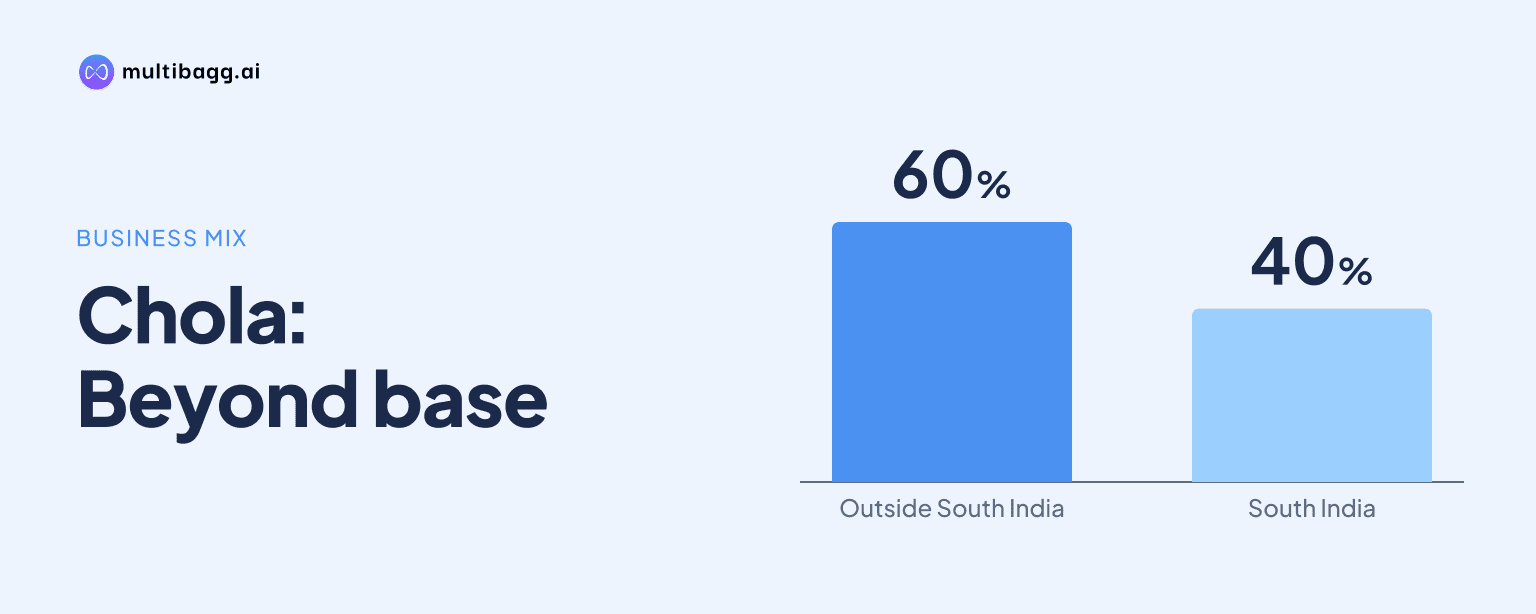
Chola Finance said in the September 2026 quarter that 60% of business originated in North, East and West India, versus 40% in the South, giving its mortgage businesses additional room to scale. Management expects regional contributions to become more balanced over one to two years as its branch network outside the South matures.
Know Cholamandalam Investment & Finance Company inside out
Results, valuation, peers and who's buying, in one view.
How much of Chola's business comes from outside South India?
Chola said 60% of its business now originates in the North, East and West, while 40% originates in South India. Management identified home loans, loan against property, small business personal loans and small and medium enterprise lending as businesses where penetration remains relatively low in several markets outside the South.
Management expects the contribution from regions to become more balanced over the next one to two years as its branches gain scale. This is a management expectation rather than a disclosed regional disbursement target, but it indicates that Chola views its existing network as a platform for growth rather than requiring a new product launch.
Mortgage lending already accounts for roughly 36% to 37% of Chola's loan book, based on management's stated mix of about 10% for home loans and 22% for LAP. In comparison, Vehicle Finance accounted for 52% of the book, and management expects it to fall below 50% over three to four years as longer-tenure mortgage assets increase.
Did Chola's home-loan and LAP disbursements accelerate in the September quarter?
Chola said underlying home-loan and LAP activity in the September quarter was only marginally better than the preceding quarter, despite a larger reported increase. Management said a technical alignment of disbursement reporting with asset recognition had prevented part of home-loan, LAP, SME and SBPL disbursements from appearing in the previous quarter's reported figures.
An analyst on the call described home-loan disbursements rising from about Rs 1,800 crore in Q1 to Rs 2,400 crore in Q2, while LAP disbursements increased from about Rs 4,800 crore to roughly Rs 6,400 crore to Rs 6,500 crore. Chola said the apparent year-on-year rise was also amplified by a comparatively lower base in Q2 of the previous year.
The operational trend still has identifiable drivers. Chola said delinquencies in home loans and LAP have remained consistently low, while network expansion over the past two to three years has improved productivity. Earlier regulatory and process changes around SRO registrations had slowed registrations and disbursement cycles, but management said those processes have now been streamlined.
What is small LAP contributing to Chola's mortgage strategy?
Chola said its small-LAP product has reached disbursements of almost Rs 500 crore per quarter and is supporting overall LAP yields. The lender now offers one LAP product for urban markets and a small-LAP product for markets between urban and rural areas, creating a second secured-lending route within the LAP business.
Management said the small-LAP product carries higher yields than the broader LAP offering, but did not disclose its standalone yield. An analyst noted that LAP internal rate of return had increased from 12.5% to about 13.3% during the preceding seven to eight quarters, and Chola attributed the maintenance of overall LAP yields to the newer product mix.
The average small-LAP ticket is about Rs 20 lakh, within a stated range of Rs 15 lakh to Rs 20 lakh. Chola specifically named LAP and SBPL among products with lower penetration outside South India, linking the small-ticket secured product to the wider opportunity in the North, East and West.
Got a follow-up? Ask IRIS
How will Chola support mortgage growth with capital and pricing?
Chola has board approval to raise up to Rs 5,000 crore of capital, subject to shareholder and regulatory approvals, to support growth across its existing businesses. Management said the proposal is intended to preserve balance-sheet flexibility rather than fund a specified mortgage acquisition or entry into a new lending segment.
As of September 2026, Chola reported a capital adequacy ratio of 20.62% and Tier 1 capital of 16.02%. Management said its prior capital raise was about three years earlier and indicated that any new transaction would depend on market conditions, valuation and capital requirements, with a possible six-to-nine-month window discussed on the call.
Chola also said it was evaluating repricing floating-rate affordable-housing and LAP portfolios in the next one to two months. About 25% of its borrowings are linked to the repo rate, another 25% to other market benchmarks, and the remaining 50% are fixed-rate or linked to marginal cost of funds-based lending rate bank funding.
What could affect Chola's mortgage expansion and returns?
Chola retained its full-year objective of around 25% growth and net credit costs of approximately 1.4%, even after saying both measures had been achieved in the first half. Management said Q3 and Q4 have historically been stronger than Q1 and Q2, but it did not raise the stated objective despite that seasonal pattern.
On funding costs, management said its full-year estimate assumes a total 50-basis-point increase in policy rates, including a further 25-basis-point rise after an earlier 25-basis-point move. Under that assumption, it expects the full-year cost of funds to rise by about 15 basis points year on year, with the effect more pronounced in the second half.
Chola also cited unresolved insurance-income rules and localized drought conditions as issues to monitor. It said the impact of reservoir levels on the Rabi season should be clearer by December, while any reduction in insurance income would be addressed through alternative revenue levers after the final regulatory outcome is known.
In its MSME portfolio, Chola said delinquencies were declining across LAP, SBPL, unsecured business loans and SME term loans. It reported some stress in secured loans below Rs 5 lakh in selected markets, although it said those pockets had begun improving; management also noted that the MSME portfolio is predominantly secured.
Conclusion
Chola's mortgage expansion case rests on the fact that 60% of its business already originates outside South India, where management sees lower penetration in home loans, LAP, SBPL and SME lending. Mortgage products account for about 36% to 37% of the loan book, and the Rs 500 crore quarterly small-LAP run rate adds a higher-yielding secured product to that mix.
The next points to watch are the proposed repricing of floating-rate affordable-housing and LAP loans over the next one to two months, the timing and structure of the approved Rs 5,000 crore capital raise, and management's December assessment of Rabi sowing and reservoir-water conditions. Chola has maintained its objective of about 25% growth and 1.4% net credit costs for the full year.