










Cholamandalam Investment & Finance Plans ₹5,000 Crore QIP
Key highlights
- Chola reported Q2 FY27 net profit of ₹1,630 crore, up 41% year on year.
- Assets under management rose 25% year on year to ₹2.68 lakh crore in Q2 FY27.
- The board approved a qualified institutions placement of up to ₹5,000 crore.
- Chola retained its FY27 AUM growth guidance of 20-23%.
powered by IRIS
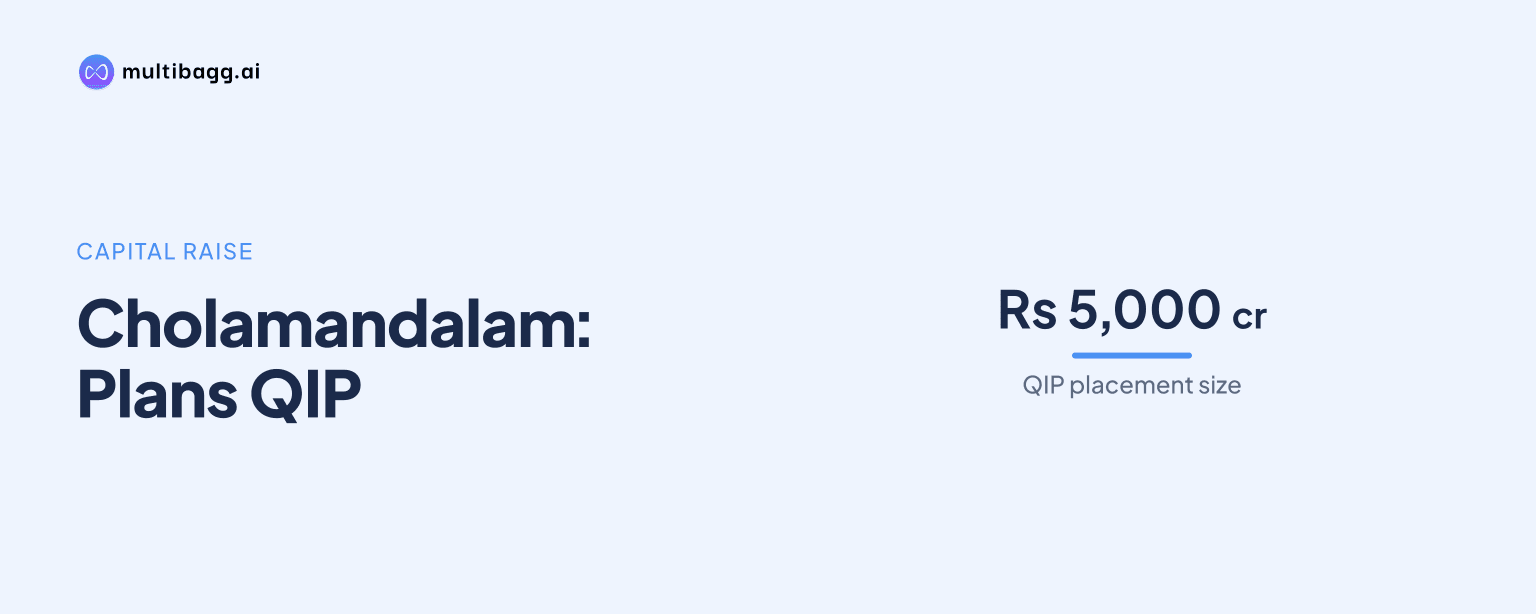
Cholamandalam Investment and Finance Company reported a 41% year-on-year rise in Q2 FY27 net profit to ₹1,630 crore and approved a qualified institutions placement of up to ₹5,000 crore as it targets 20-23% assets-under-management growth in FY27. The capital proposal is intended to support the company’s existing lending businesses while maintaining capital adequacy during expansion.
Know Cholamandalam Investment & Finance Company inside out
Results, valuation, peers and who's buying, in one view.
Why is Chola raising up to ₹5,000 crore through a QIP?
Chola has received board approval to raise up to ₹5,000 crore through a qualified institutions placement, or QIP, involving equity shares and/or eligible securities convertible into equity shares. The proposed issue may be undertaken in one or more tranches and remains subject to shareholder approval and other required approvals.
The board approved a postal ballot notice to seek shareholder consent for the fundraise. A QIP allows listed companies to issue securities to eligible qualified institutional buyers. The company has not disclosed an issue price, number of shares or the precise dilution that may arise if the placement is completed.
Chief Financial Officer Arul Selvan D said the board approval is an enabling resolution and that the company expects to begin work on the transaction. He indicated that Chola could approach the market within the next six to nine months, subject to market conditions and investor appetite.
The company has said that the proposed equity capital is intended for its existing businesses. As lending assets expand, an NBFC must maintain adequate capital to support growth and meet regulatory requirements. The QIP proposal therefore links the planned capital addition with Chola’s stated AUM growth targets.
What were Chola's Q2 FY27 financial results?
Chola reported net profit of ₹1,630 crore for the quarter ended September 30, 2026, up 41% from ₹1,155 crore in the year-earlier quarter. Total income increased to ₹9,367 crore from ₹7,590 crore a year earlier, according to the company’s regulatory filing.
Assets under management rose 25% year on year to ₹2.68 lakh crore, or ₹2,68,009 crore. The AUM increase provides the operating context for the company’s decision to seek fresh equity capital, since a larger loan book requires a stronger capital base.
Chola retained its earlier FY27 AUM growth guidance despite the strong second-quarter performance. The company expects AUM growth of around 20-23% in FY27, while some management commentary described the expected range as around 23-24%.
Got a follow-up? Ask IRIS
How does the QIP support Chola's FY27 AUM growth plan?
The QIP is designed to add equity capital as Chola pursues AUM growth of 20-23% in FY27. Management has stated that the funds are for existing operations rather than a newly disclosed business initiative, indicating that the planned capital will support lending growth across the company’s established platforms.
Cholamandalam Investment and Finance Company is a Murugappa Group NBFC that provides vehicle finance, home loans, SME loans, consumer finance and insurance agency services. It is registered with the Reserve Bank of India as an NBFC-Investment and Credit Company and is classified as an Upper Layer NBFC under the scale-based regulatory framework.
The company operates across India through 1,191 branches, based on the information provided. Its broad lending presence means that growth in AUM can be driven by multiple financing segments rather than a single geography or product category.
For an NBFC, equity capital supports the ability to grow lending assets while preserving regulatory capital buffers. Chola’s management has explicitly connected the proposed fundraising with the need to improve capital adequacy as the business expands. The actual timing and amount raised will depend on shareholder approval, regulatory requirements and market conditions.
What does the capital plan mean for shareholders and the NBFC sector?
For shareholders, the ₹5,000 crore QIP approval creates the possibility of equity dilution if Chola issues new shares or convertible securities. The degree of dilution cannot be calculated from the available disclosures because the company has not specified the issue price, number of securities or final structure of the placement.
The proposal also signals that Chola is preparing its balance sheet for continued loan-book expansion. Its 25% year-on-year AUM growth in Q2 FY27 was above the company’s stated FY27 target range of 20-23%, though the company has retained its existing guidance rather than increasing it.
For customers and industry operations, the fundraise is relevant because NBFCs rely on a combination of equity capital and borrowings to finance lending activity. Chola has not announced changes to its lending products, branch network or customer terms alongside the QIP approval.
The transaction remains at the approval and preparation stage. The board has authorised the proposal, but execution will require shareholder approval through the postal ballot process and will be governed by applicable Securities and Exchange Board of India regulations for qualified institutional placements.
Conclusion
Cholamandalam Investment and Finance Company combined a 41% rise in Q2 FY27 net profit to ₹1,630 crore with a proposal to raise up to ₹5,000 crore through a QIP. The company’s AUM of ₹2.68 lakh crore, up 25% year on year, provides the basis for management’s view that additional equity capital is needed to support expansion and capital adequacy.
Investors will watch the postal-ballot outcome, the final structure and pricing of any QIP, and whether AUM growth remains aligned with Chola’s 20-23% FY27 guidance. Management has indicated that it could approach the market within six to nine months, subject to market appetite and required approvals.