










Chola Financial Holdings Q2 disbursements rise 43%, losses 1.0%
Key highlights
- Chola’s Q2 FY27 home-loan disbursements rose 43% year on year to Rs 2,426 crore.
- Chola reported loan losses and provisions of 1.0% in Q2 FY27, versus 0.5% in Q2 FY26.
- Chola’s Q2 FY27 home-loan AUM increased 24% year on year to Rs 25,240 crore.
- Chola’s H1 FY27 home-loan profit before tax increased 35% to Rs 540 crore.
powered by IRIS
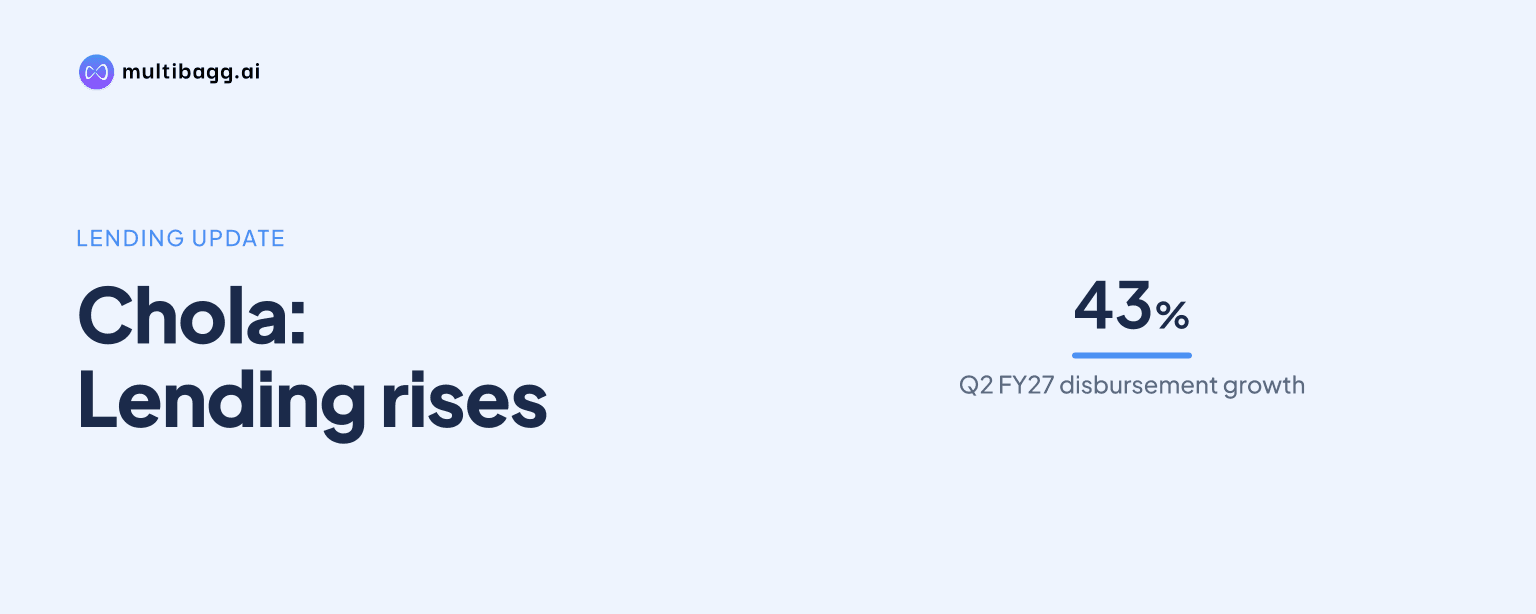
Chola Financial Holdings recorded a 43% year-on-year rise in home-loan disbursements to Rs 2,426 crore in Q2 FY27, while loan losses and provisions reached 1.0%, versus 0.5% a year earlier; Q2 profit before tax rose 24% to Rs 271 crore.
Know Cholamandalam Financial Holdings inside out
Results, valuation, peers and who's buying, in one view.
How fast did Chola’s home-loan disbursements grow?
Chola’s home-loan disbursements rose 43% year on year to Rs 2,426 crore in Q2 FY27, from Rs 1,697 crore in Q2 FY26. The quarterly increase followed 2% growth in Q1 FY27, when disbursements were Rs 1,797 crore against Rs 1,764 crore in Q1 FY26. Chola’s Home Loans reporting includes Affordable Loan Against Property, or Affordable LAP.
For the first half of fiscal year 2027, or H1 FY27, Chola disbursed Rs 4,223 crore, up 22% from Rs 3,461 crore in H1 FY26. The H1 growth rate was lower than Q2’s 43% because Q1 disbursements increased by only 2%. The period comparison shows that growth accelerated during Q2 rather than being evenly distributed across the first half.
Chola’s Q2 FY27 disbursements were Rs 629 crore above the Q1 FY27 figure of Rs 1,797 crore. The Q2 contribution was therefore the principal driver of the Rs 762 crore increase in first-half disbursements over H1 FY26. The presentation does not provide a split between conventional home loans and Affordable LAP within the reported totals.
What changed in Chola’s home-loan assets under management?
Chola’s total home-loan assets under management, or AUM, reached Rs 25,240 crore in Q2 FY27, up 24% from Rs 20,405 crore in Q2 FY26. On-book AUM increased to Rs 25,026 crore from Rs 20,138 crore, while assigned AUM declined to Rs 214 crore from Rs 267 crore over the same period.
The change in the reported mix was toward on-book assets. On-book AUM rose by Rs 4,888 crore year on year, exceeding the Rs 4,835 crore increase in total AUM because assigned assets fell by Rs 53 crore. At Q1 FY27, Chola reported total AUM of Rs 23,644 crore, including Rs 23,416 crore on book and Rs 228 crore assigned.
From Q1 FY27 to Q2 FY27, total AUM increased by Rs 1,596 crore. The presentation’s 24% year-on-year AUM growth rate was below the 43% rise in Q2 disbursements, reflecting that AUM is an outstanding portfolio measure while disbursements cover lending in the quarter. It does not disclose repayments, prepayments or portfolio run-off for the home-loan business.
Got a follow-up? Ask IRIS
Why did Chola’s reported loan-loss ratio increase?
Chola reported loan losses and provisions of 1.0% in Q2 FY27, double the 0.5% recorded in Q2 FY26. For H1 FY27, the ratio was 0.8%, compared with 0.6% in H1 FY26. These reported ratios show a higher loss and provisioning charge alongside the increase in Q2 disbursements and AUM.
The presentation identifies an ARC-related impact in Q1 FY27 of 44 basis points, or bps, negative for loan losses, and an H1 FY27 impact of 23 bps negative for loan losses. It also identifies a positive income effect of 24 bps in Q1 FY27 and 13 bps in H1 FY27. Chola does not expand the term ARC in the supplied pages.
The source does not provide an ARC effect specifically for Q2 FY27, a loan-loss bridge by borrower category, or a non-performing asset ratio for Home Loans. The disclosed data therefore support identifying the ARC-related item as a contributor to the H1 loss ratio, but do not establish how much of the Q2 year-on-year increase to 1.0% resulted from that item.
ICRA, cited in Chola’s sector outlook, expects affordable housing finance companies’ AUM to rise by 19% to 21% in FY27, supported by the government’s housing-for-all thrust. ICRA also says asset quality is expected to inch up, while portfolio seasoning and external disruptions affecting borrower income remain monitorable. These are ICRA’s sector observations, not Chola’s forecast.
Did income and profit keep pace with home-loan growth?
Chola’s Q2 FY27 home-loan income increased 27% to Rs 1,004 crore from Rs 789 crore in Q2 FY26. Profit before tax, or PBT, increased 24% to Rs 271 crore from Rs 219 crore. Income therefore grew 3 percentage points faster than PBT in Q2, when the loan-loss and provisions ratio was reported at 1.0%.
For H1 FY27, income rose 26% to Rs 1,920 crore from Rs 1,518 crore, while PBT increased 35% to Rs 540 crore from Rs 401 crore. This differs from the Q2 comparison because first-half PBT growth exceeded first-half income growth. In Q1 FY27, PBT rose 48% to Rs 270 crore from Rs 182 crore, ahead of Q2’s 24% PBT increase.
Chola states that it plans to deepen its reach among first-time buyers in semi-urban and rural markets through tailored, segment-specific products and analytics-driven direct outreach. It also cites a lean hub-and-spoke network, well-segmented underwriting, technology-enabled collections and focused recovery efforts as mechanisms intended to augment asset quality across customer segments. The supplied pages do not give branch, customer or recovery figures for these initiatives.
Conclusion
Chola’s Q2 FY27 home-loan performance combined a 43% increase in disbursements, 24% AUM growth and a 24% rise in PBT. The same quarter also carried a 1.0% loan-loss and provisions ratio, compared with 0.5% in Q2 FY26. The first-half disclosure of an ARC-related adverse effect on losses adds context, but does not quantify the specific Q2 contribution.
The next results should show whether growth among first-time buyers in semi-urban and rural markets can continue under Chola’s stated plan for segment-specific products, analytics-led outreach, underwriting and recovery efforts. Readers can also watch reported loan losses after the H1 FY27 ARC-related effect of 23 bps, alongside ICRA’s monitorable sector issues of portfolio seasoning and borrower-income disruptions.