










Chola MS reduces two-wheeler and group-health premium volumes
Key highlights
- Chola MS two-wheeler GDPI fell 21% year on year to Rs 232 crore in H1 FY27.
- Chola MS group-health GDPI declined 38% year on year to Rs 180 crore in H1 FY27.
- Chola MS total motor loss ratio rose to 86.7% in H1 FY27 from 80.6% in H1 FY26.
- Chola MS issued 37 lakh policies in H1 FY27, down from 54 lakh in H1 FY26.
powered by IRIS
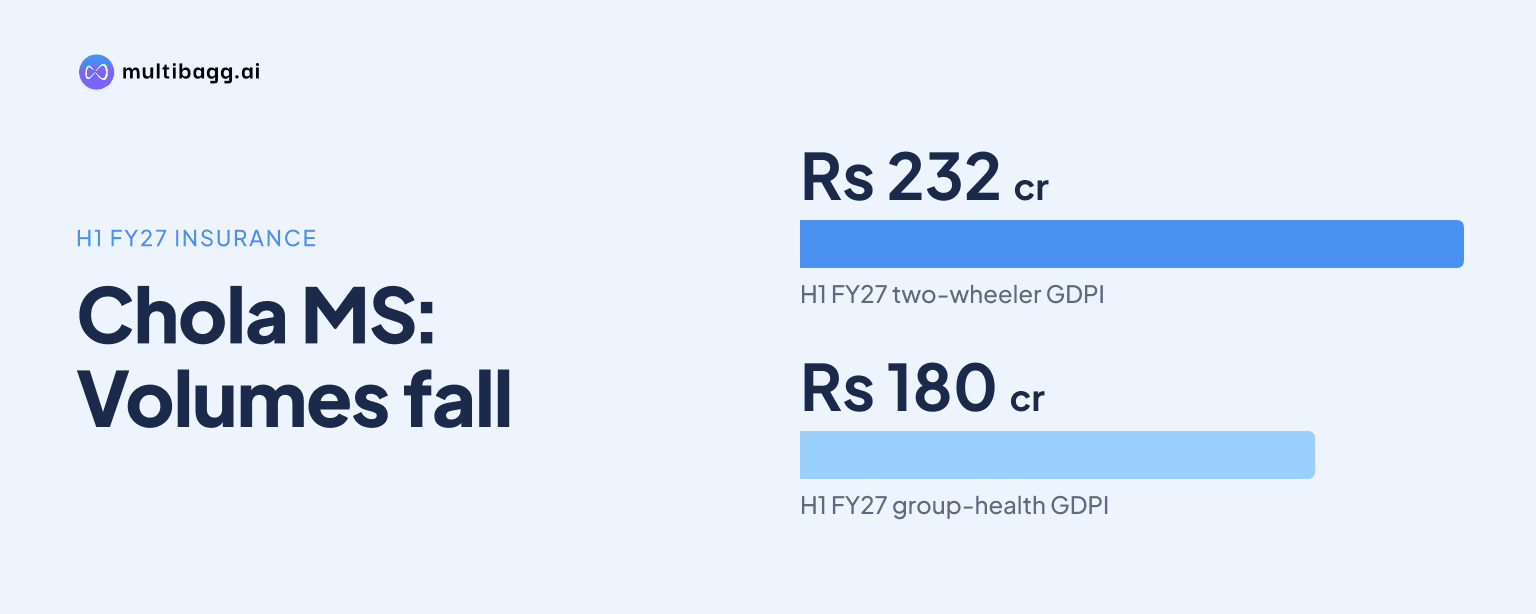
Chola MS reduced group-health gross direct premium income, or GDPI, by 38% year on year to Rs 180 crore and two-wheeler GDPI by 21% to Rs 232 crore in H1 FY27, as it calibrated participation in selected products. The reductions came as its total motor loss ratio rose to 86.7% from 80.6% a year earlier.
Know Cholamandalam Financial Holdings inside out
Results, valuation, peers and who's buying, in one view.
Why is Chola MS reducing two-wheeler business?
Chola MS is consciously reducing two-wheeler volumes, particularly motor third-party, or TP, premium, while changing the mix of its motor portfolio. Two-wheeler GDPI declined from Rs 294 crore in H1 FY26 to Rs 232 crore in H1 FY27, a 21% fall. In FY26, two-wheeler GDPI had already fallen 25% to Rs 605 crore from Rs 808 crore in FY25.
The change is also visible in Chola MS's motor ecosystem mix. Two-wheelers represented 19.6% in FY23, 10.6% in FY26 and 8.8% in H1 FY27. Private vehicles accounted for 49.5% in H1 FY27, up from 35.9% in FY23, while commercial vehicles represented 41.7%. Chola MS said there had been no revision in base motor TP premium since FY23.
Chola MS's reduction in two-wheeler business occurred alongside lower overall policy issuance. The number of policies issued fell to 37 lakh in H1 FY27 from 54 lakh in H1 FY26. Annual policy issuance had reached 137 lakh in FY24 before declining to 130 lakh in FY25 and 113 lakh in FY26, according to the presentation.
How has Chola MS's motor portfolio changed across segments?
Chola MS increased total motor GDPI by 4% year on year to Rs 2,629 crore in H1 FY27 despite the contraction in two-wheelers. Commercial-vehicle GDPI rose 18% to Rs 1,096 crore from Rs 927 crore, while private-car GDPI was broadly unchanged at Rs 1,300 crore from Rs 1,305 crore. In FY26, total motor GDPI grew 5% to Rs 5,682 crore.
The balance between motor own-damage, or OD, and TP business changed modestly in H1 FY27. Motor OD GDPI rose 2% to Rs 1,214 crore, while motor TP GDPI increased 6% to Rs 1,415 crore. Chola MS reported an OD premium mix of 46.2% in H1 FY27, compared with 45.6% in FY26, and said it ranked among the top three private players in four states by OD premium.
Chola MS's product mix shows motor remained central to the portfolio during the repositioning. Motor OD represented 33% of product mix in both H1 FY26 and H1 FY27, while motor TP increased to 38% from 36%. Health, travel and accident declined to 13% from 15%, commercial remained at 15%, and crop and other business remained at 1%.
What claims experience is prompting Chola MS portfolio correction?
Chola MS reported that its total motor loss ratio increased to 86.7% in H1 FY27 from 80.6% in H1 FY26. Motor OD loss ratio rose to 91.8% from 83.2%, while motor TP increased to 84.2% from 79.3%. Chola MS said motor OD loss ratios had increased across the industry and remained elevated for the company.
Natural-catastrophe, or NatCat, events added to the reported OD result. Excluding NatCat, the H1 FY27 motor OD loss ratio was 89.9%, compared with the reported 91.8%, and total motor loss ratio was 86.1%, compared with the reported 86.7%. The total company loss ratio was 88.6% in H1 FY27, up from 81.5% a year earlier.
The quarterly data showed a further NatCat effect in Q2 FY27. Chola MS reported a total loss ratio of 91.7% in Q2 FY27, or 89.0% excluding NatCat, compared with 81.9% in Q2 FY26. Commercial-line loss ratio was 132.8% in Q2 FY27 but 84.3% excluding NatCat, while Chola MS said portfolio-correction measures had been implemented.
Got a follow-up? Ask IRIS
Why has Chola MS cut group-health participation?
Chola MS said it calibrated participation in group health and government schemes because of competitive pricing and higher combined ratio, or CoR. Group-health GDPI fell 38% to Rs 180 crore in H1 FY27 from Rs 288 crore in H1 FY26. The decline followed a 42% increase in FY26, when group-health GDPI reached Rs 517 crore from Rs 363 crore in FY25.
The health, accident and travel portfolio declined 14% to Rs 480 crore in H1 FY27 from Rs 559 crore a year earlier. Group health's share of that portfolio fell to 37% from 52%, while accident GDPI rose 50% to Rs 141 crore and its share increased to 29% from 17%. Retail-health GDPI fell 10% to Rs 159 crore, although its mix was 33% versus 32% a year earlier.
Chola MS's health, accident and travel GDPI was also lower on a full-year basis before the H1 FY27 reduction. The portfolio declined 3% to Rs 1,125 crore in FY26 from Rs 1,156 crore in FY25. Within FY26, retail health fell 29% to Rs 370 crore, accident declined 11% to Rs 238 crore, and group health was the only major health sub-segment to increase, rising 42%.
What does Chola MS's policy and retail mix show?
Chola MS remained retail-led, with retail accounting for 65.5% of business mix and commercial accounting for 34.5%, while the volume reductions lowered retail-oriented policy issuance. Retail-oriented policies, covering motor, retail health, accident and travel, fell to 29.34 lakh in H1 FY27 from 44.47 lakh in H1 FY26. The annual total had been 94.14 lakh in FY26, down from 108.90 lakh in FY25.
Chola MS has distribution capacity across multiple channels as it adjusts its product mix. Brokers accounted for 49% of the channel mix in H1 FY27, compared with 51% in H1 FY26, while other corporate agents increased to 15% from 14%. Agents and point-of-sales persons accounted for 19%, banks 10%, direct business 7% and other channels 1%.
Chola MS also reported 41,000-plus bank branches, 60,000-plus agents and point-of-sales persons, and more than 12,000 dealers served through its network. Its rural business covered 1.66 lakh gram panchayats and more than 44.50 lakh lives or properties. These disclosed channels sit alongside the deliberate reductions in two-wheeler and group-health volumes.
Conclusion
Chola MS is reducing exposure in two-wheelers and group health while retaining growth in selected motor and accident lines. The product-level figures show the trade-off: two-wheeler GDPI declined 21% and group-health GDPI declined 38% in H1 FY27, while commercial-vehicle GDPI rose 18% and accident GDPI rose 50%.
The next disclosed test is whether the portfolio-correction measures affect results in the coming quarter, as Chola MS expects. Results will also show whether motor loss ratios move from the H1 FY27 level of 86.7%, particularly after the NatCat-adjusted motor OD ratio of 89.9%, and how the OD and TP premium mix develops.