










Chola MS says distribution reform risk is within appetite
Key highlights
- Chola MS said stress tests of lower pricing and attachment rates kept reform impact within its risk appetite.
- Chola MS said distribution cost in financing-linked motor insurance is below 15%.
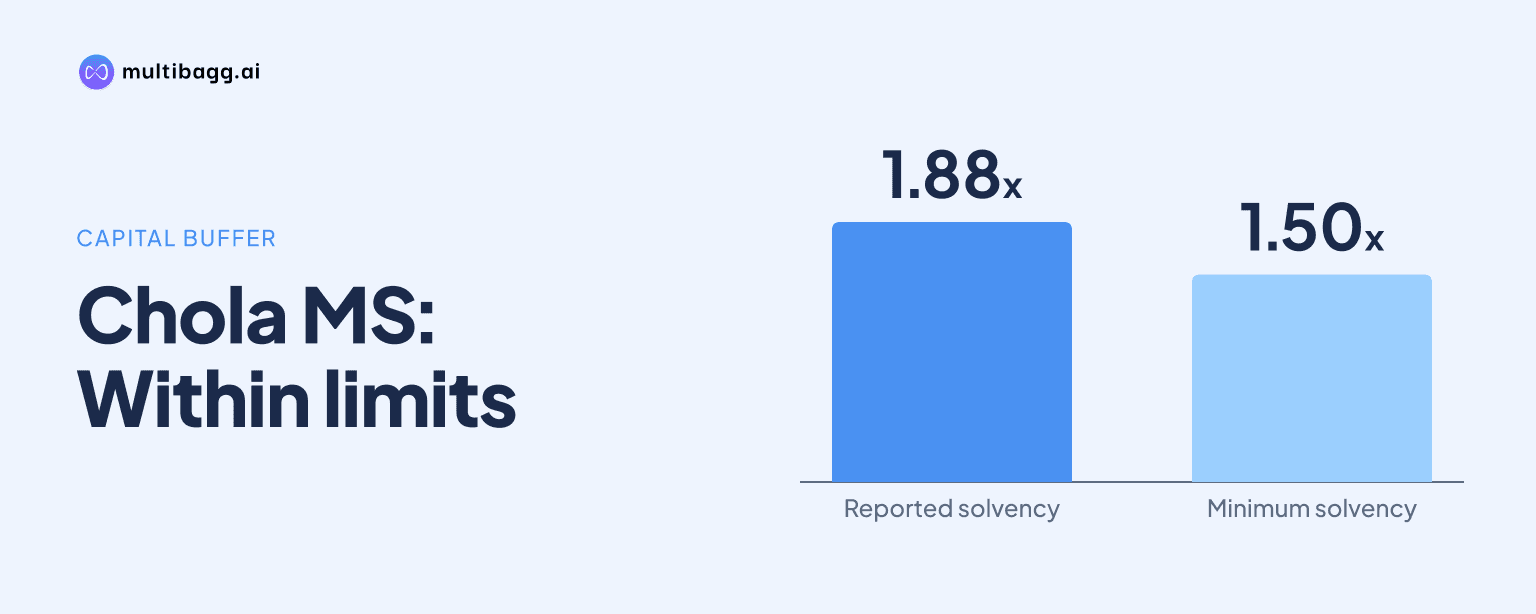
- Chola MS reported solvency of 1.88 times against a 1.50-times minimum requirement.
- Management said Rs 100 crore of subordinated debt could improve solvency by roughly 5 percentage points.
powered by IRIS
Cholamandalam Financial Holdings Limited (Chola MS) said the proposed insurance distribution reforms remained within its risk appetite after internal stress tests of lower attachment rates and pricing, while distribution cost in its financing-linked motor segment was below 15%. Management said the final impact will depend on regulatory rules and distributor responses.
Know Cholamandalam Financial Holdings inside out
Results, valuation, peers and who's buying, in one view.
How does Chola MS assess the proposed distribution reform risk?
Chola MS said the potential effect of the consultation paper is manageable because it has tested scenarios involving lower pricing and reduced attachment rates. Management said the outcomes were within its risk appetite and that the company has sufficient installed capacity to continue growing without materially affecting the metrics it described as current and proposed EOM levels.
The assessment is not a forecast of the final regulatory outcome. Management said the eventual effect will depend on how distributors, particularly bancassurance partners, respond if financing-linked arrangements are not permitted in the proposed format. The company welcomed the consultation paper’s customer-focused approach and said an outcome that is right for customers should also be right for the insurance industry.
Chola MS did not disclose the share of its premium, policies or revenue that comes through credit-linked channels. The analyst asked about motor insurance, personal accident, bank-led health and small and medium enterprise business, but management gave no percentage for business sourced through banks or non-banking financial companies. The direct exposure to lower attachment rates therefore cannot be calculated from the call.
Management’s conclusion rests on internal scenario testing rather than a published sensitivity for premium, underwriting profit or policy volumes. That distinction matters because a channel can have a distribution cost below 15% while still facing a change in customer acquisition if lenders alter their insurance facilitation practices. Chola MS did not give an attachment-rate assumption used in its stress tests.
Why does Chola MS view financing-linked motor distribution as efficient?
Chola MS said distribution cost in the financing-linked motor segment is below 15%, which management described as relatively efficient from a cost perspective. It said the cost of acquiring business through this route is not so elevated that it should by itself raise regulatory concerns. The call did not provide corresponding acquisition-cost ratios for agents, brokers, direct distribution or other bancassurance business.
Management identified financing as a catchment area for bringing uninsured vehicles into the insurance pool. It said some non-banking financial company segments contain financed assets held by younger customers, first-time borrowers and first-time vehicle owners. In this channel, the financing transaction can create an opportunity to offer motor insurance to a customer who may otherwise remain uninsured.
Chola MS said several stakeholders have represented that customer consent should guide financing-linked insurance facilitation. Management referred to an expected consent-based approach from the Reserve Bank of India effective from 1 January, while noting that consent is embedded in the Digital Personal Data Protection framework. It did not state a year for the 1 January date or say that the final insurance rules will adopt those representations.
The company’s position is therefore conditional: customer consent could preserve a route for motor insurance facilitation, but the final treatment of financing-linked arrangements remains unresolved. Management did not say whether its below-15% distribution-cost measure includes every product attached to credit, such as personal accident or bank-led health policies. The figure was specifically provided for the financing-linked motor segment.
Got a follow-up? Ask IRIS
Could lower motor commissions offset weaker credit-linked attachment?
Chola MS said lower third-party motor pricing could also reduce third-party motor commissions, creating a potential offset to any pressure on loan-linked attachment rates. Management said this consideration is relevant because its business is heavily weighted toward motor insurance. It did not quantify the possible saving in commissions or estimate the reduction in attachment rates under the consultation paper.
Third-party motor insurance covers liabilities to third parties, while own-damage motor insurance covers damage to the insured vehicle. The potential commission benefit discussed by management applies to third-party motor pricing, whereas the analyst’s question covered sales linked to loans from banks and non-banking financial companies. Chola MS did not establish that the two effects would occur at the same scale or in the same period.
The call also provided motor underwriting context, although it was not a direct estimate of regulatory impact. Management said it expects roughly 5% further improvement from current motor own-damage experience as the current year’s sourcing and next year’s experience earn through. It said the full benefit of earlier actions could take another three to four quarters to appear in reported numbers.
Chola MS manages close to 4 lakh claims annually, and management said a Rs 1,000 reduction in average claim severity per claim could have a meaningful effect on the overall loss ratio. It said it had begun work on claim severity in the private-car portfolio during the current quarter. This claims initiative is separate from the distribution consultation, but it forms part of the broader motor profitability and cost backdrop.
Does Chola MS have capital flexibility if growth changes after reforms?
Chola MS said its solvency ratio was 1.88 times, compared with the 1.50 times minimum requirement cited on the call. Management said there was more than sufficient headroom for subordinated debt, although it may require capital restructuring. The company’s paid-up capital was about Rs 442 crore, with approximately Rs 110 crore of readily available capacity, according to management.
Management said a Rs 100 crore subordinated-debt issuance would raise solvency by roughly 5 percentage points. It also said net worth of around Rs 3,400 crore could support a significantly larger subordinated-debt amount, potentially up to Rs 1,700 crore. These were descriptions of available capital levers, not an announcement that Chola MS will issue debt.
Chola MS estimated that subordinated debt could create negative carry of 1% to 2%, depending on funding costs and how quickly capital is deployed. Management said it is evaluating the appropriate balance among solvency, profitability under International Financial Reporting Standards and reinsurance economics. That evaluation means capital actions would depend on conditions rather than follow automatically from slower growth or regulatory change.
Management is extending work from the Quantitative Impact Study 2 exercise for FY2024-25 into FY2025-26 to assess its preferred capital position if a risk-based capital framework is implemented next year. It also cited premium received in advance in home, personal accident and motor own-damage quota-share portfolios as flexibility to retain more business gradually. Chola MS said the sliding-scale structure of some treaties could make higher retention value accretive.
Conclusion
Chola MS’s message was that proposed distribution reforms could pressure financing-linked attachment rates, but that stress testing placed the possible impact within risk appetite. Its main supporting figures were financing-linked motor distribution cost below 15% and a 1.88-times solvency ratio against a 1.50-times minimum. The company did not disclose the proportion of business sourced through credit institutions, leaving the size of direct exposure unquantified.
The next items to watch are the final rules on financing-linked arrangements, distributor responses and the customer-consent approach expected from 1 January. Management is also continuing FY2025-26 work on a possible risk-based capital framework and reinsurance strategy. Any decision on capital restructuring, subordinated debt or greater portfolio retention will depend on that assessment and the trade-off between solvency, accounting profitability and reinsurance economics.