










Chola MS Targets 78%-80% Motor OD Ratio in FY2028
Key highlights
- Chola MS endorsed a 78%-80% motor own-damage loss-ratio range for FY2028.
- Chola MS said H1 FY27 motor sourcing-book loss ratios improved 4%-5% excluding NatCat events.
- Chola MS reported H1 FY27 gross premium of Rs 45.17 crore, up 7.1% year on year.
- NatCat events affected Chola MS’s H1 FY27 results by about Rs 71 crore.
powered by IRIS
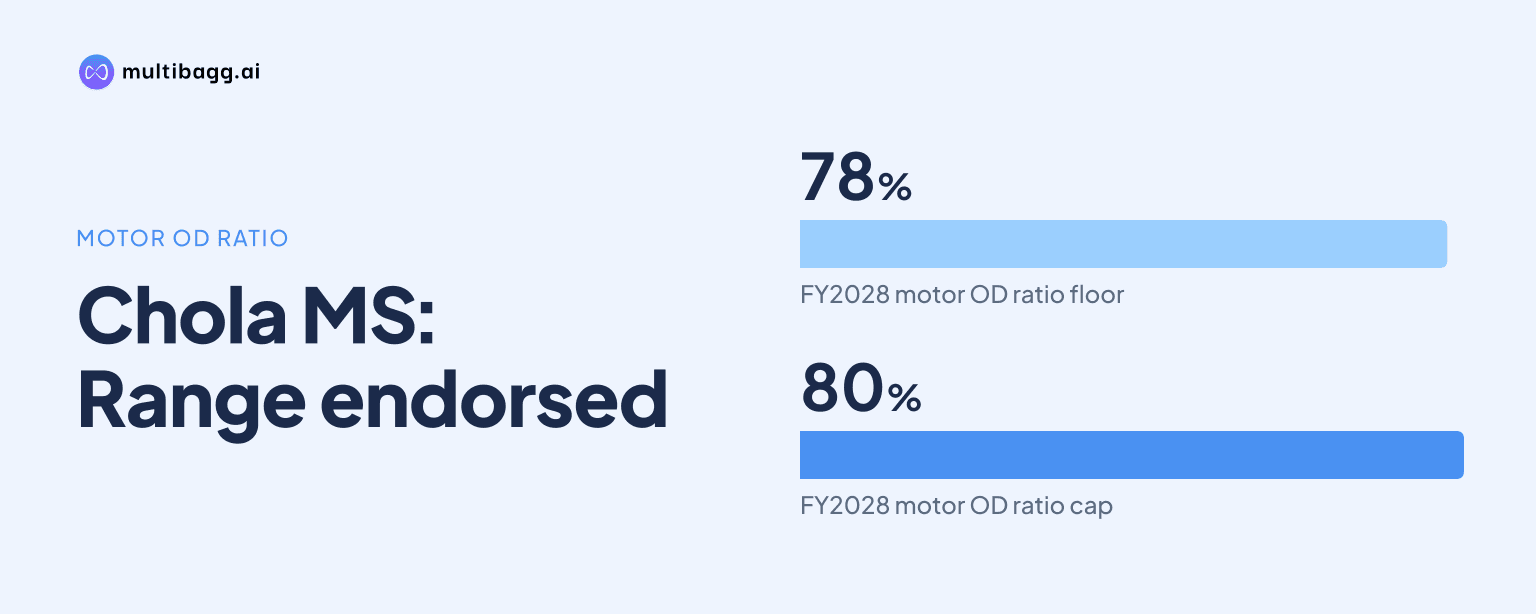
Cholamandalam MS General Insurance endorsed a 78%-80% motor own-damage loss-ratio range for FY2028, supported by a 4%-5% year-on-year improvement in H1 FY27 sourcing-book loss ratios excluding natural-catastrophe events. Chola MS said legacy claims and earnings timing mean the newer underwriting mix will take another three to four quarters to be fully reflected in reported results.
Know Cholamandalam Financial Holdings inside out
Results, valuation, peers and who's buying, in one view.
What motor own-damage loss ratio is Chola MS targeting?
Chola MS expects its motor own-damage, or OD, loss ratio to reach 78%-80% in FY2028, after management agreed with an analyst’s formulation of that range on the November 6, 2026 earnings call. The company also said it expects roughly a further 5% improvement from current levels as recent sourcing earns through over time.
The FY2028 range is based on improvement in the loss ratio of newly sourced business, not an immediate improvement in reported financial results. Chola MS said the gross loss ratio of its H1 FY27 motor sourcing book improved by about 1%-1.5% year on year including natural-catastrophe, or NatCat, events. Excluding NatCat events, the improvement was about 4%-5% versus H1 of the prior year.
An analyst cited motor OD loss ratios of 94% in Q2 FY27 and 90% in H1 FY27, excluding catastrophe events. Chola MS said those reported figures still include older underwriting outcomes and claims developments, whereas the sourcing view is intended to show the performance of the recently written portfolio.
Why will reported motor results take three to four quarters to improve?
Chola MS said the full benefit of its underwriting changes will take another three to four quarters to become visible in reported results because about 55% of last year’s business earns into FY27. Only about 45% of current-year business contributes to current-year earnings, while the remaining 55% earns into the following year.
Management identified two sources of legacy pressure. Theft claims decided through consumer forums have included significant interest costs, increasing the motor loss ratio. Separately, flood-related total-loss and constructive-total-loss claims have resulted in payouts above reserves previously carried against those claims.
NatCat losses have added to the near-term burden. Chola MS said events across Maharashtra, Gujarat, Daman and Diu affected H1 FY27 results by about Rs 71 crore, while a large risk added about Rs 14 crore. The H1 combined ratio was 124.2%, or 122.7% excluding NatCat losses, and profit after tax was Rs 78 crore.
How is Chola MS changing its motor underwriting?
Chola MS is building its no-claim-bonus, or NCB, customer base and reviewing private-car and commercial-vehicle business at the sourcing level. Management said it now uses underwriting assessments across distribution counters, geographies, vehicle categories and vehicle models to determine where it should retain, expand or exit business.
NCB customers have a lower propensity to make own-damage claims, according to management. Chola MS said that increasing the NCB share in private cars and improving the commercial-vehicle portfolio should also support third-party claims behaviour. It said it retained counter share in much of the new-vehicle market but had lost business in renewal and rollover segments, leading to the actions taken in Q1 and Q2 FY27.
Claims-cost control is the second element of the plan. Chola MS handles close to 4 lakh claims annually and said a Rs 1,000 reduction in average claim severity, or ACS, per claim can materially affect the overall loss ratio. Management began its private-car ACS initiative in Q2 FY27 and expects gradual quarter-on-quarter improvement.
Chola MS remains largely outside the two-wheeler portfolio because management considers third-party pricing inadequate where premium is locked for five years. Management said the International Financial Reporting Standards, or IFRS, review means no product is permanently excluded, but any selective two-wheeler participation would depend on regulatory compliance, claims experience and profitability.
Got a follow-up? Ask IRIS
How are premium growth and catastrophe losses affecting the turnaround?
Chola MS reported gross premium of Rs 23.86 crore in Q2 FY27 and Rs 45.17 crore in H1 FY27, up 7.4% and 7.1%, respectively. Motor premium grew 4.1% in H1 FY27, compared with 13% growth for the industry motor segment over the comparable period. Management said the slower growth reflected decisions intended to improve portfolio quality.
Commercial-lines premium grew about 6%, despite what management described as market de-growth in that segment, supported by reinsurance capacity and a wider spread of risk. Chola MS reduced group-health business by avoiding large accounts where management considered pricing unsustainable, while saying its group-health sourcing book showed a significant loss-ratio reduction without quantifying it.
The Rs 71 crore NatCat impact was increased by the timing of weather events. Chola MS said standard reinsurance contracts use 72-hour or 168-hour event clauses, but the events did not overlap within those aggregation windows. Separate deductibles therefore applied to each event; management said motor NatCat retention was Rs 10 crore.
What capital and investment capacity does Chola MS have?
Chola MS reported net worth of Rs 34.09 crore and solvency of 1.88 times at the end of H1 FY27. Management said it had sufficient capacity to support growth and was evaluating the trade-offs among solvency, IFRS profitability and reinsurance economics as it considers its preferred capital structure.
Management said paid-up capital of about Rs 4.42 crore provides about Rs 1.10 crore of readily available subordinated-debt capacity. It estimated that a Rs 1 crore subordinated-debt issuance would raise solvency by roughly 5 percentage points, while net worth could support potentially up to Rs 17 crore of such debt if required.
The investment portfolio stood at Rs 190.50 crore in H1 FY27. The debt-book carrying yield rose 20 basis points, or 0.20 percentage points, from 7.13% in March to 7.33%; realized yield was 7.45% in H1 FY27. Management said the portfolio had no stressed assets and no exposure to securities rated BB or below.
Conclusion
Chola MS’s planned motor turnaround rests on a better-performing sourcing book, with H1 FY27 loss-ratio improvement of 4%-5% excluding NatCat events underpinning management’s 78%-80% FY2028 motor OD range. However, legacy theft claims, reserve shortfalls on flood-related losses and Rs 71 crore of NatCat effects kept the H1 FY27 combined ratio at 124.2%.
The next evidence will be whether the NCB mix and ACS programme produce the gradual quarterly improvement management expects during the next three to four quarters. Investors can also watch the company’s IFRS review of two-wheelers, the possible implementation of a risk-based capital framework next year, and any capital restructuring or subordinated-debt decision disclosed by management.