










Classic Electrodes H1 FY27 income rises 18%, PAT rises 12%
Key highlights
- Classic Electrodes reported H1 FY27 total income of Rs 145.23 crore, up 18.04% from Rs 123.03 crore.
- H1 FY27 EBITDA rose 16.78% to Rs 13.94 crore, while PAT increased 12.15% to Rs 7.28 crore.
- Cost of materials consumed rose by Rs 19.44 crore year on year to Rs 127.04 crore in H1 FY27.
- The Jhajjar unit generated Rs 12.46 crore of H1 FY27 sales, representing 8.66% of total company sales.
powered by IRIS
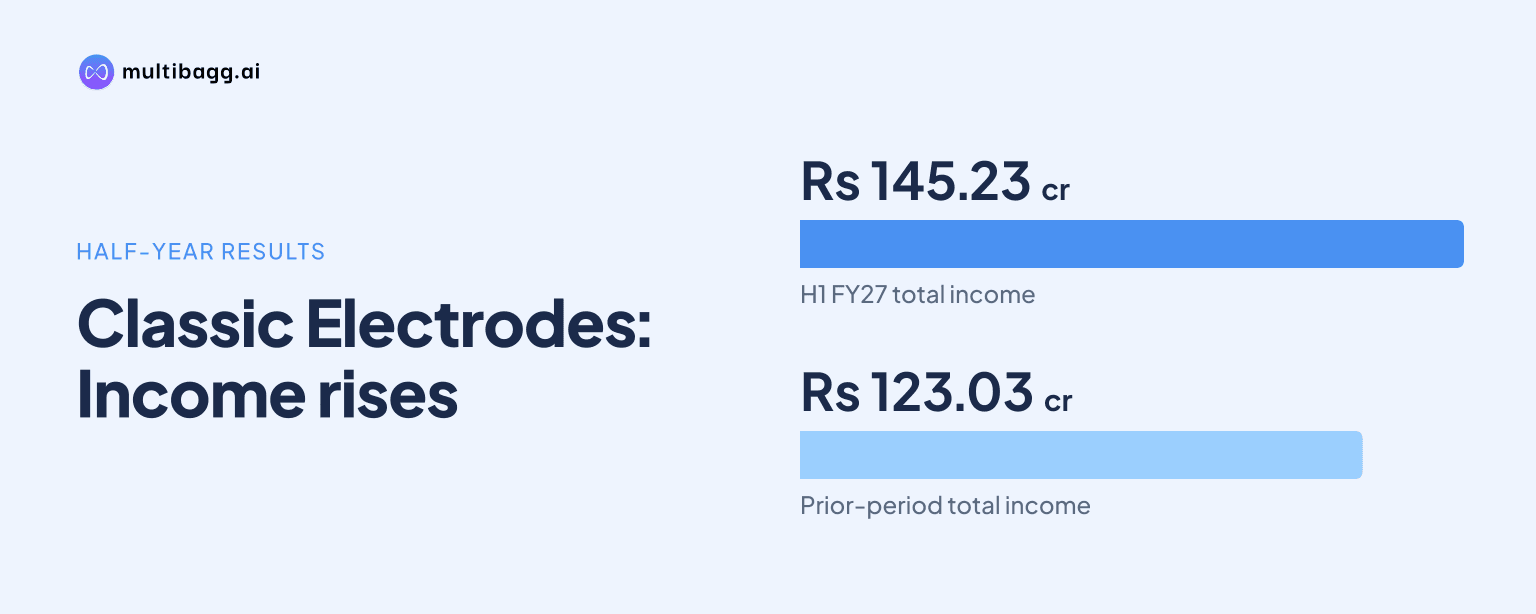
In H1 FY27, Classic Electrodes (India) Limited increased total income 18.04% to Rs 145.23 crore, while profit after tax rose 12.15% to Rs 7.28 crore as higher material costs, depreciation and tax expense moderated the conversion of revenue growth into net profit.
Know Classic Electrodes (India) inside out
Results, valuation, peers and who's buying, in one view.
How did Classic Electrodes perform in H1 FY27?
Classic Electrodes delivered higher income, operating profit and net profit in H1 FY27, although profit after tax grew more slowly than total income. Total income increased to Rs 145.23 crore from Rs 123.03 crore in H1 FY26, adding Rs 22.20 crore year on year. Revenue from operations was Rs 143.97 crore, compared with Rs 122.16 crore a year earlier, while other income increased to Rs 1.26 crore from Rs 0.87 crore.
Earnings before interest, tax, depreciation and amortisation, or EBITDA, rose 16.78% to Rs 13.94 crore in H1 FY27 from Rs 11.94 crore in H1 FY26. Profit before tax increased 15.10% to Rs 9.74 crore from Rs 8.46 crore, and profit after tax, or PAT, reached Rs 7.28 crore against Rs 6.49 crore. The reported growth rate reduced from total income through EBITDA, profit before tax and PAT during the six-month period.
Management said H1 FY27 reflected steady demand for welding consumables and resilience in Classic Electrodes’ core manufacturing operations. Managing Director Sushil Kumar Agarwal identified its portfolio of electrodes, MIG wires and flux cored wire as supporting growth. The presentation does not provide product-wise revenue, volume, pricing or order-book figures for the Rs 145.23 crore of H1 FY27 total income.
What costs caused Classic Electrodes’ PAT to lag income growth?
Classic Electrodes’ slower PAT growth coincided mainly with higher material costs, depreciation and tax expense, even as finance expenses declined. Cost of materials consumed increased by Rs 19.44 crore to Rs 127.04 crore in H1 FY27 from Rs 107.60 crore in H1 FY26. That rise was close to the Rs 22.20 crore increase in total income, leaving a smaller incremental amount before employee, operating and selling expenses.
Employee benefits expense rose to Rs 1.70 crore from Rs 1.36 crore, while operating and selling expenses increased to Rs 2.55 crore from Rs 2.13 crore. Total expenses consequently rose to Rs 131.29 crore from Rs 111.09 crore. Against that Rs 20.20 crore increase in total expenses, EBITDA increased by Rs 2.00 crore, compared with the Rs 2.22 crore increase in total income.
Depreciation and amortisation more than doubled to Rs 2.48 crore from Rs 1.19 crore, an increase of Rs 1.29 crore. Finance expenses moved in the opposite direction, declining by Rs 0.57 crore to Rs 1.72 crore. Tax expense nevertheless rose to Rs 2.46 crore from Rs 1.97 crore, and the resulting PAT increase of Rs 0.79 crore was below the Rs 1.28 crore increase in profit before tax.
Got a follow-up? Ask IRIS
How much did the Jhajjar unit contribute to sales?
Classic Electrodes’ Jhajjar unit recorded Rs 12.46 crore of sales in H1 FY27 and represented 8.66% of total company sales. In Q2 FY27, the same unit reported sales of Rs 6.45 crore and a 7.50% share of total company sales. The presentation labels this disclosure as a Jhajjar unit scale-up but does not provide a comparable H1 FY26 sales value for that plant.
The H1 FY27 Jhajjar sales figure was Rs 6.01 crore higher than the disclosed Q2 FY27 sales figure. Its 8.66% H1 share was 1.16 percentage points above the 7.50% share reported for Q2. Classic Electrodes reported Rs 143.97 crore of revenue from operations in H1 FY27, while the unit disclosure uses total company sales as its stated comparison base.
Classic Electrodes operates two manufacturing units, at Dhulagarh in West Bengal and Jhajjar in Haryana. The company overview says the business has existed for 28 years and its executive members have more than 26 years of market experience. The presentation does not split H1 FY27 income, EBITDA or PAT between the two sites, so the profitability contribution of the Rs 12.46 crore Jhajjar sales cannot be determined from the disclosed figures.
What products and expansion plans does Classic Electrodes identify?
Classic Electrodes identifies welding electrodes and engineering solutions as its existing business, while management says it is diversifying into allied engineering and metal products following H1 FY27 income of Rs 145.23 crore. Its electrode portfolio includes general-purpose, low-hydrogen, low-heat-input, low-alloy and stainless-steel electrodes. Management also cited MIG wires and flux cored wire as parts of the portfolio supporting H1 FY27 growth.
The company’s stated diversification areas include elastic rail clips, aluminium wire rods, cables and conductors, and steel wires. Management also referred to a strategic stake in HM Power and Cables Private Limited. The presentation frames these initiatives as steps intended to use Classic Electrodes’ manufacturing expertise and distribution network to pursue opportunities in existing and emerging markets; it does not disclose the stake size, investment amount, transaction date or financial contribution.
Management linked demand for welding consumables to infrastructure expansion, industrialisation, railway modernisation and the government’s push for domestic manufacturing. It also said Classic Electrodes will continue investing in technology, process optimisation and operational efficiency. Those are management outlook statements rather than H1 FY27 financial targets, as the presentation gives no revenue, EBITDA, PAT, capacity, capital-expenditure or timing target for the diversification plans.
Conclusion
Classic Electrodes increased H1 FY27 total income by 18.04% to Rs 145.23 crore and EBITDA by 16.78% to Rs 13.94 crore, but PAT rose 12.15% to Rs 7.28 crore. The reported pattern reflects a Rs 19.44 crore increase in material costs, a Rs 1.29 crore rise in depreciation and a Rs 0.49 crore increase in tax expense, partly offset by a Rs 0.57 crore fall in finance expenses.
Next, investors can watch whether the Jhajjar unit’s Rs 12.46 crore of H1 FY27 sales and 8.66% company-sales share continue to increase, and whether management’s planned technology, process and operational-efficiency investments affect costs. The presentation also leaves unresolved the scale, timing and financial impact of the HM Power and Cables Private Limited stake and the allied-product expansion.