










CMR claims 42%-45% share of India's automotive cast-alloy segment
Key highlights
- CMR claims a 42%-45% share of India’s automotive cast-alloy segment.
- CMR reports 17-20-year relationships with key OEM and Tier-1 customers.
- Aluminium alloys accounted for 81% of CMR’s FY26 revenue.
- India’s share of CMR scrap procurement increased from 20% in FY24 to 26% in FY26.
powered by IRIS
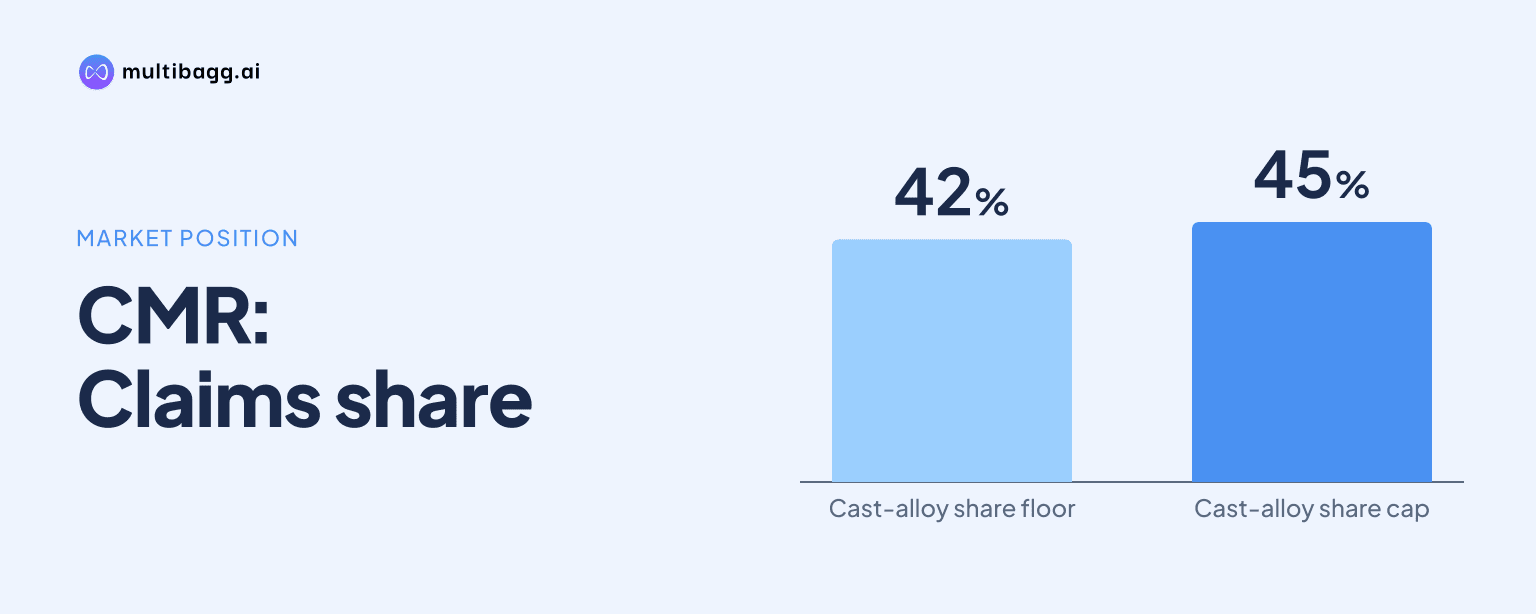
CMR Green Technologies claims a 42%-45% share of India’s automotive cast-alloy segment in its presentation, citing qualified supply to casting plants and 17-20-year relationships with key original equipment manufacturer (OEM) and Tier-1 customers. CMR says its recycled aluminium alloys can serve internal-combustion engine (ICE), hybrid and electric-vehicle (EV) platforms.
Know CMR Green Technologies inside out
Results, valuation, peers and who's buying, in one view.
What share of India’s automotive cast-alloy segment does CMR claim?
CMR claims a 42%-45% share of India’s automotive cast-alloy segment. The presentation frames this as a company estimate focused on automotive cast alloys, rather than a measurement of all aluminium products, scrap processing activities or the wider metals business.
CMR places the estimate alongside an offering of recycled aluminium-alloy ingots and liquid metal. Its stated automotive exposure includes passenger vehicles, commercial vehicles, two-wheelers and EVs, while its vehicle-platform coverage includes ICE, hybrid and EV models. The company does not provide a split of the claimed 42%-45% share by vehicle category or powertrain.
The presentation describes demand as model-agnostic across OEMs, brands and powertrains. This means CMR presents its alloy supply as relevant to casting plants serving conventional, hybrid and electric vehicles, rather than tied to one vehicle model or technology. It does not disclose the size of India’s cast-alloy segment or third-party data supporting the market-share estimate.
How does CMR integrate with automotive customers?
CMR says it provides qualified and co-located supply to Tier-1 and OEM casting plants. The presentation identifies qualification and proximity to customer plants as mechanisms supporting embedded supply arrangements for recycled aluminium-alloy ingots and liquid metal.
CMR reports relationships lasting 17-20 years with key OEM and Tier-1 customers. That duration is the clearest disclosed measure of continuity, but the presentation does not name customers, quantify customer-level purchases or disclose contract terms, renewal provisions or minimum-volume commitments.
CMR characterises liquid, or molten, aluminium as a product supporting just-in-time delivery and locked-in customers. It describes aluminium ingots as the industry-standard base product. The distinction links customer integration to the required product form and delivery timing, rather than alloy chemistry alone.
Which vehicle and product segments are part of CMR's positioning?
CMR identifies passenger vehicles, commercial vehicles, two-wheelers and EVs as its automotive end markets, with ICE, hybrid and EV platforms listed separately. The distinction indicates that CMR considers vehicle categories and powertrain technologies as different dimensions of its casting-alloy exposure.
Aluminium alloys accounted for 81% of CMR’s revenue in financial year 2026 (FY26), while zinc, steel, lead, copper, brass, magnesium and other materials accounted for 19%. The revenue mix places aluminium alloys at the centre of the company’s disclosed business mix, although the presentation does not state that all aluminium-alloy revenue comes from automotive castings.
CMR also lists zinc alloy ingots as die-casting grades for automotive and industrial components. However, it does not say zinc contributes to the 42%-45% automotive cast-alloy estimate. The estimate appears under CMR’s recycled aluminium-alloy offering of ingots and liquid metal.
Got a follow-up? Ask IRIS
What operational capabilities support CMR's alloy supply?
CMR describes a scrap-to-metal process starting with more than 1,000 scrap yards across continents, followed by segregation, processing, melting, alloying and customer delivery. It reports 13 plants using X-ray transmission (XRT), laser-induced breakdown spectroscopy (LIBS), eddy-current and colour-sorting technology, with finished goods including liquid metal, ingots, billets, sheet ingots and other alloys.
CMR says its quality checks cover chemical composition and microstructure. It also lists enterprise resource planning (ERP), artificial-intelligence-powered supply-chain tools, production controls, automated management-information-system reporting, machine scorecards and paperless shop-floor processes. The company reports four granted patents, three patents in pipeline and eight registered copyrights, without linking a specific patent to an automotive alloy or customer plant.
Domestic scrap procurement increased between FY24 and FY26. India’s share rose by 6 percentage points to 26% from 20%, while supply from outside India fell by 6 percentage points to 74% from 80%. CMR says the shift toward domestic sourcing reduces lead times and logistics costs.
How is CMR widening its market beyond automotive castings?
CMR says it is extending secondary aluminium processing beyond castings into extrusion-grade green billets made from post-consumer scrap under its Continuum product, which it describes as environmental product declaration certified. Listed applications include infrastructure, EV mobility, electrical and power transmission, automotive and large-scale transportation, data centres and renewable energy.
CMR also identifies closed-loop used beverage can recycling, in which sorting, de-coating and melting convert post-consumer cans into wrought aluminium for the rolling value chain. The company cites customer lock-in and a low-carbon footprint as features of this activity, but provides no revenue, volume, customer-count or production-capacity data for it.
Management identifies continued scale and volume growth, technology upgrades, customer-specific alloys, and a mix shift toward billets, sheet ingots and used beverage can recycling as levers for further margin expansion. These are management plans rather than numerical targets, and the presentation gives no implementation timetable or financial contribution forecast.
Conclusion
CMR’s claimed 42%-45% position in India’s automotive cast-alloy segment is based on its stated model of qualified, co-located supply to customer casting plants, 17-20-year relationships with key customers and compatibility across ICE, hybrid and EV platforms. Aluminium alloys represented 81% of FY26 revenue, compared with 19% from zinc and other metals and materials.
The next item to watch is execution of management’s plan to shift product mix toward billets, sheet ingots and used beverage can recycling while developing customer-specific alloys. CMR has not disclosed a timetable or revenue target for those initiatives, while its domestic scrap procurement share increased from 20% in FY24 to 26% in FY26 as part of its stated effort to reduce lead times and logistics costs.